"Spider Mites" is adapted from a poem I found on a website listing creepy Halloween-appropriate poems. I thought it was really to the point and imaginative. I contacted the author, Max Scratchmann, via Facebook and found him to be a quirky, very interesting guy. He kindly gave me the go-ahead to let me do my stuff with his text.
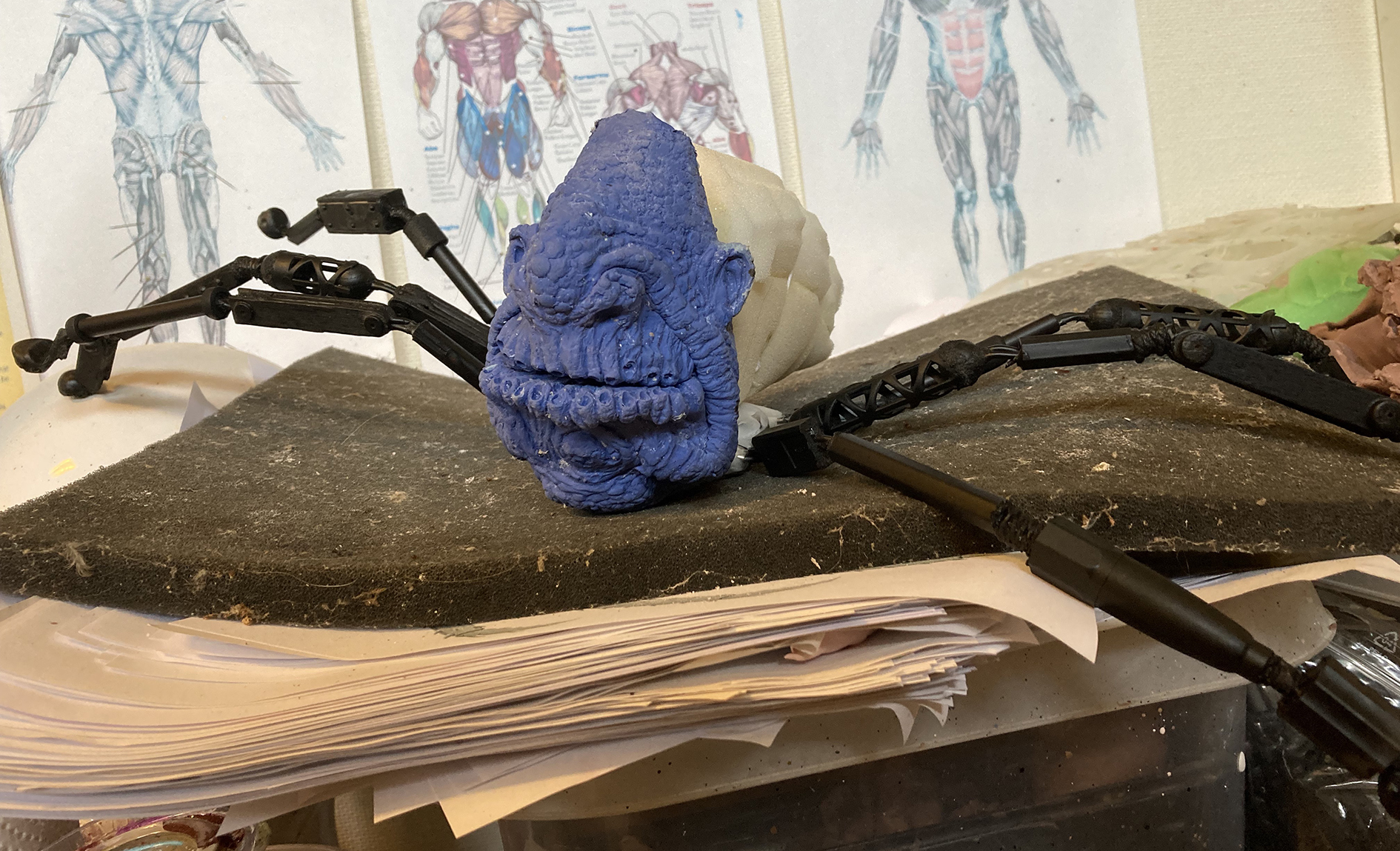
So let's start with our little titular monsters. There are clues to what they look like in the poem, mainly their clicking, clacking legs. I started with sculpting their heads in medium-grade Monster Clay. I placed them side-by-side on a slab of clay and cast a plaster mold over the heads.
I poured tinted latex into the plaster mold to create two flexible skins. The latex was tinted a pale blue. They will be painted white, so I thought that color would make a good base hue.
To give the skins some better stability I soaked thin bits of polyurethane foam in latex and pressed them into the skins. This helped make them sturdy without compromising the flexibility of the latex. In this photo, you can perhaps also see that the top fronts of the heads have been lined with white Polymorph thermoplastic. This is so I'll have a hard part of the heads I can grab hold of when animating, and the plastic also grabs hold of the aluminum wires moving the jaws.
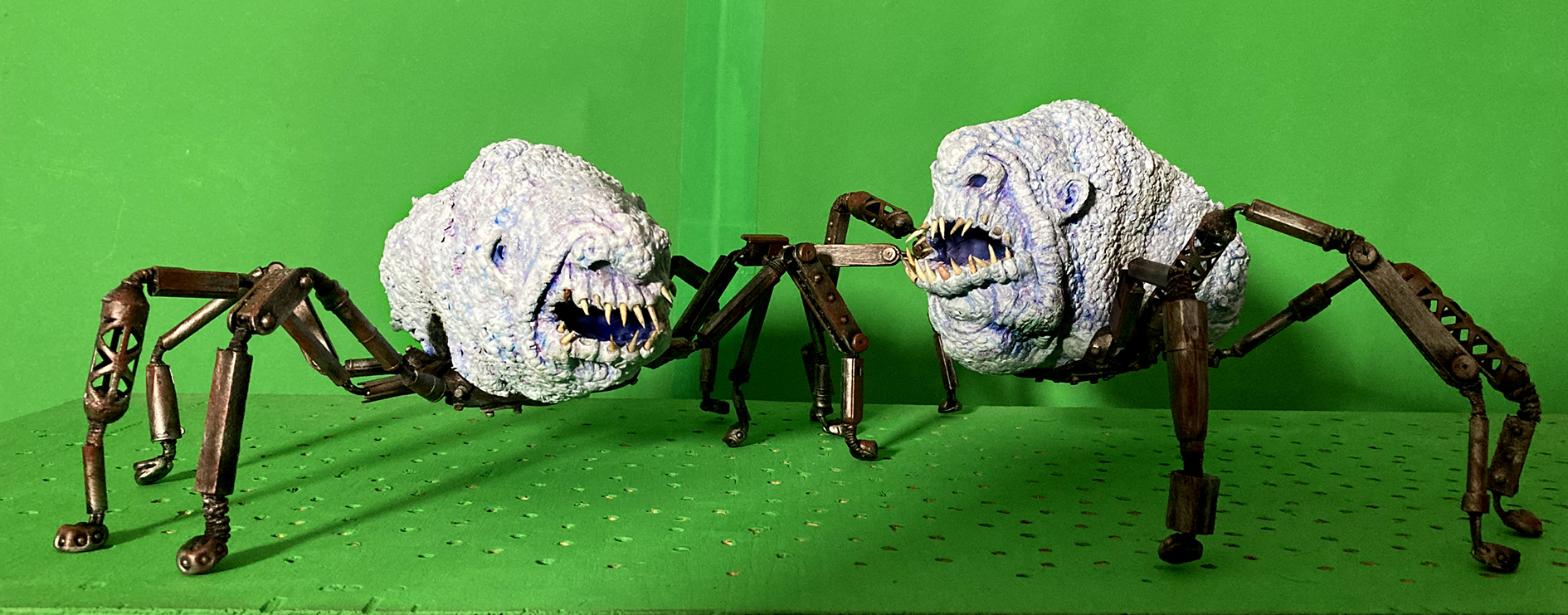
The legs are a mix of many materials. Mainly they're built out of aluminum wires, wooden ice cream sticks cut and sanded into various shapes. There are also bits of pens, glue tube caps, and small scrapbooking gems. The green girder-looking bits are rolls holding plaster bandages. Each leg has a foot with a small threaded nut attached to aluminum wires with a mix of super glue and baking soda.
As I'm building two Spider Mite puppets I made two sets of legs. They were attached to a base made from thermoplastic and ice cream stick parts.
Besides having the reinforced, hard foreheads as a hold-on point when animating I also added a short bit of plastic piping to add extra stability to each puppet.
The pulpy bodies were bits of soft polyurethane foam, with yarn wrapped around parts of the foam to give it some extra shapes. You can also see here that I've painted the legs. I've used a black base color spray paint.
To build up the skin on the body I added patches of latex skin cast from skin texture molds. When that looked ok I dry brushed on latex-tinted white using a foam sponge until I had a good balance between the white paint and the blue base paint.
Under the body and between the legs I wanted something looking like scrap metal clumsily riveted together. I use EVA foam for that. It's a very popular material for model makers and cosplayers. I cut lots of tiny rivets out of the foam using a leather hole cutter.
The EVA foam build-ups look pretty good, especially when the metal pain went on. EVA foam is pretty cheap and when working with puppet scales it lasts forever. You get a lot of material out of a single A4 size sheet.
The legs were dry brushed with a metallic waxes, mainly copper color. The teeth are snippets of tissue paper dipped in latex and shaped with my fingers. They're attached to the gums using liquid latex as a glue.
The settings and backgrounds are a mix of photos and stock videos. The photos have been cut up and prepared in Photoshop so the puppets can move around in these 2D environments, sometimes in front of parts of them and sometimes behind. All shots were put together in After Effects, as I usually do.
Hannes Karlsson, who's now been in a few of my films, played a scared kid who gets visited by the Spider Mites. I shot the scene in the bedroom of my friend Andreas Pettersson (also a frequent actor in my projects). We used ordinary daylight, with some help from a floor lamp. the color temperature was changed in After Effects. Lastly, I added a stock video of an old projected film, with catches dust and all that stuff. I just thought it would go with the jangly, scrappy nature of the little monsters.
It's quite possible I'll contact Max Scratchmann about adapting another of his works because this one was great fun to work on.
Visitors to my YouTube channel have been bugging me for a while about why I don't do any holiday-related videos. I have done a Halloween-themed film, but that didn't exactly set the internet on fire, so I stopped thinking about doing something similar. However, this past Christmas I decided to do something with the Krampus; the so-called Christmas Devil, the evil counterpart to Santa. I was already working on another project, but I paused that to make room for my Krampus video. In other words, this past December was one of the few months where I managed to produce two films featuring a fair amount of animation, and effects editing.
To give you some context, let's have a quick look at Krampus. Traditionally the Krampus character has flourished best in Eastern Europe, the alps and German-language regions like Bavaria and Austria. When Santa comes with candy and gifts, Krampus comes with coal and bundles of sticks for thrashing the bottoms of naughty children. If the kids are really terrible, Krampus puts them in his sack and carries them away.
There's been an odd resurgence of Krampus-related festivities in the last couple of decades. There are Krampus parades in both Europe and the US, and pop culture has placed the fiend in movies of varying quality and budgets. To sum up all of this info I wrote a poem that served as the basis for my video and read it myself.
I wanted my Krampus to be super traditional. Thus I sculpted a character that sort of summed up all the characteristics of the old devil folklore archetype. Medium grade Monster Clay was used, as usual.
I also sculpted what would become the horns in clay, placing the sculpture on a flat surface to make the casting of it easy.
From a plaster mold made over the sculpture, I cast two latex horn skins which were attached to a pair of metal rods padded with yarn and foam dipped in latex. When the latex had dried I twisted the wires with my fingers, making the horns curve in a way you can see on certain goats and antelopes.
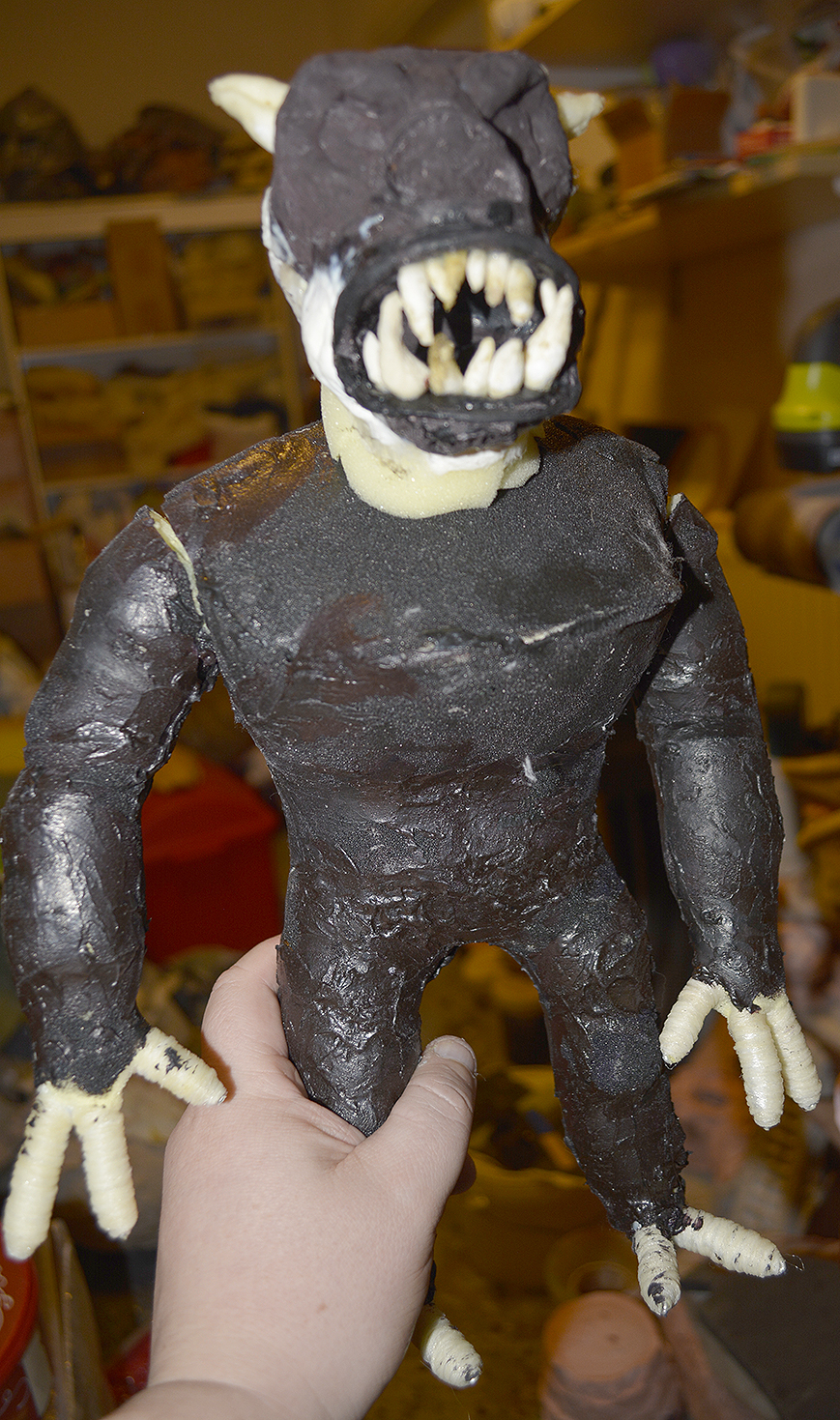
The armature was super simple; my usual mix of thermoplastic and aluminum wires. I decided to give my Krampus one human leg and one goat hind leg. He also has a tail.
The tail was covered with a wrapping of yarn soaked in latex, while the body was padded with soft polyurethane foam. As you can see the head wasn't attached at this point.
That's because the aluminum wires inside the head -for brows, ears, and jaw- were stuck directly into the latex cast of the head and torso. Thermoplastic was used to create the skull and the jaw, and also held the two pearls used for eyes in place. Liquid latex applied to both the inside of the latex skin and the foam padding worked as an adhesive.
Patches of latex skin cast in various older skin texture molds were attached in the same way. The teeth are cotton dipped in latex and rolled into pointy shapes. The human foot shape was built up using tinted latex and cotton.
I wanted the Krampus to have a mix of muted colors, ashen grey to be exact, and a color that would make the puppet "pop" a bit on screen. A dark purple seemed to do the trick.
The finished Krampus puppet was adorned with clumps of crepé hair (sheep's wool used for fake beards) to make him look old and mangy. Thin steel wires were used to make bits of body jewelry, and claws were created in the same way as the teeth. Krampus is often portrayed with a long tongue, so that had to be in there in one scene at least. I couldn't fit it into the puppet's mouth, so I made it from latex and a single aluminum wire as a loose prop that could be inserted into the mouth.
Krampus´ sack was made from real burlap and was lined with aluminum wires, so I could animate it bulging and moving around when Krampus was carrying away the kid.
All of the backgrounds in the scenes featuring the Krampus were Photoshopped images layered in After Effects. One of the busiest shots is the one where Krampus minces up the kid. It contains 12 layers: the log cabin wall, the bundle of chains to the right, the big chain to the left, the Krampus turning a mincer handle made from plastic, the table, the cleaver, the bowl, the meat (footage), the mincer, the leg going into the mincer and some smoke. The mincer handle was actually attached to a model mincer I made, but that model kept moving about when I animated the puppet turning the handle, so I simply covered it with a photo of a real mincer.
All the images I used for backgrounds were downloaded from Depositphotos.com. Most of them needed only minute Photoshop manipulation to work on the film.
Now for the actual antagonist of the film. Remember Hannes Karlsson who was the hero in my film "The Two-Headed Monster?" I recruited him again for this project, and he will pop up again in my films later this year.
My long-suffering buddy Andreas Pettersson also appears in the film as a sleeping relative given a whipped cream mustache by Hannes. Andreas' friend Leif also puts in an appearance where he's hit over the head with a pillow.
The rest of the people you see in this film are all stock footage from Videoblocks.com. They had a bunch of Christmas-themed clips which were all so horribly saccharine that I couldn't possibly produce anything myself to match them.
One of the more complicated shots in the film is when Krampus puts Hannes into his sack, simply because it needed to look totally effortless. Technically it's not very complicated. Hannes is placed over Krampus´ hand via tracking, and a mask over Hannes´ legs allow them to pass behind the sack.
Making the shot work all hinged on Hannes selling the illusion, and luckily, that's just what he did. In a single take, he's sitting on the edge of a greenscreen-clad couch supported by the arm of his mom, also clad in green. Balancing on the edge of the couch seat he looks like he's hanging in free air.
The take then continues with Hannes flipping over to a semi-handstand on the floor, wiggling his legs in the air. I sped up this part in editing, so it looks like he's very quickly stuffed into the sack. The Krampus puppet is animated to match Hannes´ movements in this footage accordingly.
So I finally made my Krampus film! It was fun and relatively quick to put together. Coming up, if I can make it, is a film about Walpurgisnight, and the goings-on of witches and fiends on that spooky evening.
Here's another adaptation of a Weird Tales poem, this time by a very young Henry Kuttner (20-something when this was first published). Kuttner went on to pen some major and minor classics in the field of fantastic literature, often in collaboration with his wife C L Moore under the pseudonym of Lewis Padgett. Moore was also a great author in her own right, writing tales like the oft-anthologized "Shambleau".
"The Ballad of the Gods" seems to exist in its own universe, but it certainly has the same feel of doom and gloom as Lovecraft's tales and some of Robert E Howard's prehistoric adventure stories.
For my own sake, it offered me the opportunity to do my own living statue piece; a sort of cliche in stop-motion history. Best known is probably Ray Harryhausen's bad-tempered bronze giant Talos, from "Jason and the Argonauts", but there are more examples from later films like "Dungeonmaster" and Harryhausen's own "Golden Voyage of Sinbad."
Let's start with the feared primal deity Jubbodar-Thool. When you read the text he seems to be made of mostly stone, or at least "his head is carved from a weathered rock." Though the head was always going to look very simply made, I wanted the best control of its look I could get, so I sculpted it in Monster Clay and created a plaster mold for it.
The puppet has a plain aluminum wire and thermoplastic armature. I’ve used very thick wire here to make the armature extremely sturdy. It’ll have quite a volume of rubber to push against when animated. To build up light weight bulk on the puppet body I attach dense but light foam using hot melt glue. The foam shapes are trimmed and softened down. Fingers and toes are fleshed out with soft string, which is later soaked in latex.
The rough shapes of the torso was created with very soft cushion foam. The shape of the limbs was defined by wrapping thin strips of foam around them. I’m using contact cement to stick all the foam bits together. The latex cast of the head was given support on the inside with thermoplastic, plus a jaw joint and a neck attachment point created using aluminum wires. I trimmed the foam body buildup a bit, and then I actually added a layer of tinted latex with a thickening agent added. Which means I could apply the latex like a layer of butter. It’ll soak into the foam a bit, but really only enough to attach to it.
My inspiration for the look of Jubbodar-Thool is actually the bulky monsters of Marvel artist Jack Kirby. So in line with his aesthetics I had to add some snaggly big teeth. Those are made from latex and cotton. I also added a few small horns using the same materials. My idea was that these pieces might be carved from real bone or ivory and attached to the statue.
The actual stone texture was made from bits of latex cast in an old plaster mold. I made this mold way back when working on my all-stop-motion video adaptation of Tolkien’s poem the Mewlips.
This texture was a dungeon wall where the Mewlips sit and count their gold. Piece by piece the puppet was covered with this patchwork of stone blocks, using liquid latex as a glue.
Jubbodar-Thool's big nose is, apparently, "the trunk of a tree", which I made by simply adding cotton dipped in latex over a bit of carved hard foam.
Painting the puppet, I’m first giving it a unifying layer of tinted latex. Then various different shades are dry brushed on. I decided to give the puppet an additional patchwork look by adding various metal clamps, applied to the statue as it started falling apart with age. I had an old plaster mold with various sculpturesof that kind of stuff, so I cast a few copies of those, and stuck them to the puppet using very strong super glue.
Lastly I put a rubber horn on his chin and added a pair of dark bronze-colored pearls to his eye sockets, so you could see something glinting in there, reflecting light.
To make the joins between the rocks in the statue's body glow during animation I filled them out with blue chroma key paint, which allowed me to remove the blue and mask in lava-like textures behind the puppet in After Effects.
Now on to the fish god Vake, who makes a very brief appearance in the film. This puppet is mainly inspired by the Sea Bishop, which was supposedly a merman creature fished out of the Baltic Sea in the 16th century.
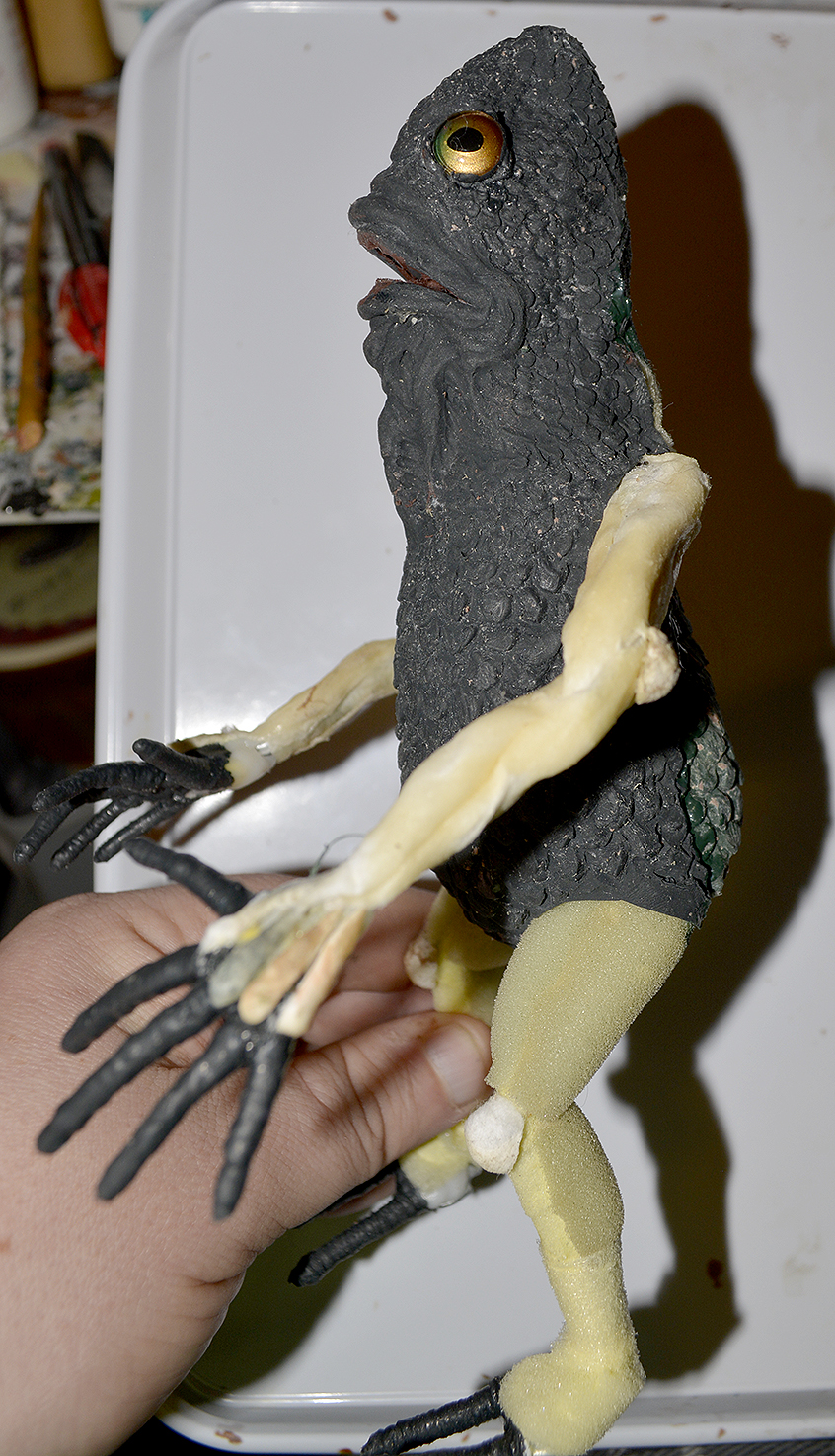
I started off with sculpting the body in medium grade monster clay. I used a pair of professionally made acrylic taxidermy fish eyes and implanted those in the sculpture. I wanted to make the look of this character kind of ornate, not necessarily organically realistic, but rather like aliving representation of an old illustration or wood cut. Which meant adding scales that were slightly exaggerated. Now, there is a tool you can get, or make yourself, which is used for sculpting scales. And the results look great, except for that you can’t really vary the size and shape of the scales. In order to have that freedom you have to sculpt them individually. Some might balk at that thought, but it’s not really that hard or time consuming, and the result is totally worth it. So I’m using one of my loop tools to carve out the scales. Then I’m using a pipe cleaner dipped in Vaseline to smooth out the rough edges.
A dental plaster mold created over the sculpture is used to cast the skin of the body in tinted latex. A piece of aluminum wire allows the jaw to be animated. The acrylic eyes are stuck to the inside of the head with thermoplastic, which also fills out the head and creates a skull. A simple aluminum wire armature was covered with soft polyurethane foam for the padding of the body, and strips of cotton dipped in latex for the arms and legs.
I wanted a different scaly texture for the arms and legs and so I needed a new texture mold for those. To create this mold I sculpted the scales in reverse by making imprints in clay with a sculpting tool. This is actually an old technique used by ace animator and puppet builder Jim Danforth. When the texture is finished I apply plaster to the clay to create a positive from my negative sculpt. The first layer goes on, as usual, very carefully, and the rest of the plaster is dumped on top of that. Now I need a new negative mold to cast my latex skins in. Danforth simply used another plaster layer, with a generous application of release agent. However, I prefer to make a mold over the plaster cast using a dental silicone putty. Tinted latex was then sponged into the mold.
The webbing between fingers and toes was created by sticking flat bits of clay to the underside of the limbs, and tinted latex was then filled in between fingers and toes. he same was made for the gills, except that they weren't attached to the puppet first. Bits of cotton and latex rolled into pointy pieces were pressed into clay and skin was built up just like with the webbing.
My reliable buddy Martin Merkel was pressed into action for another video project, here playing the hapless protagonist who has abandoned his father's gods.
All of the shots with Martin were actually filmed in the upstairs hallway of my home in front of a TINY greenscreen. Somehow we made it work. Martin is a historical reenactor and has a bunch of stuff from different time periods. To this project he brought a hand made leather shirt, a Viking short swords and other bits and bobs. To create a, kind of, pulpish fantasy look I hanged a fake fur toga over him. The wig is actually made from human hair and was a bargain on the Swedish equivalent of eBay.
Backgrounds were my usual hodgepodge of Photoshopped photos from various sources, mainly Depositphotos and Wikimedia.
There are a lot of hidden treasures in the old pulp magazines, and an astonishing amount of the material is now in the public domain. My aim is to keep digging up poems and stories that I can manage to adapt into my YouTube videos. Much of it is pretty unsophisticated when viewed according to today's standards, but there's also a lot of inventiveness and wonder to be enjoyed.