Monday, June 18, 2012

Monsters For Lovecraftian Computer Game


Since I'm actually starting to build a reputation as being able to recreate at least some of H P Lovecraft's nightmarish creatures successfully, I'm also starting to get requests from others who are making their own versions of his stories in various formats. Rolando Gutierrez is currently building a computer game, probably an online game but my details are a bit sketchy at the moment, inspired by Lovecraft's horrific monster mythos. His concept is, refreshingly, to use real actors, photographic backgrounds, and stop-motion animated monsters in the game.
 So far I've built two puppets for the project, and here they are:


Somewhere in the game a gigantic worm creature will rear its ugly head and make matters worse for the players. This monster is built from one of Roland's designs. I made it quite large to allow for more details, especially the head.


We wanted the head to be interesting to look at and went for a flowery design. The front of the mouth was sculpted flat in Chavant clay and a plaster mould built up over it. The cross shape you see in the middle is the mouth, here closed, that opens up during an attack.


This sculpture is the inside of the mouth. I sculpted it smooth, but once the plaster mould created over the shapes were dry, I drilled lots of small tunnels in the plaster, creating what looks like many tiny legs growing out of the "lips" when the latex was poured into the mould.


Here's the front of the mouth being cast in latex in its plaster mould. The latex is tinted with tinting powders from Kryolan. Even though the finished puppet may be in a different colour I prefer to tint the cast in dark fleshy hues; it helps add depth to the final paint job.


In order to create a back side or neck part of the mouth piece I removed the latex cast of the front mouth piece and simply sculpted the back over the plaster mould. This helped me make a back part that would line up very well with the front part. I could've simply built up the back with latex and cotton, but I wanted more exact detailing, and that you can almost only create by sculpting it in clay.


Here's the mouth with all of it's parts pieced together. All the petal-like frills are jointed with bendable wire and can be animated.


Here's the head attached to the spine; a thick aluminum wire with a thinner wire wrapped around it.


And here's the mouth painted and with a latex throat also added.


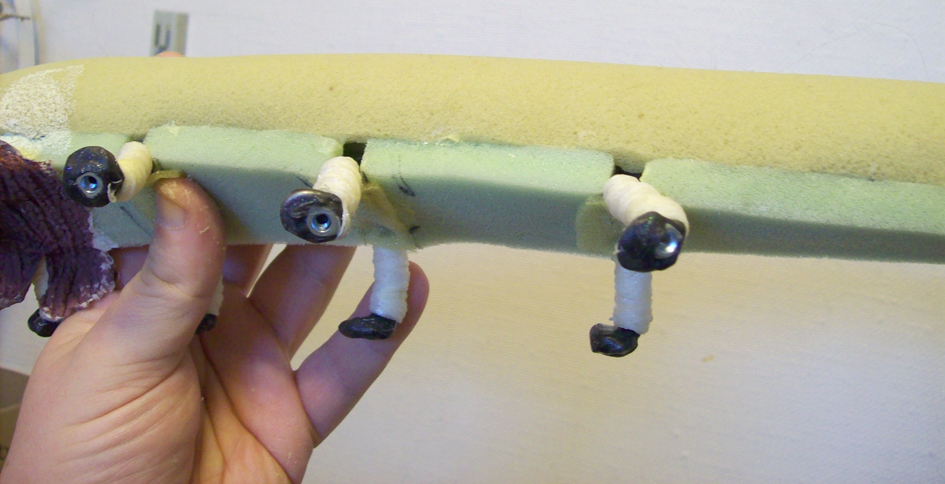
The body is supported by many small legs. The first eight have claws to hold onto its victim, the other legs have small nuts in their feet, so the puppet can be anchored to the animation stage. The armature design is based on (or stolen from, how you choose to see it) Ray Harryhausen's moon calf monster from "The First Men In the Moon".


The body was padded, as I usually do, with pieces of foam rubber, and the covered with patches of latex skin. In this case a wrinkled skin for the belly and an insect-like shell armour for the back. Both skin shapes were first sculpted flat in clay.


Here's the worm pretty much pieced together and awaiting its final paint job.


The puppet was painted with a thin layer of Prosaide III mixed with acrylic paints, and then airbrushed with Com-Art airbrush acrylics. I find these airbrush paints to bond very well to most surfaces, but I add a top coat from Medea textile airbrush colours, as an added bonding agent. The transparent Medea coat is supposed to help airbrush paints stick to leather and similar surfaces.


The tongue added in these photos is actually a separate puppet piece, to be animated on its own and added in post production editing. Here you can see the mouth fully open and fully closed.


The other puppet I built is some kind of demon character. It's based on a creature from a wood print titled ‘diable’, which comes from Collin de Plancy’s Dictionnaire Infernal, which was published 1863 in Paris. It pops up here and there as a piece of occult copyright-free art. My version of the creature is, hopefully, a little bit scarier, but still keeps the basic look from the woodcut.


The armature is, like all my armatures, homemade using aluminum wire, Friendly Plastic and wing nuts for tie-downs in its feet.


Only the head and the front of the torso were sculpted in clay and then cast in latex. The rest of the body was built up with latex, cotton and toilet paper (to create a wrinkly skin texture).


Here you can see the muscle detailing using cotton shapes, right before they're covered with tinted latex.


All the body is covered, and the head added. The teeth are also latex/cotton shapes and the eyes are Photoshop print-outs, covered with a transparent Scrap booking plastic (great stuff!)


With some Prosaide III paint mix and airbrush colours the demon is finished. It stands about a foot tall. I have added more latex/cotton shapes over the cast latex pieces to give them a gnarlier diseased look.

I have been asked to create a third puppet, which will be based on an actress participating in the game, and apparently showing her in mid-transformation into something nasty. There will be more reports about that eventually.


Tuesday, May 29, 2012

Norwegian Dinosaurs

A Swedish guy working on a Norwegian ad agency approached me a couple of months ago about buying masks from me. He had seen my work on the web (another testament to the practicality of marketing your creativity for free on the Internet) and wanted to use an old monster mask for an ad about the perils of having real "monsters" in your workplace. This is the mask he wanted to use:


The mask had to be modified to fit a woman of average build. In the ad she represented the kind of co-worker that could suddenly become nasty, and spread bad will through out the company. I cast a new, fresh version of the mask in latex and gave it an, shall we say, unexpected paint job.


I had to build up a new, slender neck, so the mask could be fitted inside the neckline of a blouse. Here's how it looked in the finished ad with a wig and modified eyes:


The customer who had ordered the ad is a recruitment firm, who also wanted to address the problem of old thinking dominating and overshadowing new talent; "dinosaurs" in the workplace, as it were. The ad people wanted me to build 7-8 full-head dinosaur masks, but I strongly objected since it would've taken me forever to sculpt and finish the masks in latex. It would also have been very expensive. Originally the ad people had approached a CGI company, with the intention of rendering the dinos digitally. But that company wanted an ungodly amount of money, which the recruitment firm wasn't at all very keen to put up, so a practical approach was considered instead.

I put forward another solution; that I could build miniature dino heads with slim necks, which the ad guys could then photograph and Photoshop in on top of the heads of the models/extras in the ad image. I made a couple of sculptures to underline my suggestion, and the ad people went for it.


I made a total of 7 dino puppet heads. The faces were fixed in dour expressions, but the necks could be adjusted.


Not all of the heads were used in the end, but I think the result turned out quite well. Here's the finished ad:


I only had a week to build all the dino heads, plus the new monster mask. I've probably never worked so fast before, but I'm happy with the result. Most importantly, the ad agency and the recruitment firm were happy, and while this was a real low-budget project I was still paid a quite handsome sum.


Saturday, May 26, 2012

The Shadow Out of Time: My Effects Contributions


The weird visions of unearthly creatures of H P Lovecraft and stop-motion animation would seem to be  a marriage made in heaven, but the fact is that very few Lovecraftian films choose to show his famous monsters at all. There are a few rare exceptions, such as Stuart Gordon's "From Beyond", which features both incredible make-up effects, practical monster effects, and a few quick glimpses of stop-mo, and the Lovecraft Historical Society's "The Call of Cthulhu", which proudly displays a stop-mo Cthulhu emerging from his crypt at the end of the film.

It seems that my main contribution to pop culture will most likely be my animated Lovecraft monsters! I've done a few, and I'm planning to do more. Probably lots more. Among Lovecraft's many weird monsters there are few weirder than his Yith; "The Great Race", which I planned to bring to life in a project of my own. When my friend Daniel Lenneer approached me with the idea of a collaboration, making as faithful an adaptation of Lovecraft's story "The Shadow Out of Time"as we could muster, it seemed like a fun project. And I was right.


The Great Race of Yith was represented by one puppet, then duplicated many times in After Effects. But I'm pretty sure you've already worked that out if you've seen the film. Like my other puppets, the Yith creature is a simple construction, using simple materials. The round head, the cluster of red tubes and the cone-shaped body was sculpted in Chavant clay and cast as latex skins in plaster moulds. The head has three glass eyes, which I think are recreations of a wolf's eye. All the limbs, including tendrils and antenna are pieces of aluminum wire wrapped in soft string, and then covered with latex. The claws were sculpted in Chavant and cast in hard plastic from silicone moulds.


The flying polyps (enemies of the Yith) were much easier to make. I bundled together bits of aluminum wire, and covered it all with soft string and pieces of foam rubber. I cast latex skins from plaster moulds, taken from bubbly lichen, and covered the three puppets with them. The flying polyps are very vaguely described by Lovecraft, but illustrators usually add gnashing mouths and bulging eyes. I just stuck with one of Lovecraft's remarks, which (if memory serves me) likens the polyps to cancerous growths. The polyp puppets were held aloft by aluminum wires painted blue. I finally spent the necessary money on some proper chroma key paint, blue and green, and I'm glad I did. Keying out both support rods and the background is now incredibly easy.


Besides the two opposing extraterrestrial forces there are other creatures mentioned briefly in the story. Among them are "the arachnid denizens of Earth's last age" -a kind of bugs that the Yith take possession of when they loose the war with the polyps, and flee with their minds into the future.
I wanted something that wasn't exactly a spider or a crab or a beetle. I hope I came up with something that was a mix of all of these, and also that the creatures had a certain creepiness, with their eye stalks and spindly legs. I actually got caught up in imagining the biology and social structure of these creatures; how they would move about and communicate by caressing each other with their long antenna. But almost nothing of this made it into the final film.

The puppet had a cast latex shell, with all other parts of the body built up over aluminum wire using latex, cotton and string. I attached a jointed blue support rod to the creature's belly. This rod ended in a modified wing nut, which worked as a tie down to fix the puppet to the animation stage. As with most of my animations, the arachnid was animated in front of a blue screen, and the support rod disappeared in post production. The legs also ended in tie downs, namely some sort of thin threaded metal rods I found in a hardware store. The thin legs couldn't have supported the body on their own, but the tie downs in the feet helped keep the legs in position while animating.


Another puppet built specifically for this project was the prehistoric amphibian Eryops, which represented the early life forms the Yith encountered when they built their civilization on Earth. The Eryops was quickly built with foam padding over a plastic and aluminum wire armature, and lastly covered with latex skin. The head was sculpted separately and cast in latex from a plaster mould.


The teeth of the Eryops were just saw-shaped paper cut-outs dipped in latex. It's actually a fairly good way of creating small, sharp teeth quickly and cheaply.


The creature was never intended to do very much, just lie on a Photoshopped log and catch a giant dragonfly with a totally incorrect chameleon-like tongue, but I think it helped add some atmosphere. The background image is a Photoshop collage based on a photo (taken a long time ago by a friend) from an exhibition at, I think, Michigan University.


Two older dinosaur puppets were pressed back into service in a short clip that eventually ended up being shown on a monitor screen in a Yith laboratory. The skin on the meat-eating Megalosaur was actually falling off as I animated it, so this was probably his last hurrah! I also did a scene with pterodactyls sitting on a rock and swooping down over the heads of some Yith botanists, but we eventually scrapped that shot because of time constraints. Daniel wanted to enter the film in an international film contest, and the running time for our project went over the accepted time limit. So the pterodactyls had to go, but they will most likely emerge in another film.


The Valusian serpent people, very briefly mentioned, were represented by another old dinosaur puppet; a sauropod who's tail and head were inserted into a still image of a guy in a monk's robe. This is terrible cheating, I know, but it got the job done without having to build an entirely new puppet for the few seconds the character is on the screen. And thank goodness for Google image search and the Wikipedia image bank! There is an abundance of public domain photos of exotic locations, that can be adjusted in Photoshop. And if there is a copyright notice attached to a photo you'd really like to use, just email the copyright holder. In my experience they're more than happy to let you use their photos in a non-profit film project.
On another note; for some reason the serpent man has provoked uniformly negative reactions from people, but in a good way. Everyone seems to think it's really creepy. Christopher Johansson, who wrote the music for the film, even dreamt about the damn thing after having scored this sequence, if you can believe that.


Another example of cheapskate dirty amateur film tricks is the shot of a barbarian, a Cimmerian actually, standing atop a cliff with violent storm clouds rising behind him. The cliff is a still image and the man is a composition of two still images of local fantasy role-players. The only things actually moving in this shot are the clouds, which is a stock footage clip downloaded for free during a marketing campaign offer, and the camera, which does a slow zoom-in created in After Effects. However, this shot is quickly followed by more stock footage of Viking reenactors beating the crap out of each other. Combined, the two shots hopefully sum up what Lovecraft refers to as "the Dark Ages" in his text.


More Photoshop magic includes all shots of the Yith moving about in their surroundings. The Yith city backgrounds are modified images of a Canadian art museum, and the interiors of the city are photos of various tile works and synthetic carpet patterns.
In many shots, the Yith are simply still images of the puppet, moving via 2D animation in After Effects. On some occasions I've added animated tendrils to the underside of the head in these still images. I know; more scandalous cheating.


Some years ago I made my very own idol of the Lovecraftian Cthulhu Mythos deity Tsathoggua, created by Lovecraft's friend and fellow fantasist Clark Ashton Smith. You can find an account of the making of this plastic effigy among the oldest posts on this blog. I always wanted to include it in a film project, and I got my chance here, since the time-travelling hero at one point sees a vision of "prehuman Hyperboreans worshipping the vile god Tsathoggua". I simply took a photo of the statue with a low light source and propped it up against a granite wall in Photoshop. The "prehuman Hyperboreans" were me, dressed in a cheap long wig dancing madly in front of a green screen, and then duplicated many times in AE.


Strange star-shaped sentinels guard the dungeons where the flying polyps are imprisoned, according to Lovecraft. These mysterious devices, dubbed "starfish willies" by Daniel, may be plants, may be animals or may be some sort of biological machines. I designed them to be of ambiguous origin. I built only one, but three of them are visible in the film. Silicone moulds were created over a two-part Chavant sculpture, and plastic castings produced from the moulds. The actual starfish willies were rigid, but I animated a snaking tongue and inserted it into the middle of each star-shaped head. My idea was that the tongue was a hyper-sensitive sensory organ able to detect any unwanted movement from the polyps.


Lastly, I added softening filters and colour grading to Daniel's shots of our hero, Åke Rosén, gradually going nuts. We decided to go with what we imagined was some sort of standard for how silent films were colorized, with a green tint for jungle scenes, blue for night and Arctic scenes, and so on. I think it worked out pretty well.

I'd like to say that more than anything, we wanted to show that even a complicated and epic story such as Lovecraft's "The Shadow Out of Time" can be managed as an amateur film project. That many tell us that it's impossible is just like waving a red flag in front of my eyes -Of course it can be done! You can adapt "The Illiad" if you wish; you just have to figure out how. There is a way to retell every story as a film no matter how many actors you have or how much money you can spend.

Tuesday, April 3, 2012

The Shadow Out of Time: The Film


Dear fellow bipeds; here's the fruit of many late evenings -The finished version of H P Lovecraft's tale "The Shadow Out of Time."

This is a collaboration between Richard Svensson (me), Daniel Lennéer and Christopher Johansson. Åke Rosén stars, and John Hutch narrates.
Daniel on YouTube: http://www.youtube.com/user/lenneer
Chris on YouTube: http://www.youtube.com/user/CJFILMvideoworks
John on YouTube: http://www.youtube.com/user/JohnHutch
Daniel's project page: http://millroad.lenneer.se

An adaption based on the novel "The ShadowOut of Time" by: H. P Lovecraft

Written by: Richard Svenssonand Daniel Lenneér

Director of live-action: Daniel Lenneér

Director of animation: Richard Svensson

Voice-over: John Hutch

Music composed and mixed by: Christopher Johansson

CAST:

Åke Rosén

...with supporting roles by;

Christopher Johansson

Thobias Ericsson

Daniel Lenneér

RichardSvensson

Greenscreen composition: Daniel Lenneér and Richard Svensson

Puppets and animations: RichardSvensson

Credits and Map animation: ChristopherJohansson

Hand actor: Owe Lenneér

Sound filters: ThobiasEricsson

Lettering: Charlotte Jolin

Assistant: David Gustavsson

Produced in unholy union between Millroad Film and The Lone Animator 2011-2012 in Sweden.

Links:
http://www.loneanimator.com
http://www.lenneer.se
http://millroad.lenneer.se

Friday, February 24, 2012

The Shadow Out of Time: The Teaser Trailer


Yet another little trailer for yet another Lovecraftian film project. Hope ya'll enjoy it!
http://www.youtube.com/watch?v=QdHBgdewN1Y&feature=channel_video_title

I'm making this film with Christopher Johansson and Daniel Lennéer; you can visit his page HERE!

Sunday, January 15, 2012

H P Lovecraft's The Shadow Out of Time

For those of you familliar with the works of H P Lovecraft, "The Shadow Out of Time" may be one of his more well-known tales. It's a strange story, more sci-fi than horror, and concerns a peculiar way of time travel. The hero, an academic from Miskatonic University, Arkham, gradually goes mad as he starts to realize that his mind and body was kidnapped during a span of several years, and used by a strange alien race known as the Yith, or "The Great Race", who came to Earth in its infancy.
Here they waged war against other, more horrifying aliens; the flying polyps! After conquering their enemies, the Yith focused on exchanging minds and bodies with representatives of the superior lifeform in different ages of Earth's history. Lovecraft's story jolts from the early prehistoric, to (then) present day, and the far future.
You may not be too surprised to hear that it's never been filmed, although I know the Lovecraft Historical Society did an audio play recording of the tale. One reason is probably that the strange creatures in the story would be difficult to portray, without looking too silly. That, however, was never reason enough for me to not do a particular project, so a while ago I started planning a short animated version called "The Rise of the Yith". I built a Yith puppet and did a test animation. My pal Daniel Lenneer found out about this and revealed his plans to make a film version of the very same story. Thus we decided to join forces and attempt an amateur version of "The Shadow Out of Time". Daniel did the live-action bits, and I produced the animated sequences. So far it's shaping up pretty well. We still have a bit to go, but here are some stills from a few finished scenes for your enjoyment (we hope).