Showing posts with label stop-motion. Show all posts

Saturday, November 30, 2019

Empire of the Robot Monsters part 1


I have a great love for clunky old monster movies, and you don't get much clunkier than the infamous "Robot Monster" from 1953. I don't know why, but the movie has some weird hypnotic effect on me, and I've wondered about what the actual background for the helmeted gorilla-alien was. Thus the development of my prequel "Empire of the Robot Monsters."


You don't build an empire with just one robot monster, so I decided to build at least three of them; two regular Ro-Men, and the Controller or Ro-Man leader (to the far right in the above photo.)


Starting off with the iconic helmet, I used medium grade Monster Clay to create my representation. I really didn't have to bother with making the "prop" too smooth or symmetrical, since the helmets used in the actual movie look like they were slapped together over a weekend using papier mache. But I decided to make my version as slick-looking as possible.


For example, to make the opening of the helmet symmetrical I used the top of a plastic thread spool to make the indentation in the clay, which would allow me to carve out the opening using small loop tools.


The finished helmet sculpture would serve as the base for both the regular Ro-Men and their leader.


A clay wall was built up around the sculpture, and DragonSkin Pro silicone poured in to create a flexible mold.


When the silicone had set I could remove the clay and prepare for casting the helmets in plastic. "Silver Bullet" Cast Magic powder was brushed into the mold. The powder will line the mold and attach itself to the plastic, making the metal color on the helmets impossible to rub off.


SmoothCast 365 tinted black was poured into the mold and slushed around the interior using the roto-casting technique to create hollow plastic castings of the helmet.


Here's how the helmets look when they first come out of the mold. There's some cleaning up to be taken care of, filing off imperfections caused by tiny air bubbles. There are also some small indentations caused by more air in the mold, which was fixed by applying a Warhammer figure paint of the appropriate color.


I'm not really sure what's covering the opening of the helmet in the real movie. I used circles cut from a transparent plastic lid and covered with bits of nylon pantyhose held in place with super glue.


The antenna is made from thick needles and plastic tubes, with yarn dipped in tinted latex used for the cable connecting them. The little mouthpiece, or whatever it's supposed to be, was made by pressing a small blob of thermoplastic into a quickly made dental silicone mold applied over a small clay sculpture.


The armature for the Ro-Men is simplicity itself, with bundles of aluminum wires held together with yarn and thermoplastic. The helmet is attached to a clump of aluminum wires which slides into a hollow wooden dowel. I chose this arrangement so I could attach the head lastly, after the puppet body was finished.


Since the body would be covered with fake fur I only added rudimentary padding using wrappings of thin polyurethane foam. I just needed the general shape of the body.


The feet and the chest area were sculpted in Monster Clay and cast in latex from dental plaster molds.
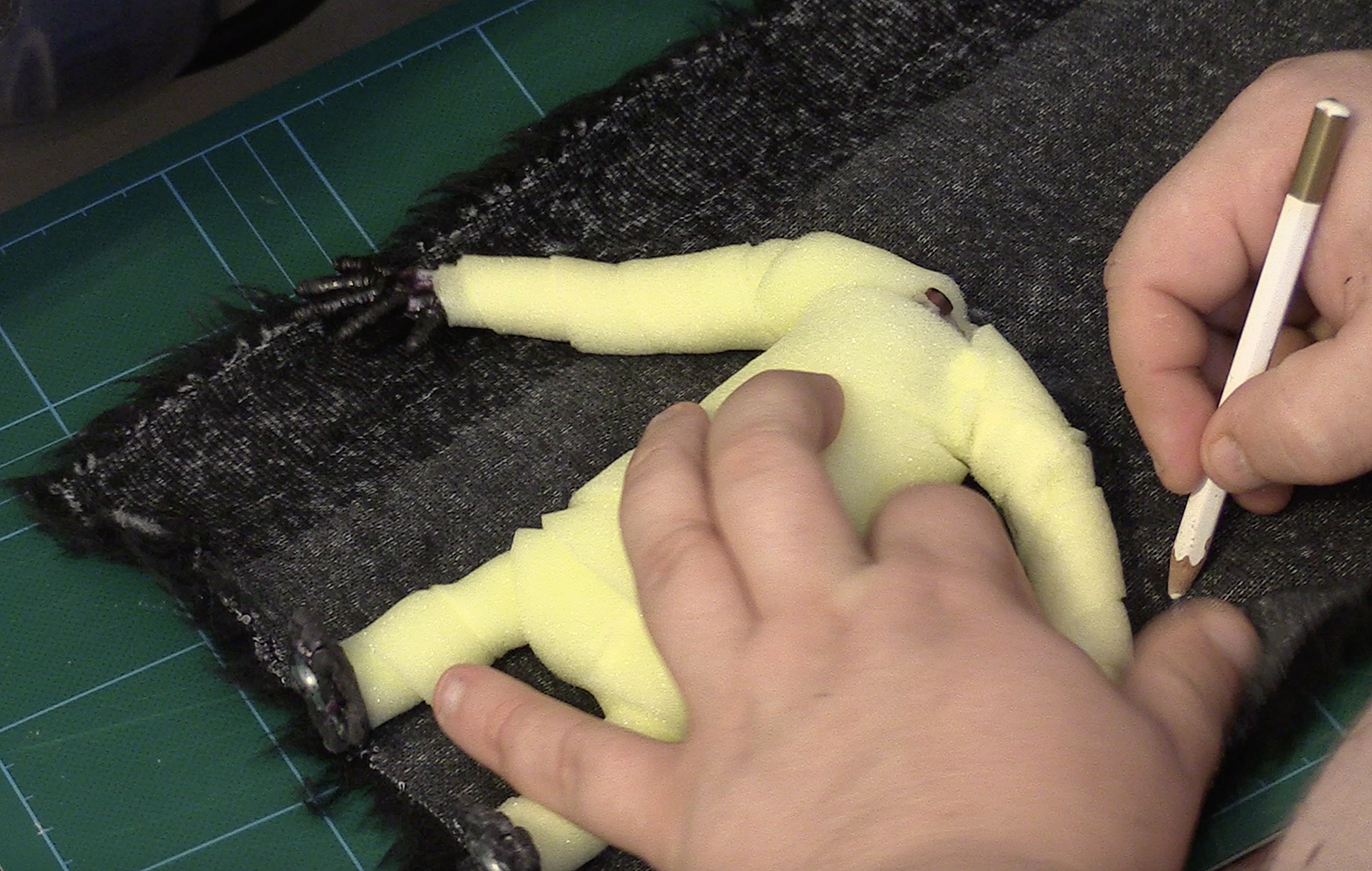


The fur covering was made the simplest way possible, namely as two outlines of the body cut from slightly elastic fake fur and joined together over the padded body using flexible but strong contact cement.


The feet and the chest piece were attached to the padded armature, and parts of the fur were folded over the latex pieces and glued down using liquid latex.


So here are the finished Ro-Men. They're fairly small puppets, standing around seven inches tall. They were, however, very easy to animate at that size, with soft bodies and strong armatures.


At the very beginning of the film, you are introduced to the unpleasant wildlife of the Ro-Man homeworld. This is represented by two puppets having a sort of argument in the barren wilderness.


I decided to shamelessly steal the basic look of these monsters from sci-fi pulp era productions. The first one was inspired by the creatures depicted (though not shown in the actual feature) on the poster for the movie "Journey To the Seventh Planet." The second monster is based on the critter shown on the cover of an old Astounding Stories.


The Astounding Stories inspired beastie had its head sculpted in Monster Clay.


The sections of the legs were also sculpted in clay and cast in latex from a dental plaster mold. I could've built up the leg sections directly onto the armature, Marcel Delgado-style, but doing it this way was quicker and the result was pleasingly symmetrical.


Another basic armature for this puppet. The eyestalks were aluminum wires wrapped with yarn and coated with tinted latex.


Various bits of soft polyurethane composed the muscles of the body, padding out the shape of the puppet.


I cast wrinkly latex skin bits from old plaster skin texture molds, that I always keep on stand-by.


The base colors were tinted latex which was dry brushed on. Augments were made with acrylic airbrush colors. The eyes were simply Photoshop print-outs glued to the back of acrylic spheres using transparent scrapbooking glue. The spheres were also bought from a scrapbooking shop. The nails and teeth are cotton dipped in latex.


The second puppet had a few more body parts sculpted in clay, since it has a somewhat insect- or crab-like appearance.


The claws and mandibles were cast as latex skins, reinforced with a cotton and latex mix, and then filled up with Polymorph thermoplastic, into which aluminum wires were stuck.


Again, a very simple aluminum wire / thermoplastic armature. It's sturdy and light, and perfect for the short sequence in which the monsters appear.


The ridged brow on the head was cut from paper and covered with cotton and latex. The jaw was built up with latex skins over an aluminum wire covered with a yarn wrapping.


The body of this puppet was kept quite simple and smooth, allowing more expression from the sculpted body parts. Overlapping bits of thin polyurethane created the basic body shape.


Again, older skin texture molds were used for the casting of the latex skin covering (I have a whole bunch of skin molds by now). The claws on the feet are also cast in latex from a plaster mold.


Like his colleague, this puppet is dry brushed with tinted latex, touched up with acrylic airbrush paints, and provided with acrylic lens eyes. A piece of fake fur with airbrush touch-ups is glued to the puppet's back with contact cement.

In the next part of my Robot monster saga, I'll go into how the backgrounds were made, and some other stuff about the look of the film.

Friday, September 21, 2018

When Chaugnar Wakes: Film and Puppets


H P Lovecraft, although not commercially successful during his lifetime, did influence a lot of writers and artists. You may have heard of "The Lovecraft Circle", which was a bunch of writers who befriended him and were inspired in one way or another by his work. One such circle member was Frank Belknap Long, or "Belknapius", as Lovecraft nicknamed him.


Long's most famous story may be "The Hounds of Tindalos", which you can find in numerous anthologies, and which has been included in the so-called Cthulhu Mythos. But he also wrote other types of horror and a fair amount of scifi. It's generally thought that Long was not as accomplished a writer as HPL, but he was more successful in his day, and I think his prose may be more accessible to a modern reader than Lovecraft's. At any rate, I enjoy the works of "Belknapus", and for years I've been thinking about how I could build and animate one of his most famous creations, the cosmic horror Chagnar Faugn. This monstrous being (and others like him) appears as the villain of his novel "The Horror From the Hills", a madcap tale of aliens, horrible transformations, strange archeology and death ray inventions.  However, I settled on a poem which Long wrote for Weird Tales, September 1932. It features Chaugnar Faugn before he comes to Earth, apparently, or may simply be a stand-alone piece of literature.


Chaugnar Fagn's appearance is not as abstract as with some of the other Lovecraftian creatures. Basically, he looks like an evil version of the Indian elephant-headed deity Ganesha. He has some kind of wings or fins that can be mistaken for ears. What looks like a trunk is a proboscis with a blood-sucking orifice, and what seems like tusks is a crystalline outgrowth which entwines towards the end of it's length. His body is generally humanoid.


I started with creating these tusks, sculpting them in medium grade monster clay.


A mold container was slapped together using bits of cardboard and hot glue, into which DragonSkin FX silicone was poured.


This is how the actual silicone mold turned out (with the cardboard removed). The clay tusks have been plied out after making a cut down what will be the backside of the mold.


The tusks were cast using Poly-Optic clear casting resin. However, since I didn't have a vacuum chamber to de-gass the material in, all the air bubbles that emerge during the mixing of the stuff was left in. This caused the tusks to become translucent rather than transparent. In my case that was OK, since completely clear tusks would've become invisible as I was animating the puppet against a blue screen for chroma key work. As the silicone mold is pretty thick it snaps tight around the back side cut, and there was hardly any plastic seeping out, creating thin bits of "flashing." In other words, the cleanup of this casting was minimal.


When the tusks were finished I sculpted the head and the front of the torso in medium grade Monster Clay. I used the shiny read half-beads that I often use for glowing monster eyes. I probably should come up with a new trick to create eyes, but what the heck -I like it! This sculpture took about two days to complete, spending a fair amount of time adding textures and details to make it all look strange but organic.


I cast the head and torso with tinted latex from a dental plaster mold created around the sculpture.


 The "ears" (or whatever they are) were made to resemble spiky fish fins using copper wire encased in soft plastic, then wrapped in soft string and covered with tinted latex. Polymorph plastic was used to hold them together. This made the spike bits animate-able, so they could squirm and move in creepy and very un-elephant-like ways.


I used my usual trick of adding skin between the moving parts by encasing the whole armature halfway down into an improvised tub of soft hobby plaster, adding more latex between the tentacle bits when the plaster had dried.


The trunk was made , like most of my tentacly bits, by wrapping soft yarn around a piece of aluminum wire. But I also sculpted a clay trunk, or rather the top side, to give it distinct texture and shape. From a plaster mold poured over the sculpture I could then cast a latex skin added over the wrapped aluminum wire.


The sucker-like mouth was made the same way as the ears, except for that I used clay to embed the armature instead of plaster. When the desired shape was achieved I built up a round orifice with latex and cotton, and also added latex teeth.


The armature was my usual aluminum wire and Polymorph construction. The limbs were covered with muscles created by soaking thin polyurethane foam in latex and rolling up bits of it into long sausages. They were all bonded together with liquid latex, and then covered by extra-extra thin foam to smooth out the shapes.


Arms and legs were padded and covered with skin separately and then joined together to form the body. The feet were also cast from clay sculptures.


The torso was completed with a head supported by a skull made from Polymorph and the armatured ears and trunk. The rest of the body was padded with thin polyurethane sheets covering bundles of cotton balls.


The foam bits were covered up with bits of latex skin cast from old plaster molds used for a number of puppets.


The puppet was painted with a unifying layer of tinted latex before getting a dry brushing with greenish grey latex.


The tusks were simply attached using hot melt glue. They stuck very well to the Polymorph skull that way. The finished puppet is pretty large, around a foot tall.


If you started reading this blog post by checking out the video posted at the top you'll know that old Chaugnar isn't the only puppet. He's being monitored by a bunch of aliens with eyes on stalks. These characters were just the one puppet, made in bits and assembled. The head was sculpted in medium grade Monster Clay.

The body, which is a space suit, was also sculpted in clay, here seen upside down.


 Originally I had the notion of making three puppets with slight differences, so I cast three heads and three bodies in latex. However, I soon realized that to make them discernible from each other I had to make them more different than I wanted, so in the end I decided to just make the one puppet, representing the whole alien crew.


I also sculpted some other bits of tech that would be cast in latex and attached to the spacesuit.


I wanted the arms and legs to be tentacle-like so I made them very simply by wrapping soft string around aluminum wire to build up a shape, and then covering that shape with sturdy macrame yarn, and lastly with tinted latex.


Here's the spacesuit body assembled.


And here's how the finished alien(s) turned out with head attached and a greyish metal color added. The eyes are tiny Photoshop print-outs covered with drops of Glossy Accents scrapbooking plastic.


The backgrounds are my usual mix of stock footage, mainly from Videoblocks, where I have a yearly subscription. Some backgrounds were made in Photoshop using stock images from DepositPhotos, where I also have a subscription.