"The Conqueror Worm" was, of course, written by Edgar Allan Poe. It's a poem allowing for all sorts of interpretations, but an overall apocalyptic theme is certainly obvious. I've been planning on adapting Poe for quite a while and I actually made an adaptation of "The Facts In the Case of Mr. Waldemar" in high school, back in the very analog video days of the 1990s. I was Mr. Waldermar and melted at the end of the film, having custard running down my face.
And, as I'm sure you know, Poe movie adaptations have been around almost as long as cinema has existed. "The Conqueror Worm" has also had its adaptation, though it's a cheat of sorts. Michael Reeve's excellent "The Witchfinder General" (1968) was distributed in the US by AIP under the title "The Conqueror Worm" to include it in the AIP cycle of Poe films, mostly starring Vincent Price.
To adapt something as symbolically themed as Poe's poem invited an opportunity to create surreal visuals of a kind I hadn't approached yet. A throng of angels watches the spectacle of humanity on a cosmic stage until the conqueror worm appears and at the end of the show is revealed to be the master of all. I plundered my usual resource, Depositphotos.com, for stock images I could revise in Photoshop. A couple of HD photos of a dilapidated theatre served as the playhouse where the angels gather. I cut holes here and there in the images so I could place CG animations of a swirling cosmos behind that layer in After Effects.
The angels were represented by stone statues prepared in Photoshop. I also found stock images of veils shot against a black background. Those were added over the heads of the angels, with some tweaking with distortion tools in After Effects.
God was a mishmash of stock footage from Videoblocks.com: A cloudy background, smoke animations arranged to create a triangle, a close-up of a man's eye, and CD lightning bolts.
Most shots are a collage of photos and stock footage from Videoblocks.com. In this shot, the mime is live-action stock footage, as is the animated background. The falling girl (along with other various things passing in and out of the shot) is a stock photo slightly animated with the AE puppet tool.
The cavalcade of horrid things humanity is guilty of is represented by plain stock footage shots of various historical violent scenes. I only added a filter over them and had them transition into each other using black ink added in water as a matte.
The very apocalyptic shots showing the appearance of the worm were, again, built using stock images. I found a few photos included in my stock photo collection showing behind-the-scenes shots from some zombie movie, where "dead" people were stacked upon each other. Perfect for my intentions.
The final shot of the angels shows one of them opening its eyes. That was simply made by using another stock shot of a woman opening her eyes, cutting out that section of her face in After Effects, and applying the footage over the face of the stone angel. The soft edges of the matte tool cut-out, some color grading and the veil in a layer over the angel hopefully helped sell the illusion.
So, now over to "our hero; the Conqueror Worm." I actually started planning this film last year and made a worm puppet, that I ended up not being happy with. I thought this lean beast didn't exactly represent the gorged monstrosity that fed on mankind. Instead, I included this puppet in my film "The Elder Pharos."
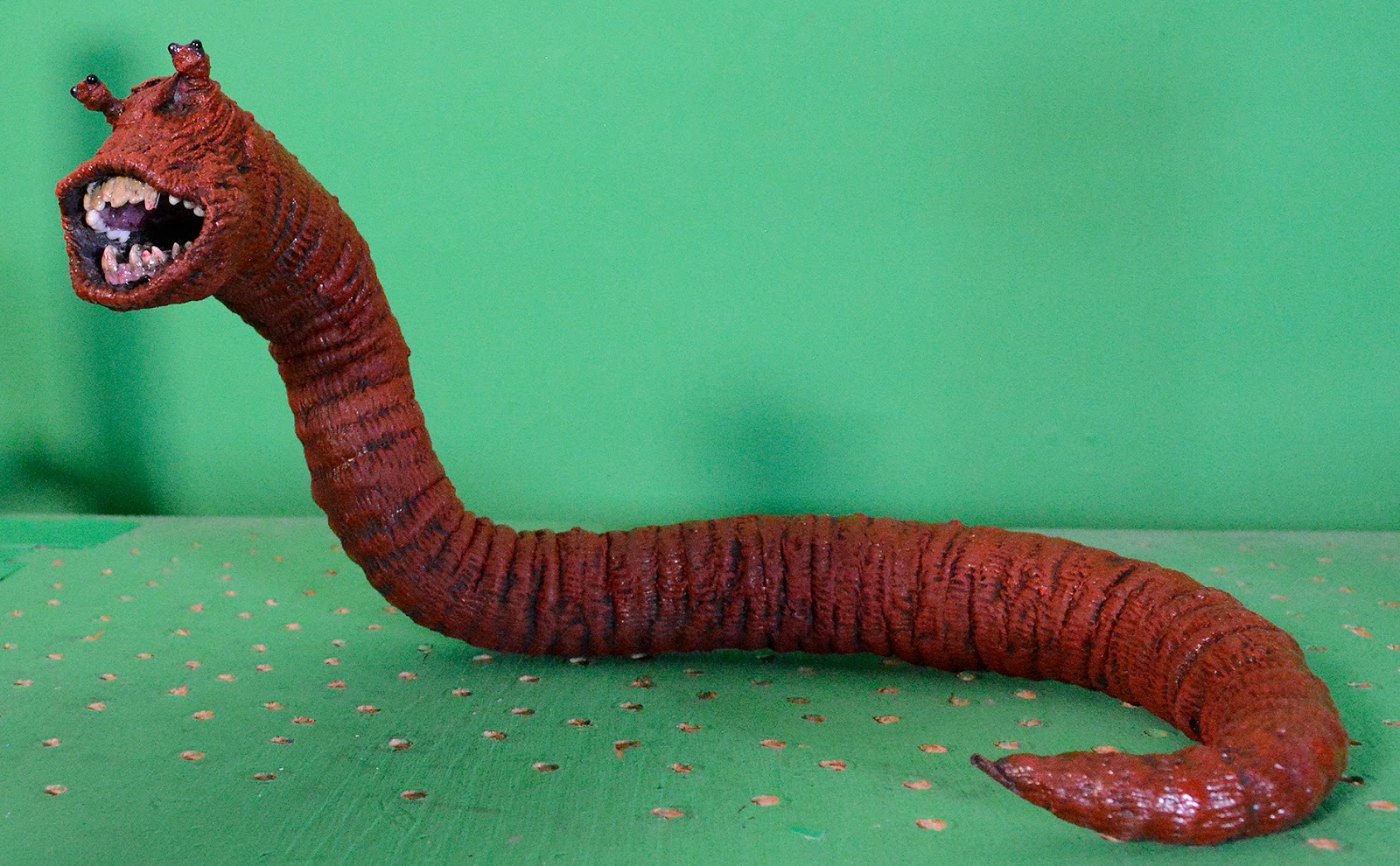
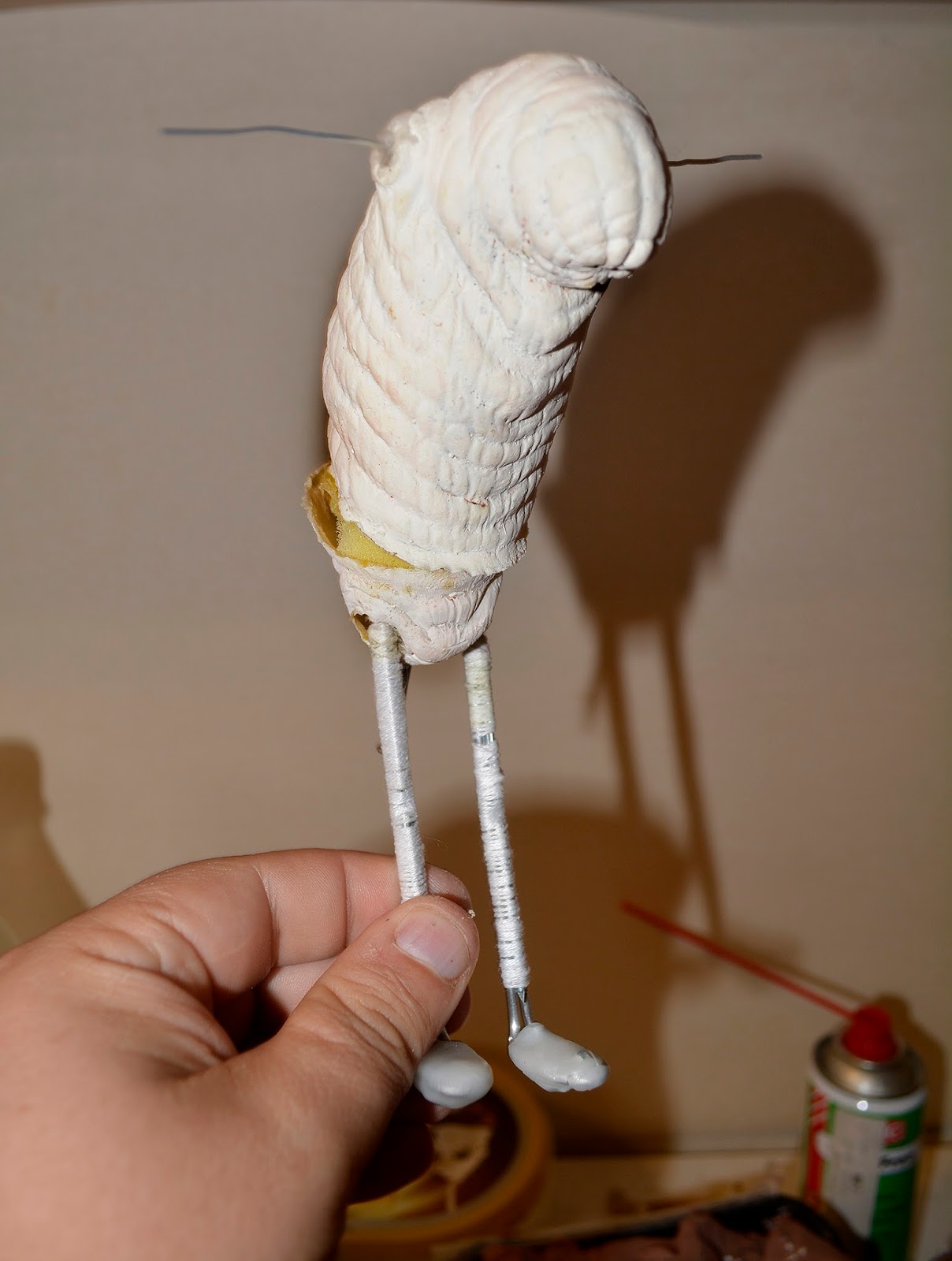
On to Conqueror Worm 2.0. I built this puppet pretty large, so I could animate it making very slow movements. As I wanted it to look like a fat maggot, I knew it needed lots of padding, something that always gets in the way of smooth and easy animation. I included a kind of rib cage in the armature to fill out the body of the puppet and create the desired bulk. The tiny legs were also attached to these ribs. I only made a section of the worm, needing just the part seen above the heaps of bones and bodies.
I used very soft polyurethane foam to pad the worm's body. I put on layer after layer very loosely. Soft yarn was wrapped around the legs and covered with latex.
To create a segmented look for the chubby body I simply wrapped yarn around the parts where I wanted to pull in the foam. Thin latex patches cast in a skin texture mold covered up the body.
The finished puppet was painted with tinted latex. The claws and teeth were made from tissue paper dipped in latex. A single t-nut stuck to the bottom of the armature secures the puppet to the animation stage.
Lastly, I have to mention my UK buddy John Hutch, who, like many times before, provided the narration. We've collaborated quite a few times by now, and will continue doing so for the forseeable future. I really wish he'd get a break as an actor. He's done bit parts here and there in various British TV shows including the fantasy series "Merlin" (where he gets knocked out by prince Arthur in one scene.) For now I'm planning on adapting Poe's "Dreamland" with John narrating.
Do I have a Poe dream project? Yes; it's animating "The Raven" narrated by Nicholas Cage.
I'm back with another hopefully delightful adaptation of a poem from H P Lovecraft's sonnet cycle "Fungi From Yuggoth." This piece of literature has provided me with quite a few subjects for films already, but I'm sure I'm not done pilfering from it yet.
This film leaned heavily on using stock images from Depositphotos.com. The stuff I downloaded was altered here and there in Photoshop to suit my exact needs and ideas for the project. The light effects were stock CG animations from Videoblocks.com, somewhat altered in After Effects.
The shepherd was also a stock footage clip found over at (I believe) Pond5.com. Though parts of this project had been brewing for a few weeks, this film was finished rather quickly, which is why I didn't engage any of my regular cronies for the non-puppet characters.
Speaking of puppet characters, there are only two of them in this film. Let's start with the one who appears first. This rather jolly-looking giant worm, lounging in a sea of skulls, was actually conceived for another project. I'm working on an adaptation of Edgar Allan Poe's "The Conqueror Worm", and this was originally meant to be the actual worm. I eventually decided against that idea, instead designing a monstrous worm that'll look far more maggot-like and repulsively familiar.
I wanted the worm's body to be clearly segmented, and since I didn't already have a skin texture mold with that exact look, I made a new plaster mold from a Monster Clay sculpture.
The armature for the worm was as simple as can be. A single 3 mm aluminum wire was used to create the armature. It was attached to a plastic bottle cap, where the head would go, and a 4 mm t-nut used for tie-downs was stuck to the wire using a blend of super glue and baking soda. The wire was then covered by soft yarn.
A denser dark brown yarn was wrapped over the softer yarn to provide an outer surface which was sturdy. The tie-down hole was left uncovered, of course.
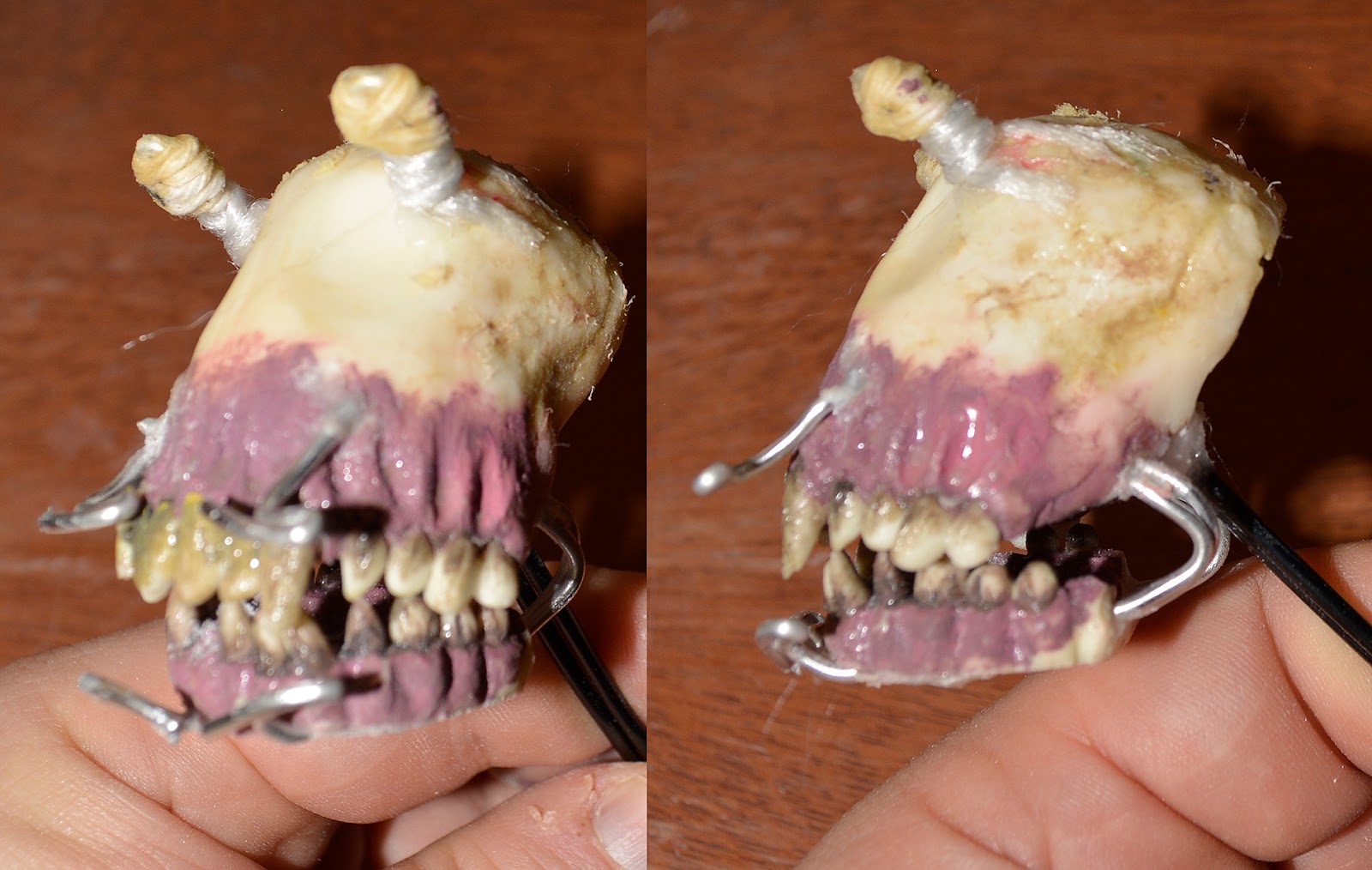
The head of the worm is actually a skull I made some years ago for a replica of King Kong. I never used it, and I thought I could press it into service to create a weirdly humanoid head for the worm. The knobs near the top of the head were supposed to move the eyebrows of Kong. For the worm, I used them as eyestalks.
the actual head was built up using strips of soft polyurethane foam, covered with skins of tinted latex cast in skin texture molds. The same soft foam was attached between the head and the body to create a natural transition.
The segmented skin was cast as two long bits of tinted latex, and attached to the yarn-wrapped body using liquid latex as a bonding material.
As the worm was originally built to represent the ominous entity of the Poe poem it was colored red using tinted latex dry brushed on with a foam sponge. In this film, it was changed to a greyish green using color tools in After Effects. The four small black eyes on the stalks are plastic beads.
The Elder Thing inhabiting the ancient pharos (lighthouse) was said to wear a bulging yellow silken mask. This character was achieved by using several stock photos and computer-generated images blended together in Photoshop. The moving silk mask is a CG flag, waving in the wind, but here deformed using After Effects tools, and changed into a bright yellow.
We finally see what's under the mask, as a toothy mouth surrounded by writhing tentacles pops out. This stop-motion construction was simply made using 12 aluminum wires covered in soft yarn and dressed with scaly latex skins. The mouth is just an immobile hole decorated with latex and cotton, with teeth made from the same blend of materials.
The tentacles are held in place with blobs of Polymorph thermoplastic. This also created an attachment point for the rig holding up the mouth.
The very simple rig was just a piece of wood painted with green chroma key paint and attached to an aluminum 90° angle profile, held down with a powerful glue clamp. A pair of screws in the wood allowed the mouth the be attached using more thermoplastic.
Making short films hardly using any actors and with stock images and clips for editing material is, of course, somewhat of an expression of laziness, but I like the results one can achieve with stock media. Also, in these times when we all sit isolated it's not easy getting around to shoot original content.
Here's a quick walk-through on yet another puppet for the Carcosa film project. This one was very simply made, and it might be something in here you can pick up on if you're a puppet-maker yourself. I now almost exclusively use Monster Clay for my puppet sculptures. I've grown accustomed to the relative firmness of this material, and I find that I can work it just the way I want to. A little bit of heat from my heat gun gets the clay soft enough to knead it into the basic shape it should be to get started on the detailing. I sculpted the body for this puppet rather quickly and at a slightly smaller scale than usual. Since this creature didn't have to move neither head nor body I could get away with a simple construction and a one-piece semi-rigid torso.
To cast this sculpture I needed a two-part mold, and I decided to split the mold along one of the segmented portions of the creature's body. The clay wall split ended up just above where the body is tapering off, so I had no undercuts.
To make sure as much of the sculpted detail as possible got into the mold, the first layer of dental plaster was brushed on with a soft, broad brush. The rest of the plaster was mixed rather thickly and ladled on with a spatula.
Here's the bottom section with a pair of improvised clay "legs" added to the torso, just so there would be two funnels where I could pour in the latex.
The whole mold has now set up, been split apart and the two sections of the torso have been cast in latex tinted white, using latex tints from Monster Makers.
Before joining the two halves of the torso I've added jointed legs and two thin metal wires to create small tentacled arms. All limbs were covered with soft string and thin polyurethane foam to build up bulk and shapes.
And here's the finished critter. The toes are built up with cotton and latex, as is that curiously familiar worm-like appendage between his legs. Washes of purple, blue and red acrylic airbrush colors added the final touch, along with Glossy Accents scrapbooking liquid plastic around the mouth area to simulate glistening moisture.
My work for Rolando Gutierrez' computer game is almost over: I built three more puppets and I have some animation left to do.
One of the more striking scenes in the game will feature a transforming woman, realized as a stop-motion puppet. I sculpted a twisted torso based on the likeness of an actress from the game's live-action portions. From the shoulders up I made the plaster mould in two parts.
As I usually do I sculpted a flat piece of skin and made a plaster mould over it. I prefer to have a bunch of plaster mould skin textures on hand to cast small and big pieces at my leisure when I build up my puppets.
The puppet is a mishmash of cast latex pieces and parts built up with latex and cotton over foam shapes. My idea was that this lady would undergo a transformation inspired by the final revealed appearance of Wilbur Whateley from Lovecraft's "The Dunwhich Horror". I'm sure some of you know what I'm talking about.
The finished puppet was painted with acrylic airbrush colours and decorated by tufts of crepé hair.
A monstrous worm puppet was also required. I had a design mailed to me, but for some reason I strayed a bit from it. Here's the head sculpture for the cyclopean monster.
The legs were aluminum wires with a cotton/latex mix applied over them.
The mid-body section was a cast originally sculpted for another puppet monster; the blunderblat (see my earlier blog posts). The spine of the puppet was braided aluminum wires, with Friendly Plastic thermoplastic added as support.
The skin for the rather long body was sculpted flat in clay with various details.
All the latex was tinted black using Kryolan tinting powders before being poured into the plaster moulds. This isn't the final colour, but it's a fairly good base colour, and automatically creates deep shading in hard-to-get-to spots.
Some simple foam padding was added before covering the puppet's body with the cast latex skin pieces. Liquid latex is the bonding agent.
And here's the little bugger with its finished paint job, and a plastic lens eye fitted into its head.
Don't ask me why I can't post this image standing up, ask Blogspot!
It's a pretty nice monster, if I may say so myself. However, this wasn't really what Rolando had intended for his game, so it was back to the workshop.
I started building another version, and this time I stuck exactly to the sketch I was given. The belly and back parts of the monster's body was sculpted in clay and cast as two separate latex skins.
The skins were wrapped around a foam padded aluminum wire armature with lots of legs.
The finished terror attached to my animation stage using a tie-down nut in its belly.
The first version of the bugworm will probably be used in another project.