Showing posts with label film. Show all posts

Thursday, August 31, 2023

Hello?


Like last month's post, this entry is about a project that started off as a YouTube shorts project, until I rejected that idea. In the end, I ended up just making a very short, silly video. 


My inspiration for the ghost in the film was this Victorian illustration. I have no idea where it's from but it's included in a huge book on supernatural literature, which I've had for years.


I sculpted the face in medium-grade Monster Clay on a flat slab of aluminum and did all the rest: a plaster mold of the clay and the casting tinted latex into the mold. The chest area was cast in a mold created many years ago for the demon in my film "Memory."


I wanted striking eyes for the puppet since it would only be on screen for a very short bit. I picked a couple of semi-transparent plastic pearls, for a sort-of luminous effect, and reamed a concave surface into each pearl to create a lens effect. The eyes were detailed with acrylic airbrush paints painted on with a thin brush. UV resin was then added to create the actual lens effect.


I wanted the arms to be really spindly and skeletal, so they were built up with thin metal rods folded over and covered with soft crochet yarn soaked with latex.


When the puppet parts were assembled the whole thing was attached to a wooden rod, one of those you stick into a flower pot to support a floppy plant. Thermoplastic was used to hold it all together.


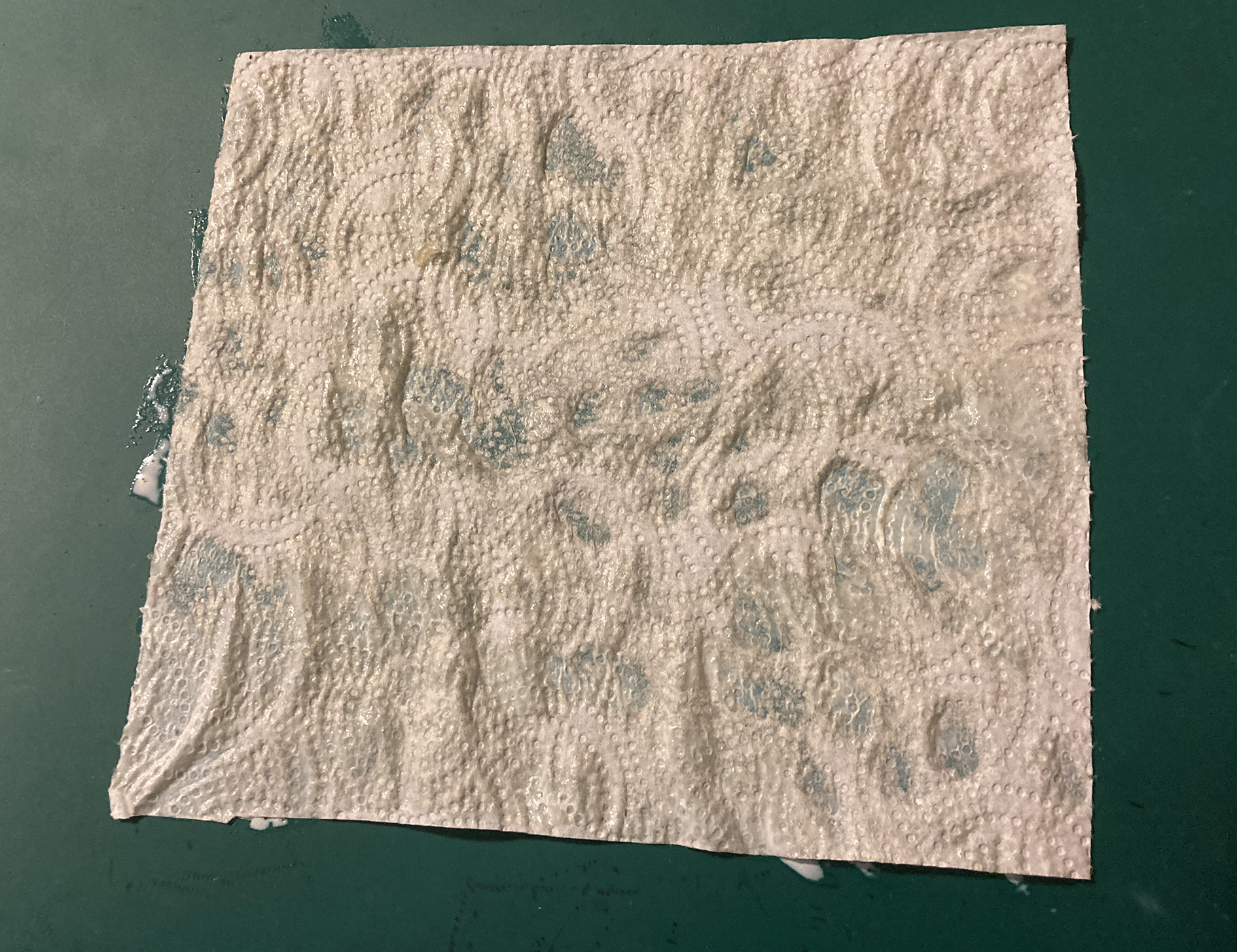
The flimsy garment of the ghost / dead thing was made with kitchen tissue paper soaked in latex. I then simply cut pieces from it and pressed them together. the sticky surface of the paper as a bonding agent.


So, here's the finished ghost. The arms, the neck, and the jaw were the only articulated parts of the puppet. the hair was made from crepé hair (sheep's wool used for fake beards.)


The second puppet in the film is the man who walks by the cave and engages in conversation with the ghost. This is actually a very old puppet, built at the end of the 1990s. It's still holding up, barely. The latex is really dry and brittle but the clothing and the armature are fine. As you can see he hasn't got any real feet because for the film he was originally built, he doesn't show his feet. I didn't make any tie-downs back then, I just clamped the puppet down on a tabletop with a small glue clamp.

Some of my YouTube viewers were disappointed that the film was short and thought it was just "gimmicky." Others thought the film was fun. It was an interesting experiment.


Tuesday, May 28, 2019

H P Lovecraft's Dagon


Welcome again to the wacky world of H P Lovecraft! This time I've tackled a real classic, his early and game-changing tale "Dagon". You could say that this short story defines most of his work that comes after it. It introduces that most parodied Lovecraftian cliche: the narrator who keeps writing down what happens up to and including his own demise, death screams and all.


Let's start with the title. Since monolithic imagery is such an important part of this story I decided to expand this theme to the titles. I sculpted the letters of the name "Dagon" in clay and cast a plaster mold around them. This allowed me to cast extremely light weight versions of the letters in latex, reinforced with cotton, and then paint them with a mix of latex and various tinting mediums. The letters were placed on a green screened turntable and then filmed one by one. The separate letters were then lined up against a black background in After Effects and synchronized to turn all together.


The story takes place at the beginning of WW1, and I decided to try and stick with that period. I think I managed to scrape by just about when trying to maintain the credibility. I recruited my stalwart filming buddy Martin Merkel to play the narrator. It was a no-brainer to engage him in the project since he, besides being ever reliable, also had a decent collection of costumes and props from the WW1 era, coming mostly out of his cosplaying and historical reenactment interests. I filmed all of Martin's scenes outdoors against a green screen. Well, almost all, because I needed some shots of him walking at a distance, and my screens weren't big enough to handle that.


To get those shots we found a slope of short grass, and Martin simply walked in front of it.


This may look primitive, but with the aid of an AE plug-in called Smooth Screen I could transform the grass into a more unified green background. This allowed me to pull Martin out of the green as with any ordinary green screen shot.


But to get rid of most of the background I also had to draw a "garbage matte" around him, and changing the shape via keyframes I could track his walk with a minimum of background showing.


Martin was then sandwiched in between two Photoshopped background images, allowing him to walk into the rather nauseous landscape of the dry ocean floor.


Lastly, the green around him was removed, and the rendered shot was treated with atmospheric filter effects and then rendered out again.


These backgrounds were all created in Photoshop using photos of ebb and tide beaches combined with hundreds of images of stranded sea creatures. Sometimes, like in the top image, I've added a tracking camera move to add some depth, creating a 3D effect with artificial means.


It's done rather simply by marking all the layers of the shot as 3D layers, and then adding a distance between each layer. Depending on how big that distance is, the perspective effect is more or less accentuated when a camera move is animated in the shot. It's kind of crude, but it certainly helps sell the illusion if you do it well enough.


The monolith of this story is a very famous Lovecraftian artifact, which needed all my attention. But at the same time it's impossible to create the definite version of such a thing, so I just went with trying to literally recreate what the text says about the artifact. It has peculiar carvings depicting humanoid monsters that look like a cross between a fish and a frog. One of them is battling a whale. So that's what I went with. The images are depicted as bas reliefs, which meant they had to protrude out from the stone surface; a tricky bit of time consuming sculpting. I wasn't up for that, so I used a technique from my early days of prop-making. Instead I carved out the details, in reverse, so to speak, on a flat clay surface.


When I poured hard dental plaster onto this surface, the dry plaster cast revealed just the kind of bas relief I wanted. Again, crude but effective. This plaster cast was joined with three clay walls to create the actual monolith. Over this I applied four layers of DragonSkinFX silicone to shape a flexible mold.


SmoothCast 325 was poured into the silicone mold and roto casted to create a hollow plastic copy of the monolith sculpture. This casting was painted with washes of bronze, blue and green acrylic paint, and the whole thing was attached to a rudimentary but sturdy wooden stand.


The Dagon monster hugging the monolith was a foot tall puppet, built with my usual materials and techniques. I started off with a head and torso sculpture in medium grade Monster Clay. Like the monolith, this creature has achieved mythic proportions and there's a ton of art out there depicting it. How to make a version that's wholly original and yet familiar enough? The only way was to make it look like I think it should look, which is probably a distillation of loads of images from other artists, as well of real world fish and amphibians.


The armature was very simple; aluminum wires held together with thermoplastic, and reinforced with bits of metal rods to make the hard parts of the "skeleton."


The head and torso was cast in tinted latex from a plaster mold built up around the sculpture. An aluminum wire angler fish rod was added, along with fangs made from yarn dipped in latex.


Very soft polyurethane foam (the yellow bits) was mixed with denser foam (the green bits) to create a muscle padding, which was then covered with scaly patches of latex skin.


I wanted the monster to have fin-like outgrowths that looked worn, befitting an ancient sea giant. After attaching spikes made from cotton and latex to parts of the puppet, soft Monster Clay was pressed up against these spikes and tinted latex was brushed over both spikes and clay. When the latex had set, I had achieved that look of worn skin that I wanted.


The finished puppet was painted with acrylic airbrush paints, including the eyes, which were then covered by Glossy Accents scrap booking plastic to create that deep sea fish look to the eye lenses. The angler outgrowth has a glass pearl at its end. 


That's all folks! My take on Dagon has been generally well received, though there have been a few angry people letting me know what they think of this mangled version of one of their favorite tales. But that's how it goes. The more famous the tale you adapt, the more criticism you'll get.

Sunday, May 20, 2018

The Age of Invention: The finished film.


Here's the finished "Age of Invention", warts and all. Due to various technical issues and some problems during the filming, it's not as polished as I wished it would be, but I hope you'll enjoy it nevertheless. Since all dialogue is in Swedish, it's subtitled in English.

Tuesday, December 20, 2016

Sunday, November 20, 2016

Carcosa Project: The Finished Film


After working on this project for over a year, here's the finished film. I hope you'll enjoy it.

Now here's the story behind it. In 2015 I bought Chaosium's collection of Hastur-related tales, and found among them Lin Carter's poem "The King In Tatters." I thought it was very atmospheric, and offered many interesting visuals, if one were to adapt it as a film. I contacted Robert M Price, who is the manager of the Lin Carter estate, and he generously gave me the permission to make a filmed version for YouTube.

Originally "The King In Yellow" is a book by Robert W Chambers, first published in 1895. For a book of that age it's very modern, and collects a number of more or less weird stories. Some of them circle around a fictional play, "The King In Yellow", a work said to drive people insane with its second act. The text alludes to a place called Carcosa, and a mysterious king with a pallid mask.


Other writers after Chambers have expanded the rather impenetrable hints given by the original author, and the world of Carcosa and its inhabitants have been gradually fleshed out. It has been given a mythos of its own, though it is sometimes included into the Lovecraftian Cthulhu mythos, basically created by Lovecraft's protegĂ© August Derleth, and not always for the best. In the same way Chambers´ mysterious dreamlike references to Carcosa and the King In Yellow has been given a tad too much clarity sometimes. Not surprisingly, this mythos has been incorporated into RGPs, just like Lovecraft's world.


The King In Yellow also pops up in various other pop culture phenomena, most recently in the first season of "True Detective." There have also been comic book adaptations, and various amateur film efforts.


My version of the world of Carcosa began taking shape last September, when I filmed Samuel Lange, the friend of a friend (but now also my friend) as the narrator of the poem; a man who seeks forbidden knowledge through arcane practises. As the weather was fair we shot all of his scenes outdoors, with my greenscreen slung over a light erector set.
Samuel costume was pieced together from a number of things. The boots are riding boots bought at a garage sale. His pants were salvaged from a closed-down stage wardrobe. The red robe is a gospel choir robe bought from the Swedish equivalent of eBay; Tradera. And the sword is a Greek "kopis" or "falcata" made from aluminum and brass by my blacksmith buddy Martin Merkel.


The only thing created especially for this project is the pendant, sculpted in clay and cast in 325 SmoothCast plastic from a silicone mold. It sports the classic Hastur sign, made popular by Chaosium's RPGs and then other illustrators. It was silly going for the most well-known version of "The Yellow Sign." I should've made my own version, which I eventually did for the Hastur puppet. Let's just say that its inclusion in the film is because Samuel's occult cultist is a fan boy, and that he, like me, didn't know any better.


What I had no idea about when asking Samuel to join my project, was that he actually had two big occult tattoos on his body; a pentagram on his chest, and an image of black magic bad boy Aleister Crowley on his back! I guess fate was in play, or as the poem says: "Fate, or my stars, or some accursed pride had brought me here."


The only complicated shot in the film (which wasn't really complicated) is when the character mounts his interstellar ride, the Byakhee. Samuel just straddled a bar stool covered with green screen fabric, and I was later able to place him on the back of the Byakhee puppet. Some masking in After Effects placed him behind the neck of the monster, though he was really superimposed on top of it.


When the Byakhee is in flight and seen from afar I just printed out a small still image of Samuel, cut it out and taped it down onto the back of the puppet. The simplest solutions are always the best.


The only exception to this is this shot, where the Byakhee has a paper cut out of Samuel's legs on its back, while the torso of the live-action Samuel is keyed in on top of the cut out legs. I did this in order to have some subtle movement in his robe and from his head during the shot. It's there, though hardly noticeable. I'd like to think it still helps sell the illusion. I hand tracked Samuel's torso in After Effects, also using the masking tool to place him behind the neck of the puppet.

As usual, I'm shamelessly using tons of stock footage from Videoblocks and Pond5. They have a wealth of atmospheric nature footage, which can be dropped into my film with hardly any additions, except for a few filters. I'm subscribing to Videoblocks yearly, and it's so much quicker and easier for me to log in, find what I need and continue editing, than going out with my own camera, trying to film the backgrounds that I want.


I do, however, piece together my own "matte paintings" in Photoshop. The example above shows the palace of the King emerging from the Lake of Hali (another name-drop from the Carcosa mythos). There is about eight layers to this shot. All the cliff faces are photos I took of rocks by the sea in the south of Sweden, the castle is a mix of stock photos of various ruins, and the tree is another stock photo. The sky is a mix of a Nasa space photo and stock footage time-lapse clouds. The lake itself is footage from a sewage plant, with stock smoke shots added around the base of the castle cliff, with fires shot against black from Detonationfilms coming out of the castle towers. All of it is, of course, brought together in After Effects.

And as usual, the narration for the film is provided by my trusty voice-over guy John Hutch, recorded while on vacation in Spain, no less.
After I had shot the footage with Samuel, which only took a couple of hours, and had to let go of the project for quite a while. I was at the time working on a media project for disabled people, which started to eat up almost all of my time, even on supposedly off work hours. As this project wound down in April I found myself hurled out into the world of unemployment again, and vast vistas of free time opened up before me. Still, putting together all the bits of the film, building the puppets and animating them, dealing with wonky technology and other issues, made this production a very lengthy one. again, I've learned a lot from it, and I'll take it with me to the next film.

Friday, November 18, 2016

Carcosa Project: The Last Puppets


As I write this, my Carcosa film project, finally named "In the Court of the Yellow King", is actually finished. My top level Patreon supporters were given a premiere viewing of the film a couple of days ago as a part of their bonus reward. But I will make the film public on YouTube this weekend, and hopefully you'll enjoy it. Until then, here's some info on the last trio of puppets built and animated for this project.


I wanted to add at least one citizen of Carcosa, someone casually drifting by the camera, and came up with a VERY simply constructed character. Basically he's an unwrapped mummy, with his head on fire, going somewhere. I slapped together this armature out of thermoplastic and aluminum wires. As usual there are wing nuts in the feet for tie-down purposes.


The whole puppet was covered with soft yarn and cotton dipped in tinted latex. I basically let the materials create the textures, with some gently prodding from me and a pointy sculpting tool.


It wasn't really necessary, but I chose to cast some additional latex textures from old plaster molds, and added those here and there. More tinted latex was sponged on to make the colors more unified.


And here's our dapper chap, walking through the street of Carcosa City. I added the fire to his head by using stock footage of a burning brush shot against a black background, and superimposing it over the animated puppet, using the tracking tool in After Effects to make it follow the character's head.


Finally, finally, the main character (and we, the audience) reach the throne of Hastur; the King In Yellow. I decided to give him a consort; an attractive, but in some way weird lady. For a while I thought about asking one of my lady friends to portray her, but then I decided against it, thinking that I'd have greater control over the clothes she'd wear if I made her as a puppet. This character wasn't required to do much, just turning her head, actually. So I made a torso sculpt of a voluptuous woman in medium grade Monster Clay.


To this torso I added the skimpy clothes using soft Monster Clay, as it's a faster material to sculpt and smooth out that the medium grade variety. By now I had decided to slice off the top of her head and have nasty green smoke come out of her skull.


I also used the soft Monster Clay to create a dividing wall for the mold making. 


Here's the front half of the mold made out of pink dental plaster.


And here's the finished two-part mold, with the clay cleaned out. The string of clay smudges at the bottom of the left half are put there by me to cover some air bubble pockets that unfortunately slipped through.


All the bare skin parts of the puppet were painted in with flesh-colored latex into the mold using pipe cleaners, while the dress bits were painted a leathery black. After this initial latex layer had set up the mold was closed up and held together with straps, while more latex was poured into the mold and sloshed around to add a thicker skin.


Here's how the "queen" looked right after coming out of the mold. As you can see there is a fair bit of "flashing" where the latex has seeped into the seam of the mold.


To support the puppet a thick piece of aluminum wire goes front the feet right up to the top of the head. Armatured arms have been added and covered with soft yarn and tinted latex. The seam flashing has been cut, and the marks left by it have been covered with liquid latex.


Here she is with a finished paint job using PAX paint (Prosaide makeup glue + acrylic paints). The rings connecting her top with the skirt are bits of yarn dipped in latex and painted with metallic colors.


For the king I actually started with his throne. I made it out of old cardboard boxes held together with lots of hot melt glue.


It was a very quick build, and this is what I ended up with for the basic shape.


To give the throne a bit of texture I created a scaly pattern in soft hobby clay using one of my sculpting tools.


Over this pattern I added a layer of tinted latex using a polyurethane sponge, and reinforced the latex with tissue paper and more latex.


Thus the negative imprints in the clay turned into a positive latex cast.


The whole cardboard throne was covered with latex and cotton dipped in tinted latex. This added subtle organic textures to the prop.


Cotton and latex were also used to create other decorations, such as fingers reaching up onto the armrests from below, and a row of spikes on top of the back rest.


The armature for the king was super simple. No facial features and a very basic humanoid shape. I was going to cover up the puppet in robes with very little padding, but I also wanted his dimensions to be slightly distorted, hinting that it wasn't anything human at all under the clothes.


 This is the simple padding, using strips of thin polyurethane foam. I've covered the feet, forearms and head with soft yarn and tinted latex.


I chose a very bright yellow fabric for the robe, and again the shapes used to make the robe was very simple.


The finished robe, with a little waist cord made from thick yarn dipped in latex tinted yellow using Monster Makers´ latex tints.


In all stories concerning the King In Yellow he's said to wear a pallid mask. I decided to make my version of the mask eye-less, to further augment the character's inhuman features. I sculpted a simple neutral face in soft Monster Clay and cast a plaster mold over it. Tinted latex reinforced with cotton was cast into this mold to create a feather-light leathery mask.


Here's the monarch seated on his throne with mask on and some airbrushing added to his robe.


In the finished film I've added cgi stock footage of wiggling organic shapes over the yellow robe, and used the masking tool in After Effects and hand-made tracking to make the footage envelop and follow the robe. Just a bit of extra added weirdness. I also placed a rotating crown of fire over his head, using footage of a torch filmed against a black background and animating several layers of this torch into a "circle". The guard you might've read about in an earlier blog post is joining the king, and the queen has her column of green smoke added to the top of her head. The background is a digital animation of long ribbons running downwards and changing color.


All in all this has been a fun project, but lots more work that I had anticipated when I initially planned it out. More and more details were added, and every one of them ate up more time. I've learned a lot from doing this film, and in the end that's the big payoff.