Monday, October 30, 2023

The Path Through the Marsh


A while back I did a short film called "Changeling", based on a poem by American weird fiction writer and poet Leah Bodine Drake. Her poems are a treasure trove of moody genre musings, so I decided to tackle another of her creations, this time "The Path Through the Marsh." This poem dwells on the legend of a fearsome presence in a boggy forest. Is it just a Native American legend of a demonic nature spirit, or is it something akin to Bigfoot? I decided it was something in between. 

I'm a big fan of the movie "The Legend of Boggy Creek", mostly because of its dense atmosphere. You never really see the Bigfoot creature said to inhabit the wilderness around Fouke, Arkansas, but you do glimpse it, and that's all the movie needs to put its audience on the edge. The movie underlines that the mysterious monster is right at home in nature, while we aren't anymore. It's an organic part of the swamp, while we're only intruders. The movie also says that nature may be far scarier and more dangerous than we think, even if we're only talking about the woods around the corner of our house.

All the backgrounds used in this film were found at Depositphotos or Storyblocks, and they're all shots or pictures of American swamp land. I had to do very little tweaking to make them look creepy or moody. I did add a fair amount of fog drifting around because you can't have a swamp monster film without any fog.

So let's talk about the monster. I actually based the puppet on a half-finished abandoned puppet project. this was going to be a big goblin creature, but since I wasn't happy with how it turned out I chose another path and did a different version. I had, however, progressed a bit and saved what I had built. This was the whole upper torso of the character, so I just stuck on a pair of legs, and I had the beginnings of my swamp monster.


Since the body of this creature would be covered with a very ornate and concealing texture, I didn't spend much time n making the foam padding look organic.


I did cover up the foam with patches of textured latex skin since I knew the final texture wouldn't cover up exactly everything.


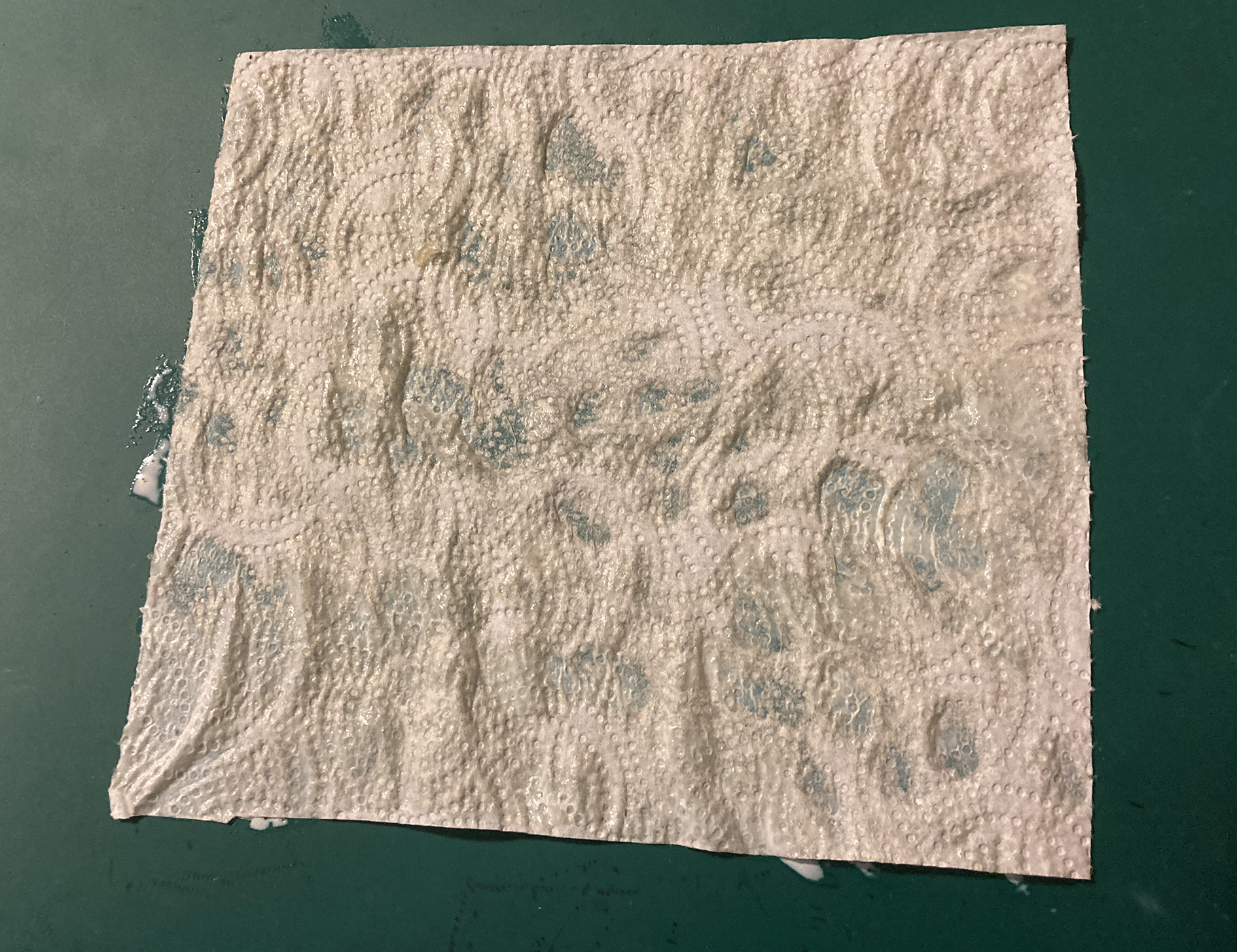
This texture I keep mentioning is "chunks-o-flesh", a favorite thing among many a special effects makeup expert. You basically take a sponge, soak up some latex, and paint it out on a neutral, non-absorbant surface. You let it dry and then rough it up with your fingernails until the layers turn into something that looks like a fishing net. You can then pull the latex off the surface and the spongy rubber texture can be applied to make fake wounds, stringy flesh for zombies to chomp through, or, as in this case, to make a puppet look like it's covered with strange organic textures. I tinted the latex a dark green before using it. For zombie flesh, you'd tint it red.


The finished puppet turned out pretty okay. The chunky flesh texture bits were attached using liquid latex as a binding agent, and the whole thing was dry-brushed with several light layers of differently tinted latex. The eyes are two scrapbooking pearls that reflect the light cast on them.


The teeth were made from tissue paper dipped in latex. I hope I managed to pull off a character that has both the feel of a malignant nature spirit as well as a Bigfoot flirtation.


Swamp monsters have been around for a while, mostly in comics. The Heap was first out during World War II. He was a heroic character and was followed in that same vein by two more well-known monsters.


I'm of course talking about Marvel Comics´ Man-Thing, and DC Comics´ Swamp Thing. A comparison between my monster and them is inevitable, though none of these were at the forefront of my mind while building the puppet. The original version of The Heap is in the public domain, by the way. I might do something with that character eventually.


Tuesday, October 3, 2023

Hunter of Hyperborea

I can't recall where the idea for "Hunter of Hyperborea" came from, but the general notion was to make a film starring a hunter or a hero who recorded his successful exploits and clearly lied about the whole thing. I already had a bunch of prehistoric creature puppets, some of them not featured in films posted on my YouTube channel, and that kind of decided the plot. 


Instead of posting the same info twice, I'll just post links to older blog posts detailing the making of the puppet in question. Regarding the "terror bird," it was featured in a film called "The Age of Invention", made with my special needs people film group, and that film isn't posted on my YouTube channel. You can read about that puppet HERE.


The mammoth (there's just a single puppet) was also built for "The Age of Invention," and you can read about making that puppet HERE.


The big yeti-like ape monster was made for a film that is on my YouTube channel; "In the Ooze of Ubbo-Sathla." This puppet was only very briefly featured in that film, so I thought it deserved to have another go. I added a little horn to its forehead in a nod to both "Trog" the giant Neanderthal in Ray Harryhausen's "Sinbad and the Eye of the Tiger" as well as the "orangopoid" from the 1936 "Flash Gordon."
You can read about the making of this puppet HERE.

So, over to the puppet that was actually built specifically for this project, namely our hero, the hunter of the title. 

The character was sculpted in medium-grade Monster Clay (well, the head and neck.) I tried to make him look meek and maybe a bit comical.


After creating a hard dental plaster mold over the sculpture, I cast a copy of the sculpture as a latex skin. The eyes are made from small plastic fake jewelry pearls, placed in sockets made from silicone clay. Since this puppet was fairly small -about six inches tall- I only used single 2 mm aluminum wires for the armature. 3 mm threaded nuts are attached to the feet with a mix of super glue and baking soda. A 3 mm t-nut was also stuck to the puppet's behind so I could attach him to my flying rig for certain scenes. 


The body was padded with a wrapping of very thin and soft polyurethane foam. Fingers were made with crochet yarn wrapped around aluminum wires and dabbed with tinted latex. And also, he got some hair.


I used crepé hair for the beard and hair. It's sheep's wool boiled and tufted, then braided. Stage productions use it for fake beards and mustaches on actors.


Liquid latex was used to glue down the hair, one tuft at a time. To press down the hair I use a dental spatula tool.


To make the application of eyebrows easy on such a small puppet I simply painted them on.


The clothes of our hunter are actually based on what Ötzi the Ice Man was wearing. So I'm beginning with giving him a linen diaper-like loincloth. this is made with tissue paper dabbed with latex.


The rest of his clothes would be made with leather -or, rather, small bits of latex cast in a texture mold.


The hunter's tunic is made from thicker leather and I resorted to using the thin foam I wrapped the armature in. These are washing pads I bought at a local drugstore.


To make "leather" out of the foam I soaked each patch with tinted latex, applying the latex with a piece of foam sponge.


The shoes were also made from these foam pads.


Apparently, during at least a part of the Neolithic age, nobody wore pants but rather used leg hoses, like many native American people. 


Our hero is equipped with three spears made from simple wooden flower pins.


I roughed up the surface on each pin by rubbing it against a coarse abrasive pad so it'd look a bit more worn and hand-made.

The flint spear points were simply made from scrunched-up tin foil and then painted with hobby paints.


Of course, he'd need some cool hunting trophy so I made a claw necklace from plumber's epoxy and a bit of flexible garden wire.

The hunter would be wearing a rather makeshift deer skin disguise, which apparently was a thing according to established archeology. I made two small horns from tissue paper and latex.


The actual deer skin was a piece cut from an old winter hat made from short fake fur. I added a 1 mm aluminum wire along the edge of the skin, so I could animate it flapping and folding when the hunter was making fast movements.


So, here's our finished protagonist. I also made a flint knife from tin foil, but I can't recall if I ever used it. It was a while ago since I made the film, or even watched it. It seems my little stone-age drama was well-received on YouTube. People got the joke at the end. I used the word "Hyperborea" in the title mainly because it had a suitable pulpy connotation. My hunter had adventures not unlike those endured by hardier heroes like Conan the barbarian, but without any of the success of a legendary champion. The moss he eats at the end of the film was plucked from a branch on a very old oak tree standing at the edge of my garden.


Thursday, August 31, 2023

Hello?


Like last month's post, this entry is about a project that started off as a YouTube shorts project, until I rejected that idea. In the end, I ended up just making a very short, silly video. 


My inspiration for the ghost in the film was this Victorian illustration. I have no idea where it's from but it's included in a huge book on supernatural literature, which I've had for years.


I sculpted the face in medium-grade Monster Clay on a flat slab of aluminum and did all the rest: a plaster mold of the clay and the casting tinted latex into the mold. The chest area was cast in a mold created many years ago for the demon in my film "Memory."


I wanted striking eyes for the puppet since it would only be on screen for a very short bit. I picked a couple of semi-transparent plastic pearls, for a sort-of luminous effect, and reamed a concave surface into each pearl to create a lens effect. The eyes were detailed with acrylic airbrush paints painted on with a thin brush. UV resin was then added to create the actual lens effect.


I wanted the arms to be really spindly and skeletal, so they were built up with thin metal rods folded over and covered with soft crochet yarn soaked with latex.


When the puppet parts were assembled the whole thing was attached to a wooden rod, one of those you stick into a flower pot to support a floppy plant. Thermoplastic was used to hold it all together.


The flimsy garment of the ghost / dead thing was made with kitchen tissue paper soaked in latex. I then simply cut pieces from it and pressed them together. the sticky surface of the paper as a bonding agent.


So, here's the finished ghost. The arms, the neck, and the jaw were the only articulated parts of the puppet. the hair was made from crepé hair (sheep's wool used for fake beards.)


The second puppet in the film is the man who walks by the cave and engages in conversation with the ghost. This is actually a very old puppet, built at the end of the 1990s. It's still holding up, barely. The latex is really dry and brittle but the clothing and the armature are fine. As you can see he hasn't got any real feet because for the film he was originally built, he doesn't show his feet. I didn't make any tie-downs back then, I just clamped the puppet down on a tabletop with a small glue clamp.

Some of my YouTube viewers were disappointed that the film was short and thought it was just "gimmicky." Others thought the film was fun. It was an interesting experiment.