Saturday, March 9, 2019

The Ballad of the Gods


Here's another adaptation of a Weird Tales poem, this time by a very young Henry Kuttner (20-something when this was first published). Kuttner went on to pen some major and minor classics in the field of fantastic literature, often in collaboration with his wife C L Moore under the pseudonym of Lewis Padgett. Moore was also a great author in her own right, writing tales like the oft-anthologized "Shambleau".


"The Ballad of the Gods" seems to exist in its own universe, but it certainly has the same feel of doom and gloom as Lovecraft's tales and some of Robert E Howard's prehistoric adventure stories.


For my own sake, it offered me the opportunity to do my own living statue piece; a sort of cliche in stop-motion history. Best known is probably Ray Harryhausen's bad-tempered bronze giant Talos, from "Jason and the Argonauts", but there are more examples from later films like "Dungeonmaster" and Harryhausen's own "Golden Voyage of Sinbad."


Let's start with the feared primal deity Jubbodar-Thool. When you read the text he seems to be made of mostly stone, or at least "his head is carved from a weathered rock." Though the head was always going to look very simply made, I wanted the best control of its look I could get, so I sculpted it in Monster Clay and created a plaster mold for it.


The puppet has a plain aluminum wire and thermoplastic armature. I’ve used very thick wire here to make the armature extremely sturdy. It’ll have quite a volume of rubber to push against when animated. To build up light weight bulk on the puppet body I attach dense but light foam using hot melt glue. The foam shapes are trimmed and softened down. Fingers and toes are fleshed out with soft string, which is later soaked in latex.
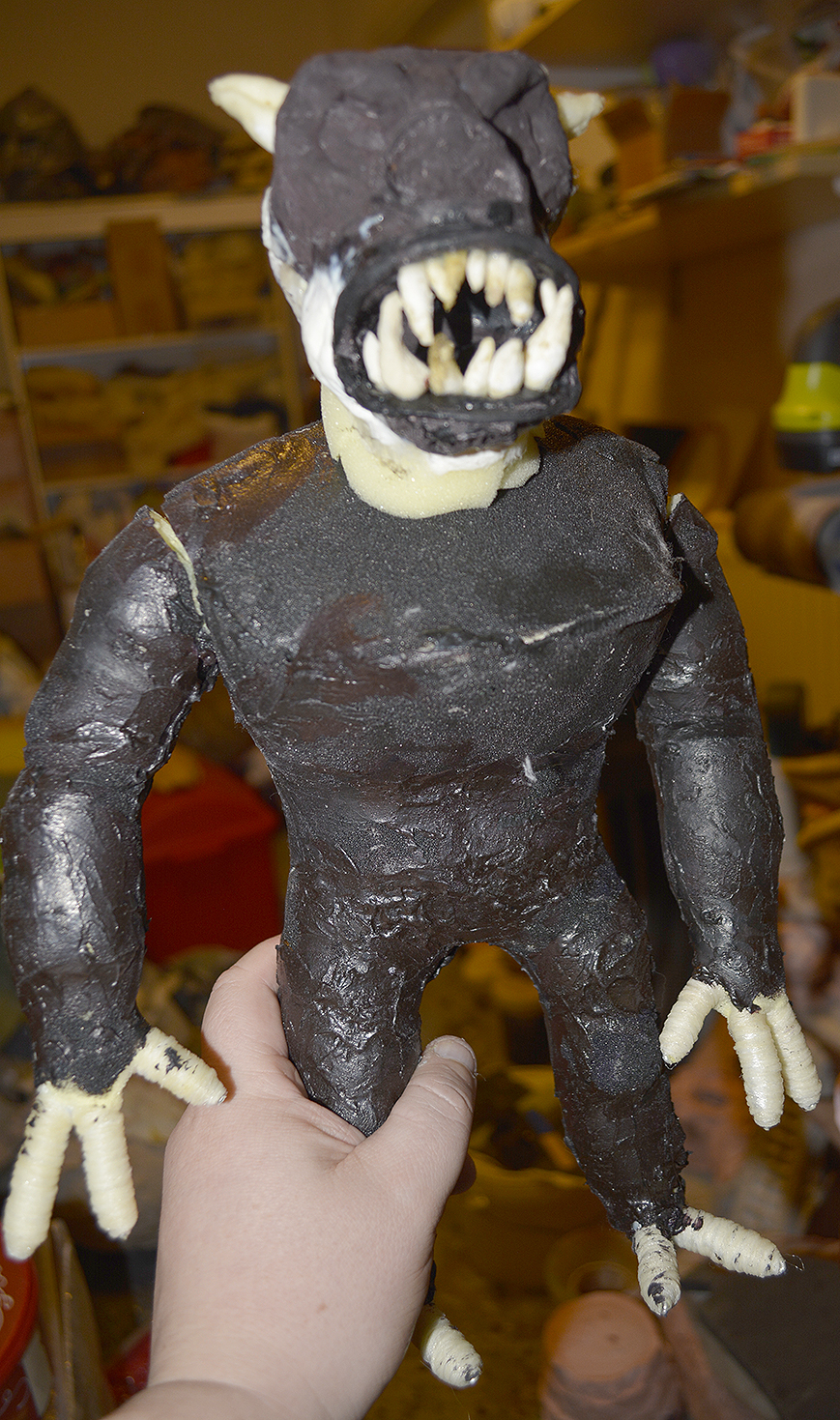

The rough shapes of the torso was created with very soft cushion foam. The shape of the limbs was defined by wrapping thin strips of foam around them. I’m using contact cement to stick all the foam bits together. The latex cast of the head was given support on the inside with thermoplastic, plus a jaw joint and a neck attachment point created using aluminum wires. I trimmed the foam body buildup a bit, and then I actually added a layer of tinted latex with a thickening agent added. Which means I could apply the latex like a layer of butter. It’ll soak into the foam a bit, but really only enough to attach to it.

My inspiration for the look of Jubbodar-Thool is actually the bulky monsters of Marvel artist Jack Kirby. So in line with his aesthetics I had to add some snaggly big teeth. Those are made from latex and cotton. I also added a few small horns using the same materials. My idea was that these pieces might be carved from real bone or ivory and attached to the statue.


The actual stone texture was made from bits of latex cast in an old plaster mold. I made this mold way back when working on my all-stop-motion video adaptation of Tolkien’s poem the Mewlips. 
This texture was a dungeon wall where the Mewlips sit and count their gold. Piece by piece the puppet was covered with this patchwork of stone blocks, using liquid latex as a glue.


Jubbodar-Thool's big nose is, apparently, "the trunk of a tree", which I made by simply adding cotton dipped in latex over a bit of carved hard foam.


Painting the puppet, I’m first giving it a unifying layer of tinted latex. Then various different shades are dry brushed on. I decided to give the puppet an additional patchwork look by adding various metal clamps, applied to the statue as it started falling apart with age. I had an old plaster mold with various sculptures  of that kind of stuff, so I cast a few copies of those, and stuck them to the puppet using very strong super glue.
Lastly I put a rubber horn on his chin and added a pair of dark bronze-colored pearls to his eye sockets, so you could see something glinting in there, reflecting light.


To make the joins between the rocks in the statue's body glow during animation I filled them out with blue chroma key paint, which allowed me to remove the blue and mask in lava-like textures behind the puppet in After Effects.


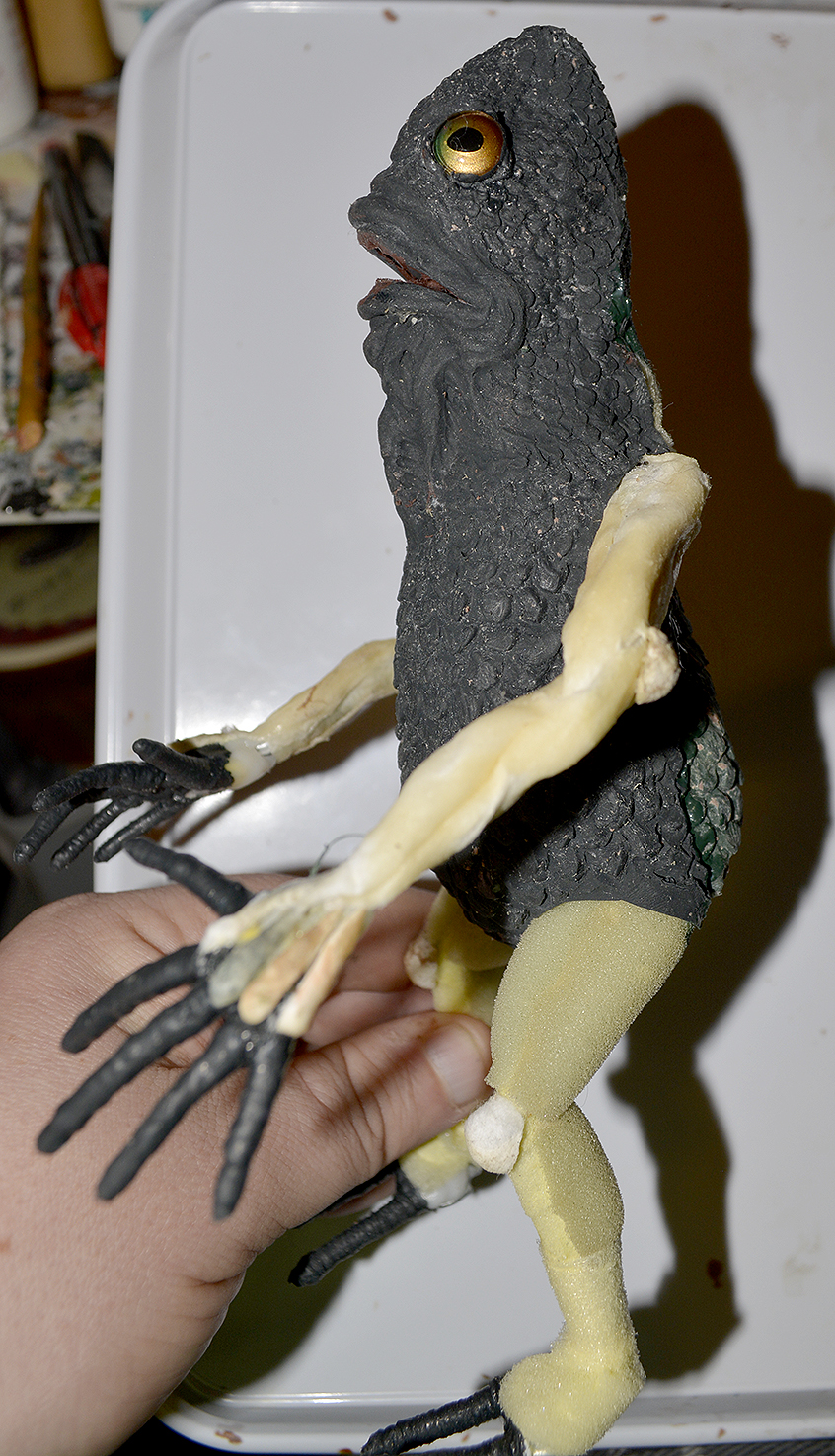
Now on to the fish god Vake, who makes a very brief appearance in the film. This puppet is mainly inspired by the Sea Bishop, which was supposedly a merman creature fished out of the Baltic Sea in the 16th century. 


 I started off with sculpting the body in medium grade monster clay. I used a pair of professionally made acrylic taxidermy fish eyes and implanted those in the sculpture. I wanted to make the look of this character kind of ornate, not necessarily organically realistic, but rather like a living representation of an old illustration or wood cut. Which meant adding scales that were slightly exaggerated. Now, there is a tool you can get, or make yourself, which is used for sculpting scales. And the results look great, except for that you can’t really vary the size and shape of the scales. In order to have that freedom you have to sculpt them individually. Some might balk at that thought, but it’s not really that hard or time consuming, and the result is totally worth it. So I’m using one of my loop tools to carve out the scales. Then I’m using a pipe cleaner dipped in Vaseline to smooth out the rough edges. 


A dental plaster mold created over the sculpture is used to cast the skin of the body in tinted latex. A piece of aluminum wire allows the jaw to be animated. The acrylic eyes are stuck to the inside of the head with thermoplastic, which also fills out the head and creates a skull. A simple aluminum wire armature was covered with soft polyurethane foam for the padding of the body, and strips of cotton dipped in latex for the arms and legs.


I wanted a different scaly texture for the arms and legs and so I needed a new texture mold for those. To create this mold I sculpted the scales in reverse by making imprints in clay with a sculpting tool. This is actually an old technique used by ace animator and puppet builder Jim Danforth. When the texture is finished I apply plaster to the clay to create a positive from my negative sculpt. The first layer goes on, as usual, very carefully, and the rest of the plaster is dumped on top of that. Now I need a new negative mold to cast my latex skins in. Danforth simply used another plaster layer, with a generous application of release agent. However, I prefer to make a mold over the plaster cast using a dental silicone putty.  Tinted latex was then sponged into the mold.

The webbing between fingers and toes was created by sticking flat bits of clay to the underside of the limbs, and tinted latex was then filled in between fingers and toes. he same was made for the gills, except that they weren't attached to the puppet first. Bits of cotton and latex rolled into pointy pieces were pressed into clay and skin was built up just like with the webbing.


My reliable buddy Martin Merkel was pressed into action for another video project, here playing the hapless protagonist who has abandoned his father's gods.


All of the shots with Martin were actually filmed in the upstairs hallway of my home in front of a TINY greenscreen. Somehow we made it work. Martin is a historical reenactor and has a bunch of stuff from different time periods. To this project he brought a hand made leather shirt, a Viking short swords and other bits and bobs. To create a, kind of, pulpish fantasy look I hanged a fake fur toga over him. The wig is actually made from human hair and was a bargain on the Swedish equivalent of eBay.
Backgrounds were my usual hodgepodge of Photoshopped photos from various sources, mainly Depositphotos and Wikimedia.


There are a lot of hidden treasures in the old pulp magazines, and an astonishing amount of the material is now in the public domain. My aim is to keep digging up poems and stories that I can manage to adapt into my YouTube videos. Much of it is pretty unsophisticated when viewed according to today's standards, but there's also a lot of inventiveness and wonder to be enjoyed.

Thursday, February 28, 2019

Troll Hill

It's been a while! I haven't posted anything here since November last year, simply because I've been over-busy with all sorts of things, mostly my two day jobs. But stuff is in the pipeline. You can expect more posts the coming weeks. Now over to a film I did last year.


"The Troll Hill" is based on a local folktale which is typical for how trolls behave in Swedish folklore. It was actually made for one of my day jobs, an educational centre where I produce videos on a number of subjects.


I recruited my pal Andreas Nordkvist to lay the hapless farmhand who gets kidnapped by the trolls. We went out into the woods to film on the Eve of Midsummer, no less; the biggest holiday in Sweden bar Christmas. It was the hottest summer in Sweden -ever, so we were absolutely broiled. Luckily for us a cool breeze made the maneuver bearable.


I used a bunch of puppets that are getting on a bit. The fact is some of them are by now 20 years old and quite brittle. Those that didn't stand up for any manual animation were simply manipulated in After effects using the puppet tool. A bit of a cheat, but it allowed me to finally put some of these previously unused puppets in a film.

I'll probably do more folklore-themed films later this year; I hope you'll like `em :)

Saturday, November 17, 2018

The Fisherman and the Genie


If you're familiar with the Tales of the Arabian Nights, then you probably know this story. This film was made for my day job at an educational organization, and it had a very short production history, about one week from conception to filming, which meant that I had to hurry up creating both the genie bottle prop as well as the genie itself.


Let’s start with the bottle. It’s supposed to be a copper bottle, according to the Arabian Nights tale upon which this film is based. In fact, it is a squirt bottle for showering plants, and the worst thing about making this prop was probably removing the paper label on the bottle. It took quite some time, and a lot of scrubbing.


The bottle is decorated with various ornaments. They all came from molds made from sturdy dental silicone clay. I’m using my Polymorph thermoplastic to make castings in these molds. The plastic is melted using a heat gun, and then simply pressed into the molds. After a little while the plastic has cooled down and can be pried out of the mold.  All of these bits are stuck on using very fast super glue.


Since the bottle has been lying in the ocean for a few hundred years I thought it would be nice to add some barnacles to the bottle as a detail. Those barnacles were sculpted in clay and a DragonSkin silicone mold was made over them.


Into this mold I added hot melt glue, which is probably the fastest, cheapest and at the same time sturdiest casting material out there. I just let the glue sit in the mold, which isn’t damaged by the hot glue. And when the glue had cooled I just popped the barnacles out. Of course, I had to trim off all the excess glue with a pair of scissors.


This is the cork for the bottle, adorned with the magical seal of Solomon, scourge of demons and genies. I made a mold from an old amulet I have, actually sporting this seal, and did another casting with the Polymorph plastic. It’s attached to the top of a container for those tubes of effervescent tablets you dissolve in water when you have a headache.


This cork fits nicely into the squirt bottle top, but that top doesn’t look right at all, so I had to cover it up. I didn’t have any epoxy at home, so I did a clay sculpt and then created a silicone mold over that. More Polymorph was used to cast the new bottle opening.


The bottle was first given a coat of copper spray paint, then a layer of grayish green acrylic paints, and then another layer of copper, dry brushed on. And that’s about it for the bottle.


On to the genie. The genie in the bottle was played my my old buddy Martin Merkel, who’s used to be made up as orcs and other creatures appearing in live action fantasy roleplaying.


I didn’t have time to sculpt a new genie mask, so I actually used an orc face mask mold I made several years ago. I added tinted latex to the mold using a bit of polyurethane foam. For areas requiring more delicate detailing I used a q-tip and a pipe cleaner. To speed up the curing of the latex I used a hair drying on its highest setting. I added three layers of latex to this casting, not in every area, but on the deeper spots needing to be more sturdy, like the eyebrows and the cheekbones. The edges which will be glued down, are, of course, as thin as I dared make them. As you can see the skin color is a deep reddish brown. This will not be the skin color of Martin when I’m finished making him up, but this dark color will be a very good base upon which I will add the makeup. 

I also cast a pair of large pointy ears and a chin piece.


I wanted the genie to have horns, as they often do both in old picture books as well as in old Arabian manuscripts. The horns had to be very light, and, again, made very fast. What you see in this image is actually a Velociraptor claw I made some years ago, cast in plastic. I simply built up the horns over this claw using tinted latex and cotton. I added about two layers of this latex-cotton mixture, and let it dry properly. I then cut a slit along the inside of the curve of the horn and peeled off the latex skin like a banana peel. The latex skin was glued together again using latex, and the horn was stuffed with cotton.


The fingernails were very simply made. I used an old plaster texture mold, adding tinted latex to it and then a few layers of tissue paper, laminated with more latex. When this concoction had dried I could peel it off the plaster mold and cut these kind of witchy fingernail shapes. They bend if you touch them, of course, but for these shots I wouldn’t have to worry about that.


I also wanted to add some bony horn structures to the elbows and shoulders of the genie. I used these, which were actually leftover horns for a big dragon’s head I helped build for a stage production. They were made the same way as the other horns, kind of. They were built up over clay shapes.


 Martin in my kitchen, ready to have genie bits stuck on.


 A latex bald cap, and the ears go on first. I use Prosaide cosmetic adhesive to glue down the rubber parts. The white stuff you can se smeared over the edges is Prosaide mixed with Cabosil powder. It creates a butter-like substance which is diluted and adjusted simply with saliva on a finger, and it covers the edge between latex appliance and skin.


 The face piece and the chin attached.


The horns are glued to the skullcap using liquid latex. The other horn bits also go on, including the nails, which are glued on over Martin’s own nails using the Prosiade.


Finally, the skin and the rubber bits are given a coat of rubber mask greasepaints, various hues and some rouge effects are added. The reddish brown base color now helps add some depth to the face.


So there you go, a budget version of the mighty djinn, but in the end I think it turned out OK. Latex compared to foam latex or silicone is an inferior mask material, of course, but you can still go quite far with it. Think about all this classic Doctor Who makeups, mostly created by John Friedlander with liquid latex cast in plaster molds. I think some of them, like Davros, are still very effective.


Filming the djinn was a very simply set up. We filmed outdoors in the soft evening light. I used a fold-out greenscreen stuck to my garage wall. Martin was standing against it, shot from the waist up. The natural color of Martin's skin was adjusted to a purplish red in After effects, and a digital plug-in tool called "Ugly Box" was used to make his skin appear mottled and wrinkly.


 What about the fisherman, then? He was played by Staffan Bonnedal, an avid participant in local stage productions. I've worked with Staffan in a few of them and figured he'd make a great older-looking poor fisherman, and he did. We shot all of his scenes on a small stretch of sand beach not far from my work. This particular day was quite warm (early June) and the beach was full of people, kids and dogs, although it was in the morning on a regular work day.


To get rid of the busy setting behind Staffan we employed a green screen, which was easier said than done, since it was also a very windy day. I held up the screen with a the aid of a temp trainee named Sandra, and my colleague at my day job, Ola Nilsson, shot all of Staffan's scenes.

That's it for "The Fisherman and the Genie". Though it was all pulled together quickly it was great fun to make, and my plan is to make more folklore- and mythologically-inspired videos the coming year. If time, funds and health allow that remains to be seen.