The subject for this little film had been on my mind for many years, namely to use a woodcut describing "imps", witches' familiars, as a template for stop-motion puppets.
I am, of course, thinking about the famous woodcut featuring witchfinder general Matthew Hopkins and two of his victims-to-be. The presumed witches are parading a pretty impressive lineup of servitor demons in various animal shapes, some more bizarre than others. The names of these imps were pretty cool too.
Lets' start with Sacke & Sugar, which is actually just the one creature. In the woodcut, it's apparently a black rabbit of some kind. I went with a zombie rabbit kind of thing instead. This little monster has an exposed skull, which I sculpted in medium grade Monster Clay. The skull and the jaw are separate.
Both parts of the skull were replicated in Rhino casting plastic from two DragonSkin FX silicone molds (after cleaning out the clay).
The aluminum wire skeleton has a pair of t-nuts in its feet, with bits of harder wire lashed to the aluminum wires using yarn, creating the "bones" of the skeleton. An aluminum wire also goes into the jaw.
Since most of the puppet would be covered by fake fur I didn't have to spend too much time on shaping the foam padding into exact muscle replicas. General shapes were quite adequate. A latex cast of a mummified-looking chest sculpted for another puppet was re-used. To create bits of shredded, dried tissue I simply rolled up thin skins of tinted latex sponged out over a plastic tray, the so-called "chunks-o-flesh" method. The insides of the ears were simply made by carving negative shapes into clay with the end of a paintbrush and then adding tinted latex into those shapes. The eyes are German-made taxidermist's glass eyes (don't know what animal they're supposed to be used for.
The fur I used was also used for the puppets in Empire of the Robot Monsters and is a short-haired synthetic fur attached to a slightly elastic fabric, which means that it will stretch slightly when animating the puppet.
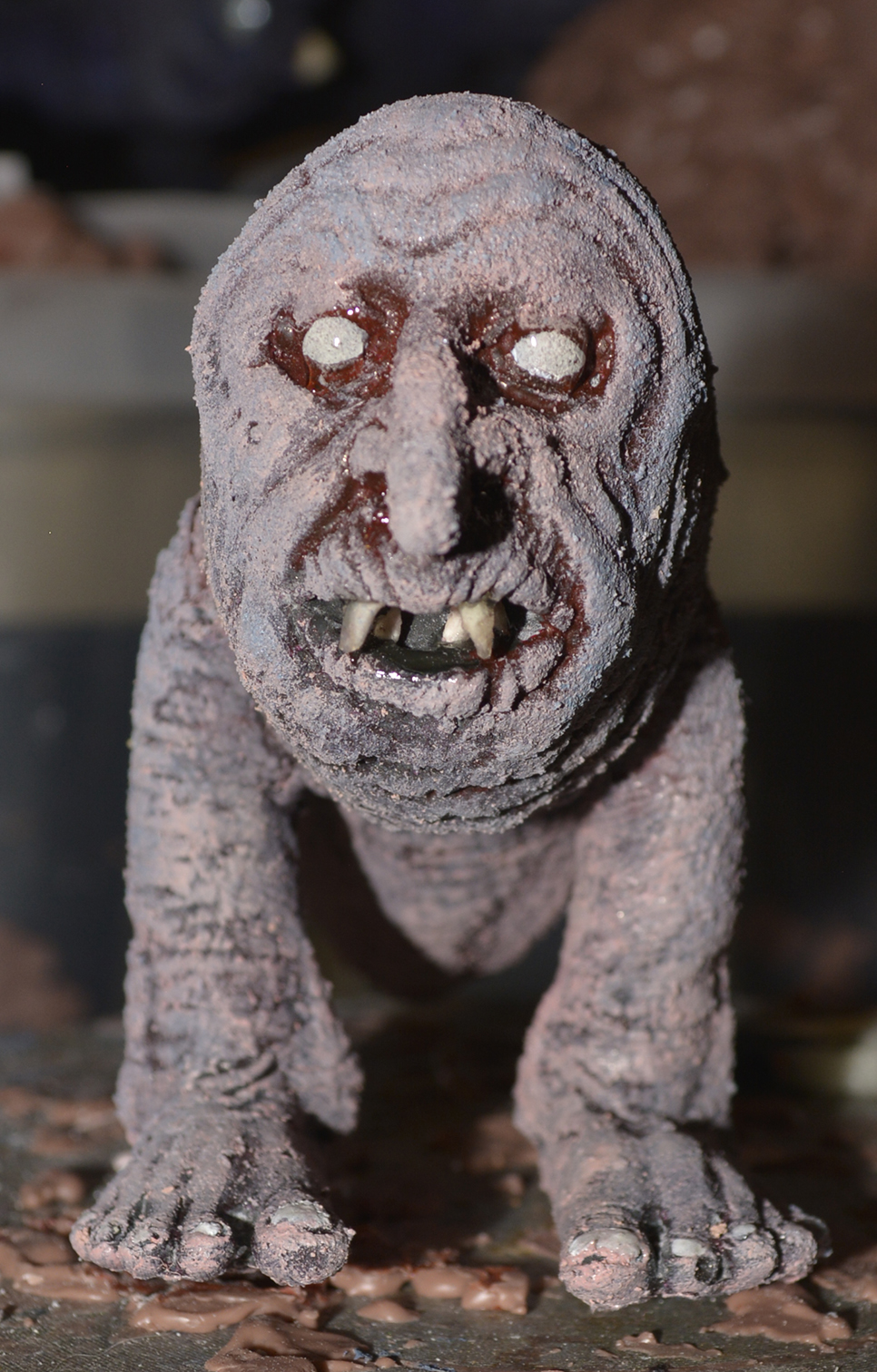
Greedigutt isn't pictured in the woodcut but Imagined it as a dwarfish Hieronymus Bosh kind of creature. The head and feet were sculpted in clay, and then cast in latex from a dental plaster mold.
This little fellow was built in one day, having a very simple body padded with foam. The tail was built up over an aluminum wire using soft yarn.
Patches of latex cast in old skin texture molds covered the puppet. It was given a base paint of reddish-brown using tinted latex applied thinly with a sponge.
A lighter coat of tinted latex was then dry brushed on. White latex pigments helped create a pale skin tone. The white eyes were just painted on, but the lower lip could be animated via an aluminum wire.
Another quickly built puppet (though not in one day) was Jarmara, the caterpillar dog. Actually, in the woodcut, he most resembles a creepy version of Dougal from The Magic Roundabout. It doesn't look like he's got any legs, so I decided that he probably walked like a caterpillar. The only thing I sculpted in clay was his head.
A latex cast of the head, reinforced with a cotton/latex mix, was attached to the aluminum wire skeleton. Aluminum wires were also used for the ears, which were covered with more latex and cotton. More padding with that soft yarn.
Jarmara's head and feet were dabbed with tinted latex and his buggy eyes were another pair of German taxidermy work. Strips of soft foam helped to further pad out the body.
Finally, fake fur from an old had was used to cover up the body. The aluminum wire torso could be contracted and extended to ape the movement of a kind of caterpillar.
The idea for Pyewacket (another imp not shown in the woodcut) was inspired by dancers and contortionists who can bend their hips and legs over their shoulders. It's a fairly impractical way of walking, but it sure looks strange. Another simple aluminum wire armature provided the skeleton. The dark grey blob at the bottom is a bit of dense foam from a camping seat cushion, filling up the chest area, without adding any real weight.
The head was sculpted in Monster Clay..
..While the rest of the body was built up using foam shapes of various densities.
Patches of latex cast in texture molds then covered the foam.
The finished Pyewacket was painted with tinted latex, and detailed with acrylic airbrush paints spattered onto the puppet using a toothbrush. Fake fur from an old jacket collar was glued on here and there using the very strong and transparent Telesis silicone glue.
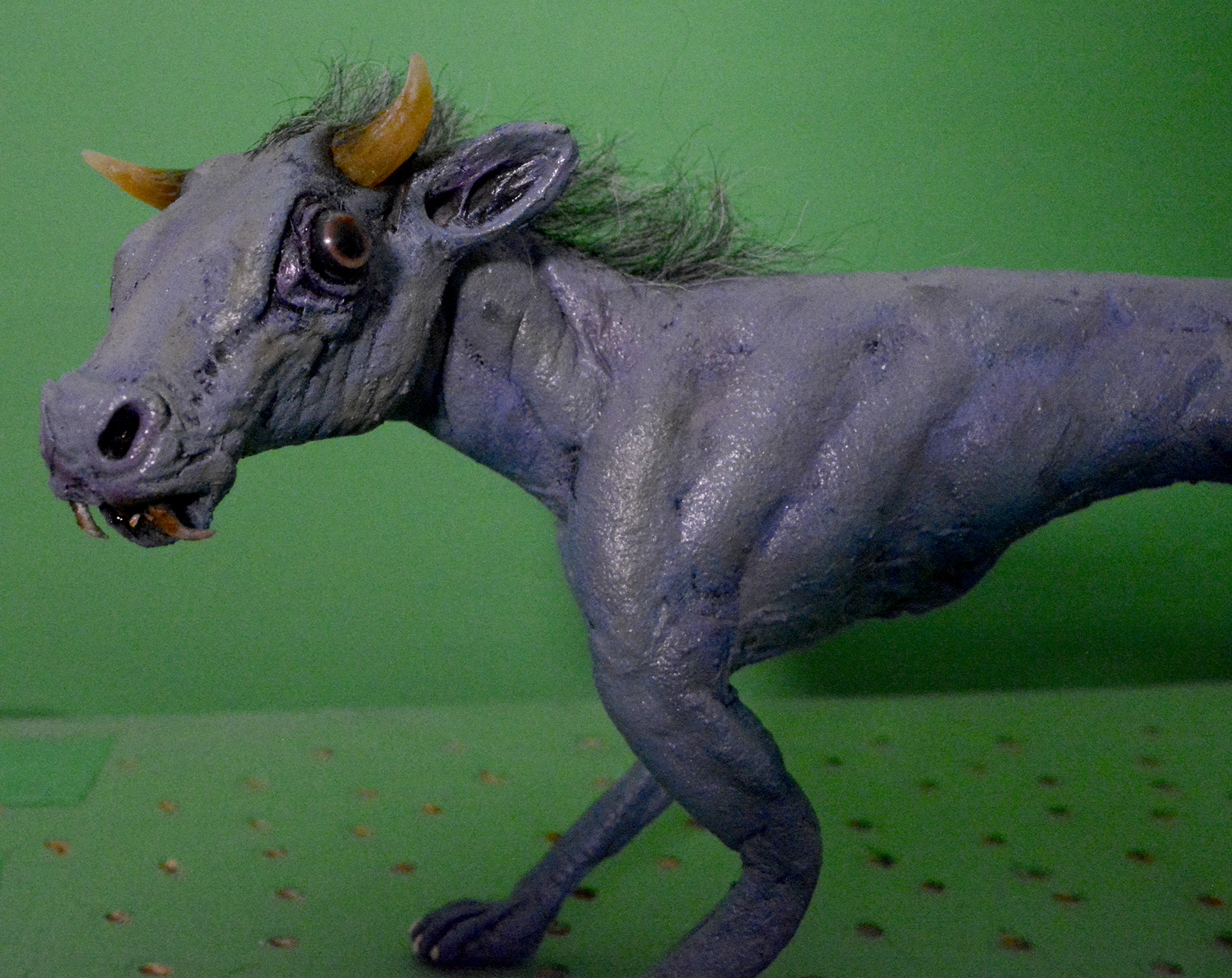
The best-remembered critter from this woodcut is doubtless Vinegar Tom, the strange cow-whippet-thing. The head was another Monster Clay sculpture, using plastic pearls for the eyes.
The horns were cast in latex from an old plaster mold. Small aluminum wires help move the ears and the jaw. The tie-downs I use are usually M4 t-nuts, but for this puppet, I used M3 to make the feet really small.
For Vinegar Tom, I did a pretty intricate foam muscle build-up. I based this on both cow and dog muscle diagrams.
The pearl eyes were used so I could move them around, BUT looking at the woodcut I realized the eyes were simply too small. I simply glued a pair of bigger glass taxidermy eyes over the original pearl eyes, and built up eye sockets around the eyes using cotton dipped in latex. A finely detailed latex skin was added over the foam padding.
More fake fur was used to add a short mane to Tom's neck. Teeth were made from cotton and latex, as were the toes. This puppet was painted with PAX paint (Prosaide glue + acrylic paint) using a sponge, with acrylic airbrush paints adding a bit of subtle detailing.
Grizzle, our last little critter, was basically a scary pig standing on his hind legs. He only appears for a short bit at the end, so I decided to make him something recognizable. There are examples of demonic pigs in religion, folklore, and pop culture, so it seemed a suitable choice. I sculpted and cast both head and torso in latex from a dental plaster mold.
Again, a very simple aluminum wire armature did the job. It's still strong enough and versatile enough to allow the puppet to be used for more projects.
The latex skin was partially padded with thin bits of polyurethane foam. Aluminum wires go into the ears and the jaw. Also, reflective pearls were glued into the eye sockets.
The foam muscle padding was quite detailed, though most of the focus would be on the latex torso, which was attached to the padded body using liquid latex as a bonding material.
Reddish tinted latex was applied as a base paint, with a purple-greyish latex paint dry brushed over that, with strands of fake for added as bristles to the neck, and cotton/latex tusks stuck into the mouth. Saliva and snot were created with Glossy Accents scrapbooking plastic.
That's all about the imps, but what about their mistress. Well, I don't know who she is, because she's just a bunch of stock footage clips from Videoblocks.com, but I'm glad I found her.
All of the film was treated with a couple of filters in After Effects to make the image a bit fuzzy and dream-like. Libby Grant delivered another excellent narration (our previous collaboration was Baba Yaga's Hut). Almost all of the backgrounds were found on Depositphotos.com, where I have a monthly subscription.
Last autumn I discovered the vibrant, funny and slightly irreverent children's poetry of Darren Sardelli. He's both an author of several books but he's also doing lots of work within the US educational system, inspiring kids to start writing. Good stuff, in other words!
Of course, I was mainly attracted to one of his poems called "The Two-Headed Monster." I thought it could become a bubbly, crazy YouTube video, featuring a really weird and goofy stop-motion monster. I contacted Darren and he gave me the go-ahead straight away.
So let's start with the two-headed star of the show because that's what I did. I sculpted the heads and the torso in medium grade Monster Clay, using plastic pearls for eyes. I didn't sketch out or prepare any designs for this character other than I wanted to make it look goofy and maybe a bit scary in the same way that the Mad Hatter and the Cheshire cat from Alice In Wonderland are a bit scary because of their craziness. I applied a mold of dental plaster over the sculpture.
I wanted to make the arms a bit cartoony and bendy-toy-bendy, so this is what I came up with. The balls or bumps that make out the arms are actually yarn wrapped around aluminum wires to create these shapes. The wrinkly skin is bits of latex cast in a skin texture mold.
As per usual this puppet armature is made from bundles of aluminum wires held together with Polymorph thermoplastic. You can see in this photo the t-nut tie-downs in the feet, as well as the spiked ball at the end of the tail. It's made from a paper ball covered with cotton dipped in tinted latex, with cotton/latex spikes attached.
The body didn't have to be all that detailed when it came to the padding. I just wanted it to be lumpy. Thin strips of polyurethane foam were wrapped and glued down over the armature.
Here's the puppet covered up with latex skin pieces, and with the cast torso latex piece attached to the armature and the foam padding. I've also stuffed some cotton balls into the belly.
Here's the final objet d'art. Teeth and claws are also latex, mixed with cotton. The final paint job is achieved with tinted latex, dry brushed on. The plastic ball eyes are simply animated by sticking a needle into the pupil hole and twisted around.
Here's our young hero of the piece, played by Hannes Johansson (reading appropriate literature in the shape of Ruth Manning-Sanders "Monsters.") Hannes is actually placed into a wholly fake and Photoshopped room. Almost all of the elements used to create the backgrounds were stock images downloaded from Depositphotos.com.
In actuality, Hannes was residing in a very simple green screen set-up, which is how all the scenes with actors were shot for the film.
In one shot, Hannes is sitting on the couch that gets eaten by the monster. The couch is a Photoshop printout glued to a bit of stiff card, and Hannes is cut out from his green screen environs and stuck to the couch by manual tracking in After Effects. There is a semi-automatic tracking tool in AE, but I've only made it work satisfactorily once.
The shot where grandpa (Andreas Pettersson) gets his hat plucked off his head was another blend of interaction and animation. Hannes' mom Martina stuck her arm into a green bodysuit and snatched the hat away. In After Effects her hand was keyed out and replaced with the monster's animated hand.
All the stuff the monster eats was made the same way as the couch: It's all Photoshop printouts glued onto thick bits of card. When the monster eats I just snip off bits of the image with a pair of small sharp scissors.
One thing is not made from paper, though, namely mom's cooking. That peculiar dish is a bit of oil-based clay animated like a shapeless blob flying into the monster's mouth.
I'd like to adapt more of Darren's fun poems for kids, although I can see that my videos made for a younger audience won't reach the kind of viewing numbers my Lovecraftian and pulp horror pieces get. But it's an area that's almost unexplored by me and I believe I can achieve some entertaining and imaginative stuff in that department too.