Showing posts with label richard svenssson. Show all posts

Saturday, March 9, 2019

The Ballad of the Gods


Here's another adaptation of a Weird Tales poem, this time by a very young Henry Kuttner (20-something when this was first published). Kuttner went on to pen some major and minor classics in the field of fantastic literature, often in collaboration with his wife C L Moore under the pseudonym of Lewis Padgett. Moore was also a great author in her own right, writing tales like the oft-anthologized "Shambleau".


"The Ballad of the Gods" seems to exist in its own universe, but it certainly has the same feel of doom and gloom as Lovecraft's tales and some of Robert E Howard's prehistoric adventure stories.


For my own sake, it offered me the opportunity to do my own living statue piece; a sort of cliche in stop-motion history. Best known is probably Ray Harryhausen's bad-tempered bronze giant Talos, from "Jason and the Argonauts", but there are more examples from later films like "Dungeonmaster" and Harryhausen's own "Golden Voyage of Sinbad."


Let's start with the feared primal deity Jubbodar-Thool. When you read the text he seems to be made of mostly stone, or at least "his head is carved from a weathered rock." Though the head was always going to look very simply made, I wanted the best control of its look I could get, so I sculpted it in Monster Clay and created a plaster mold for it.


The puppet has a plain aluminum wire and thermoplastic armature. I’ve used very thick wire here to make the armature extremely sturdy. It’ll have quite a volume of rubber to push against when animated. To build up light weight bulk on the puppet body I attach dense but light foam using hot melt glue. The foam shapes are trimmed and softened down. Fingers and toes are fleshed out with soft string, which is later soaked in latex.
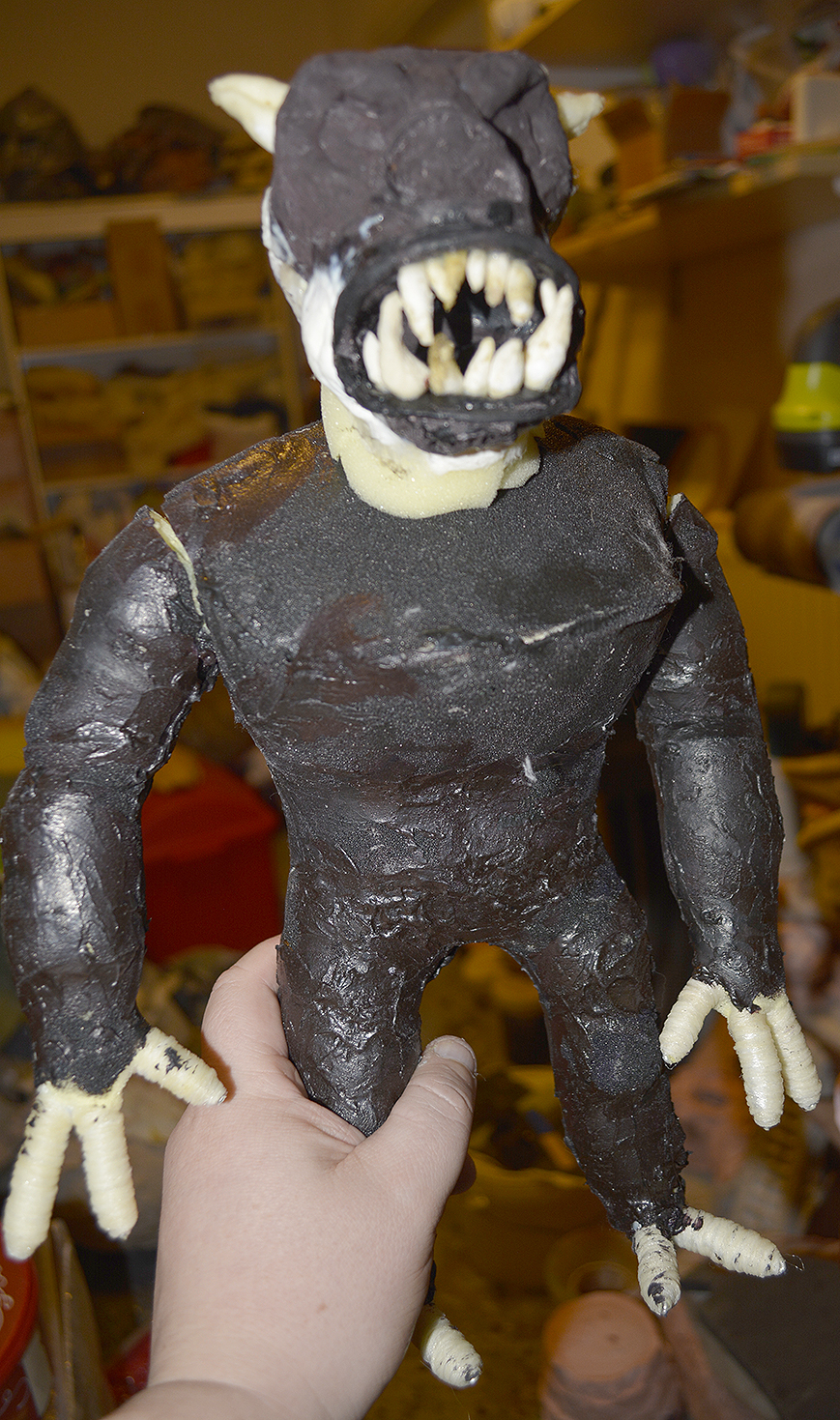

The rough shapes of the torso was created with very soft cushion foam. The shape of the limbs was defined by wrapping thin strips of foam around them. I’m using contact cement to stick all the foam bits together. The latex cast of the head was given support on the inside with thermoplastic, plus a jaw joint and a neck attachment point created using aluminum wires. I trimmed the foam body buildup a bit, and then I actually added a layer of tinted latex with a thickening agent added. Which means I could apply the latex like a layer of butter. It’ll soak into the foam a bit, but really only enough to attach to it.

My inspiration for the look of Jubbodar-Thool is actually the bulky monsters of Marvel artist Jack Kirby. So in line with his aesthetics I had to add some snaggly big teeth. Those are made from latex and cotton. I also added a few small horns using the same materials. My idea was that these pieces might be carved from real bone or ivory and attached to the statue.


The actual stone texture was made from bits of latex cast in an old plaster mold. I made this mold way back when working on my all-stop-motion video adaptation of Tolkien’s poem the Mewlips. 
This texture was a dungeon wall where the Mewlips sit and count their gold. Piece by piece the puppet was covered with this patchwork of stone blocks, using liquid latex as a glue.


Jubbodar-Thool's big nose is, apparently, "the trunk of a tree", which I made by simply adding cotton dipped in latex over a bit of carved hard foam.


Painting the puppet, I’m first giving it a unifying layer of tinted latex. Then various different shades are dry brushed on. I decided to give the puppet an additional patchwork look by adding various metal clamps, applied to the statue as it started falling apart with age. I had an old plaster mold with various sculptures  of that kind of stuff, so I cast a few copies of those, and stuck them to the puppet using very strong super glue.
Lastly I put a rubber horn on his chin and added a pair of dark bronze-colored pearls to his eye sockets, so you could see something glinting in there, reflecting light.


To make the joins between the rocks in the statue's body glow during animation I filled them out with blue chroma key paint, which allowed me to remove the blue and mask in lava-like textures behind the puppet in After Effects.


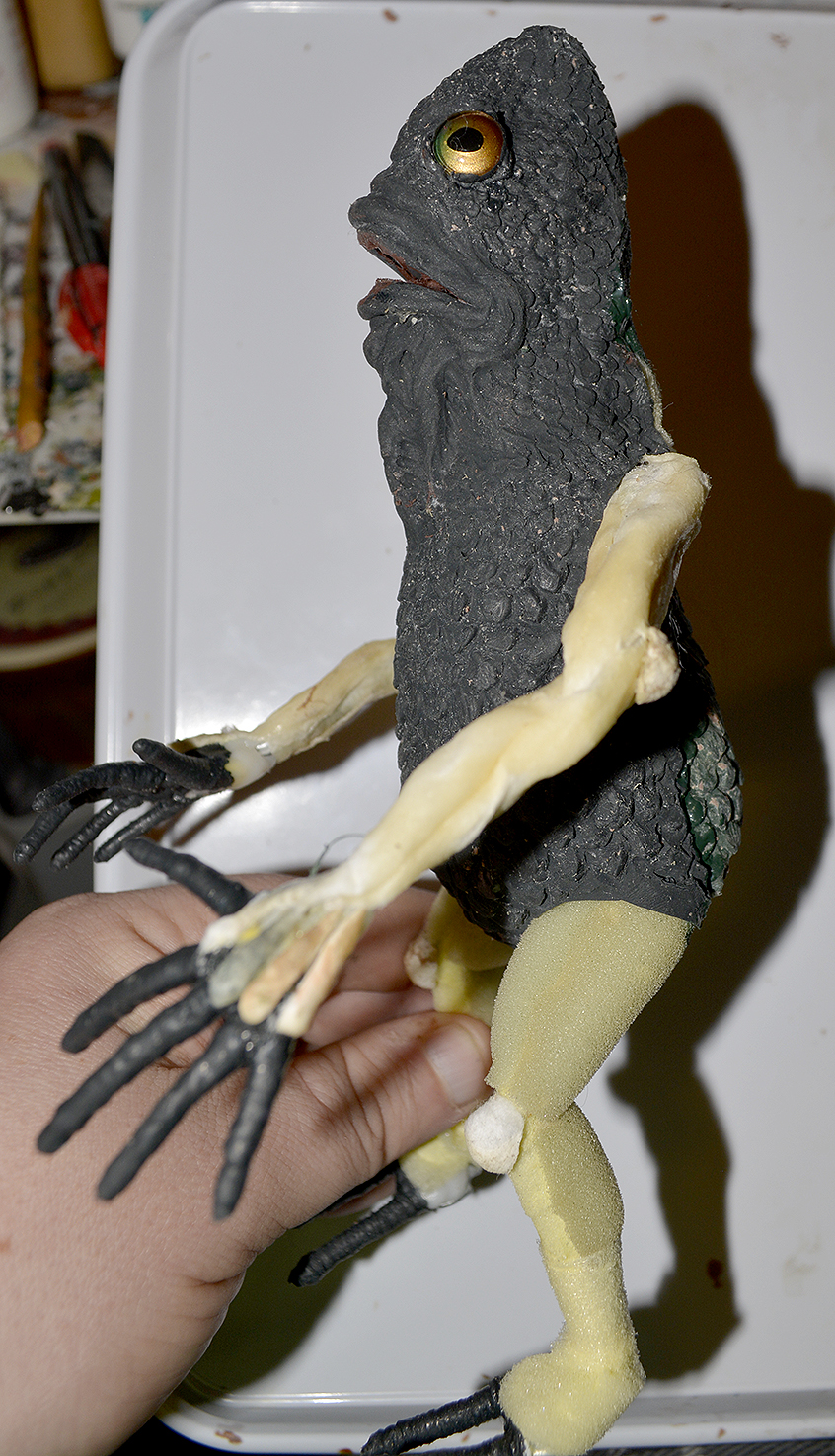
Now on to the fish god Vake, who makes a very brief appearance in the film. This puppet is mainly inspired by the Sea Bishop, which was supposedly a merman creature fished out of the Baltic Sea in the 16th century. 


 I started off with sculpting the body in medium grade monster clay. I used a pair of professionally made acrylic taxidermy fish eyes and implanted those in the sculpture. I wanted to make the look of this character kind of ornate, not necessarily organically realistic, but rather like a living representation of an old illustration or wood cut. Which meant adding scales that were slightly exaggerated. Now, there is a tool you can get, or make yourself, which is used for sculpting scales. And the results look great, except for that you can’t really vary the size and shape of the scales. In order to have that freedom you have to sculpt them individually. Some might balk at that thought, but it’s not really that hard or time consuming, and the result is totally worth it. So I’m using one of my loop tools to carve out the scales. Then I’m using a pipe cleaner dipped in Vaseline to smooth out the rough edges. 


A dental plaster mold created over the sculpture is used to cast the skin of the body in tinted latex. A piece of aluminum wire allows the jaw to be animated. The acrylic eyes are stuck to the inside of the head with thermoplastic, which also fills out the head and creates a skull. A simple aluminum wire armature was covered with soft polyurethane foam for the padding of the body, and strips of cotton dipped in latex for the arms and legs.


I wanted a different scaly texture for the arms and legs and so I needed a new texture mold for those. To create this mold I sculpted the scales in reverse by making imprints in clay with a sculpting tool. This is actually an old technique used by ace animator and puppet builder Jim Danforth. When the texture is finished I apply plaster to the clay to create a positive from my negative sculpt. The first layer goes on, as usual, very carefully, and the rest of the plaster is dumped on top of that. Now I need a new negative mold to cast my latex skins in. Danforth simply used another plaster layer, with a generous application of release agent. However, I prefer to make a mold over the plaster cast using a dental silicone putty.  Tinted latex was then sponged into the mold.

The webbing between fingers and toes was created by sticking flat bits of clay to the underside of the limbs, and tinted latex was then filled in between fingers and toes. he same was made for the gills, except that they weren't attached to the puppet first. Bits of cotton and latex rolled into pointy pieces were pressed into clay and skin was built up just like with the webbing.


My reliable buddy Martin Merkel was pressed into action for another video project, here playing the hapless protagonist who has abandoned his father's gods.


All of the shots with Martin were actually filmed in the upstairs hallway of my home in front of a TINY greenscreen. Somehow we made it work. Martin is a historical reenactor and has a bunch of stuff from different time periods. To this project he brought a hand made leather shirt, a Viking short swords and other bits and bobs. To create a, kind of, pulpish fantasy look I hanged a fake fur toga over him. The wig is actually made from human hair and was a bargain on the Swedish equivalent of eBay.
Backgrounds were my usual hodgepodge of Photoshopped photos from various sources, mainly Depositphotos and Wikimedia.


There are a lot of hidden treasures in the old pulp magazines, and an astonishing amount of the material is now in the public domain. My aim is to keep digging up poems and stories that I can manage to adapt into my YouTube videos. Much of it is pretty unsophisticated when viewed according to today's standards, but there's also a lot of inventiveness and wonder to be enjoyed.

Tuesday, December 20, 2016

Monday, August 31, 2015

New Home Page!


I've finally revamped my old, sad home page, with a big help from my buddy Daniel Blohm. It's still a work in progress, but a little at a time I'll get there. Go check it out HERE :)

Sunday, August 3, 2014

Diving for Deep Ones

Among H P Lovecraft's more popular monsters are the charming "Deep Ones"; the end result for the peculiar people living in the seaside town of Innsmouth. In short, when they reach adult age, they turn into fish monsters and return to the sea. It's all told in "The Shadow Out of Innsmouth", one of Lovecraft's better tales, actually, where the narrator is first horrified by what he sees in Innsmouth, but at the end of the story he reveals he's discovered he's actually a fish-person himself, with gills already growing on his neck, and he returns to the town to join his scaly kin.


US Lovecraft enthusiast and game developer Rolando Gutierrez had me build a bunch of monsters for him a while ago -you can read about that here:
http://loneanimator.blogspot.se/2012/06/monsters-for-lovecraftian-computer-game.html
And here:
http://loneanimator.blogspot.se/2012/08/monsters-for-lovecraftian-computer-game.html


I started with a head and torso sculpture, as I usually do when I make humanoid puppets. This gives me a better overall idea of the other proportions of the character. My first concept was the traditional fish-like deep one, but Rolando preferred a more frog-like design, so off came the crest and the "beard".


The head and the chest was cast as a loose latex skin. When I want to add extra support to the head on a puppet, I usually mix cotton and latex to created a flexible, but tough and leathery layer on the inside of my puppet skins. This time, however, I mixed latex with micro balloons; the white, sand-like substance that you can mix with polyester or epoxy when working on boat and car bodies.  The micro balloons gives the latex a cream-like feel, which is very helpful when you want to thicken latex for certain types of work. Adding chemical thickener usually adds setting time. Using micro balloons lets the latex dry within an ordinary time frame. I'll talk more about this technique in a later blog post.


Here the cotton and polyurethane puppet body has been covered with patches of latex skin, which are tinted green as a base colour. Next, a thin layer of PAX paint (Prosaid prosthetic glue and acrylic paint) is sponged on using a piece of polyurethane foam. The inside of the mouth is a separate latex casting, one I'm often using for insides of round or wide mouths.


And here's the froggie deep one finally finished, using acrylic airbrush colours. I don't know if I'll be animating him yet or just snap some photos. Eventually I'll make my own deep ones, as I suspect I won't be able to stay away from the "Innsmouth" story. They're cool monsters without really being bad guys.


Sunday, July 20, 2014

Gorn Masks and Dragon Heads

A few years ago I made a replica of the mask used to portray the monstrous "Gorn" in the classic Star Trek episode "Arena", where he matched wits and brawn with the formidable force of nature known as William Shatner. My Gorn mask was built according to my personal opinions of how the original mask was constructed, as there is very little info on the subject.
You can read about the making of my Gorn mask here:
http://loneanimator.blogspot.se/2011/09/wrestling-with-gorn.html
The mask was actually eventually sold to Bobby Clark, the stuntman who played the monster. Bobby is now touring Trek conventions displaying my mask as the best replica he's seen, and he should know since he spent several days encapsulated in the hot rubber suit.


Here's Bobby with my mask at the actual location where "Arena" was filmed. I guess that's kind of cool!


Bobby had some reservations about my version, as the original was apparently bigger, and the eyes were covered with glittery sequins. I haven't been able to find any sequins as small as they appear to be in the stills from the episode, but there might've been a sequin of that type in the 1960's. Maybe the Trek costume department had the stuff on hand.


My old Gorn mask seems to be worn out and Bobby contacted me to ask me to make a new copy. Ideally, a new bigger version would've been much better, and I am actually working on that now, but to meet Bobby's convention schedule, a copy of the old version will have to do. So I recently sent a new Gorn mask off to him, along with a plastic baby hatchling. You can read about the making of the Gorn baby here:
http://loneanimator.blogspot.se/2011/09/making-gorn-baby.html
Now, is making copies of monsters someone else has designed and established a fun job? Not really, although it seems to be a popular way of making a name for yourself as a creative person. I see many wonderfully made replicas of the Alien, the Predator, and other famous movie monsters. But  I'd much rather  make my name doing my own thing.
It's surprisingly hard work copying what what's been done before, and the simpler the design, the harder it is to get it right. Just try to draw Donald Duck off the top of your head. I'm trying to do less of this kind of work, though getting an order from an old monster performer is flattering and hard to say no to.


During the past four months I've been juggling four part-time jobs. I wouldn't recommend it, as I came very close to experiencing a burnout. I have friends who have gone through this ordeal, and it's no joke. One of my jobs was building props for the outdoor stage show "The Brothers Lionheart", based on a very popular Swedish children's book. I made plastic helmets, rubber spear tips, and similar stuff, but the main big thing was creating the paw and huge head of the dragon Katla. The production team bought a previously used fiberglass dragon head from another stage show. This head was very poorly detailed, and my job was to build up a completely new surface on it. This entailed mixing sculpted and cast skin pieces with structures built up directly on the fiberglass surface. I actually used a thick acrylic paint mixed with cotton to create Katla's new skin, and the result was a very durable, leathery structure.


Here's the Katla head with a new lick of paint, but still not quite finished.


Katla in action during the show. A smoke gun located in the mouth and nostrils  provided necessary dragon ambiance, along with loud sound effects and dramatic music. Apparently Katla's a success with the audiences.

This is my last stage production. I've made a loooooot of them, starting when I was 13, creating props and masks for a fairy tale show. It's always hard work, but usually there's also lots of fun. Now, the fun seems to have gone out of the equation, and it's just work for me. As success coach Brian Tracy says, "if you're stuck in a job you don't like, get out of that job as you would get out of a burning house." And as the old Klingon proverb goes, "only a fool fights in a burning house."
For the sake of reducing stress and disappointment in my life I've now learnt to use the most powerful word there is: "NO!" Now I say no to all offers of working on stage productions. Instead I'm focusing all my efforts on my personal work, i e my miniature animation work, with occasional props and masks created for my own films, or for projects of close friends. If I can't use my creativity to put joy into my life, then what good is it for? I've no idea if my personal work will ever result in any sort of monetary success, but now that seems unimportant. I'm more concerned with what kind of legacy I can leave behind, and I'd rather realize my own ideas than someone else's. I've heard people say that's a pompous and presumptuous attitude, but shouldn't we believe in our own talents and abilities? Seriously; we must believe that our work comes to good, is important to other people, and is worth every second of effort.

Wednesday, May 7, 2014

Aladdin: Props and makeup

As I've mentioned before in my posts, right now I'm working half-time at a project called "Media Power", where special needs people of all ages learn how to blog, make interviews, do pod casts, make videos, and generally find out how to use the free social medias to promote themselves and their various interests. I'm the technical go-to guy, and I also try to think up fun stuff for the crowd to do. Last year we made three short films; among these "Beans vs Aliens", which I covered in a couple of posts here. 


Now I'm feverishly editing our next project" Aladdin and The Magic Lamp", which was all shot in front of a green screen. This means I'm now spending my days (and sometimes nights) compositing every single scene for this 20-minute film. It's a huge experiment, and an incredible amount of work. However, I felt this was the only way to make a visually exciting representation of this evergreen fairy tale.


My two co-workers on the project, Jenny and Mia, have worked very hard on it too, but the brunt of the work has fallen on my shoulders. I feel that my colleagues don't feel it's necessary to put in as much effort into the production as I do. But I want people to be surprised at what we have accomplished, using fairly primitive equipment. As for our actors, they're certainly a motley crew both in talent and commitment. Emil, who plays Aladdin, is doubtlessly the big star, carrying the narrative of the fantastic story with great panache.


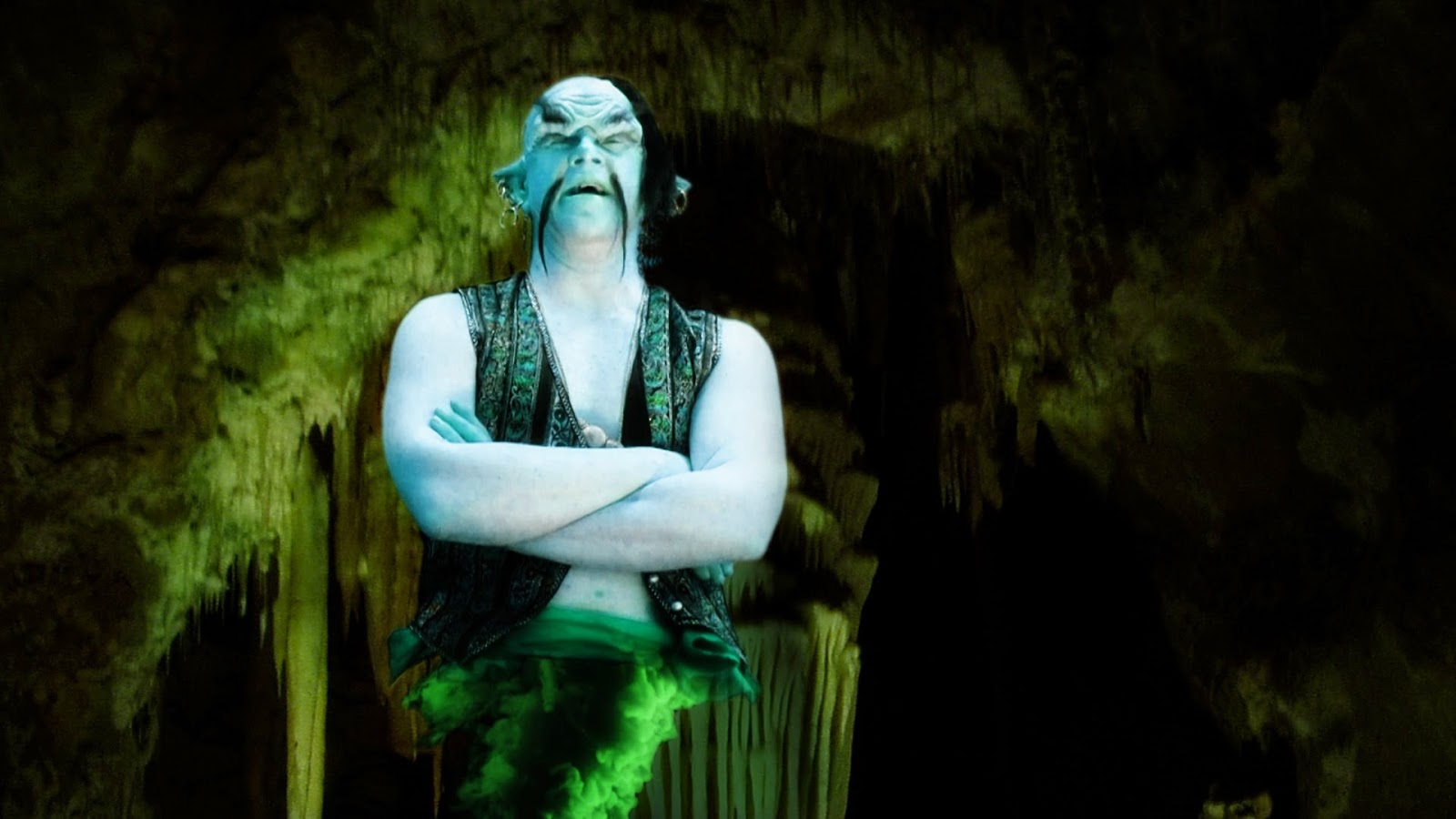
I thought it might be interesting to show some of my work on this project, so lets start off with the genie of the lamp. Not having a properly impressive genie would make for a poor Aladdin story, so I decided to apply some rubber to the face of our genie actor Henrik to make him less meek in his appearance. I slush cast a bald cap, a forehead and two pointy ears in latex, using old plaster moulds made for orc and dark elf mask pieces. The appliances were stuck on with ProsAide glue, and the edges covered up with a ProsAide/microballoon paste.


Crepe wool hair was used for the eyebrows and mustasches, and also for a ponytail eventually added to the top of Henrik's head.


Rubber mask greasepaint covered with a sealer was used to blend skin and latex to a uniform look.


I can't say that Henrik particularly enjoyed the process of being made up into the genie, but once the makeup was complete and he went in front of the camera he forgot about the uncomfortable mask, and acted out his domineering genie part to the hilt!


When filmed Henrik sat on a stool with a piece of the greenscreen tucked into his pants. A red sash provided a barrier between his body and what would in After Effects editing become a traditional legless smoke-pillar lower body. His skin tone was also changed in AE to a properly alien-looking hue.


I wanted to create the look of old Hollywood Arabian Nights epics, where lush costumes make up a big part of the overall enjoyment. For example, we were going to have a couple of palace guards pop up here and there, and I wanted them to have a special look as part of my big scheme. I decided to build a golden shield to be carried by the guards, and used an old plastic snow saucer I bought years ago. My plan had always been to make a shield out of it, but I never got around to it until now.


First, the two handles had to come off, and I used a Dremel drill tool to cut the thick plastic.


I saved one of the handles to create a simple grip on the back side of the shield. Some soft yarn made the handle more comfortable to hold.


The handle was stuck to the shield using hot glue and screws. Bits of wooden dowel placed in the handle ends created durable points of attachment.


Before painting the shield I'm adding some detail. During the summer I haunt the local flea markets and garage sales in search of various interior design brick-a-brack. This piece here is apparently the decorative end bit of a curtain rod. It looks exactly like those brass studs and plates stuck to leather armour in Roman Empire epics, making them look functional as well as attractive. In fact, pieces like this will add some glamour to mostly anything, as you'll soon see.


I'm making a silicone mould from this piece, so I can cast any number of copies in plastic.


A simple containment wall was created using thick paper sealed up with hot glue.


DragonSkin FX was poured over the metal plate to create the mould.


When the silicone had set, SmoothCast 325 dyed black was used for the casting process.


Here's the first one out of the batch..


..And here's a bunch of them, all produced in an afternoon.


The "Roman studs" were stuck on with hot glue, along with some other decorative cast pieces, including a lion's head moulded from a toy shield.


A coat of black base paint was first sprayed on..


..Then followed by durable gold spray paint. I found a metallic paint that stinks to high heaven when you use it (preferably outdoors) but won't chip off as far as I can detect. Subconsciously I seem to have been slightly influenced by the snazzy shield carried by Harry Hamlin's Perseus in Ray Harryhausen's original "Clash of the Titans".


To show just how fast and easy you can piece stuff together, here's a "steel" chest plate made from an ordinary paper plate, another plastic lion head cast, and studs made out of hot glue squeezed into a silicone mould.


Joakim, playing one of the palace guards, is here see sporting the full ensemble. The sword is plastic and aluminum, created for another film project years ago, and the helmet is real steel, and built by my blacksmith buddy Martin Merkel. The armour is real leather, but all the decorations are plastic castings.


I couldn't find a real old oil lamp, and the only ready-made fake option was the Disney version. I opted to make my own instead using a cheap sauce boat with some Monster Clay added.


Hot glue and thick paper was used to create a containment area for the silicone.


Skipping the silicone-pouring part, here's the plastic cast right out of the mould.


Some epoxy paste and a plastic bead creates a small lid on top, and a copper spray paint guilds the lily.


Making chroma key effects with consumer film recording equipment is asking for trouble. The results vary from really good-looking to merely passable. The nay-sayers (and there are plenty of those in my native Sweden) ask what the point is then, if I can't make it look professional all the way through.


But I can't be bothered with those who ask "why", just the ones who ask "why not?" There are many levels of creativity, and if you're not making your art for the sake of commerce, then it's your damn duty to make it for the fun of it.
Lastly, and perhaps not surprisingly, I've managed to infuse this version of Aladdin with some stop-motion monsters. More about those in an upcoming post.