It was suggested by a couple of my YouTube viewers that I should adapt Donald Wandrei's story "The Red Brain". It's an example of the "weird tale" that I really like; a proto sci-fi/horror story that mixes genres before any genres were really defined. The full title of the story is "The Red Brain -A Tale of Cosmic Horror", and that really sums up what this is.
Apparently, this story is a very early effort from Wandrei. It was written when he was just 16 and eventually published in the seminal magazine Weird Tales in 1927. He became one of H P Lovecraft's friends and went on to co-found the publishing company Arkham House, which was dedicated to Lovecraftian fiction.
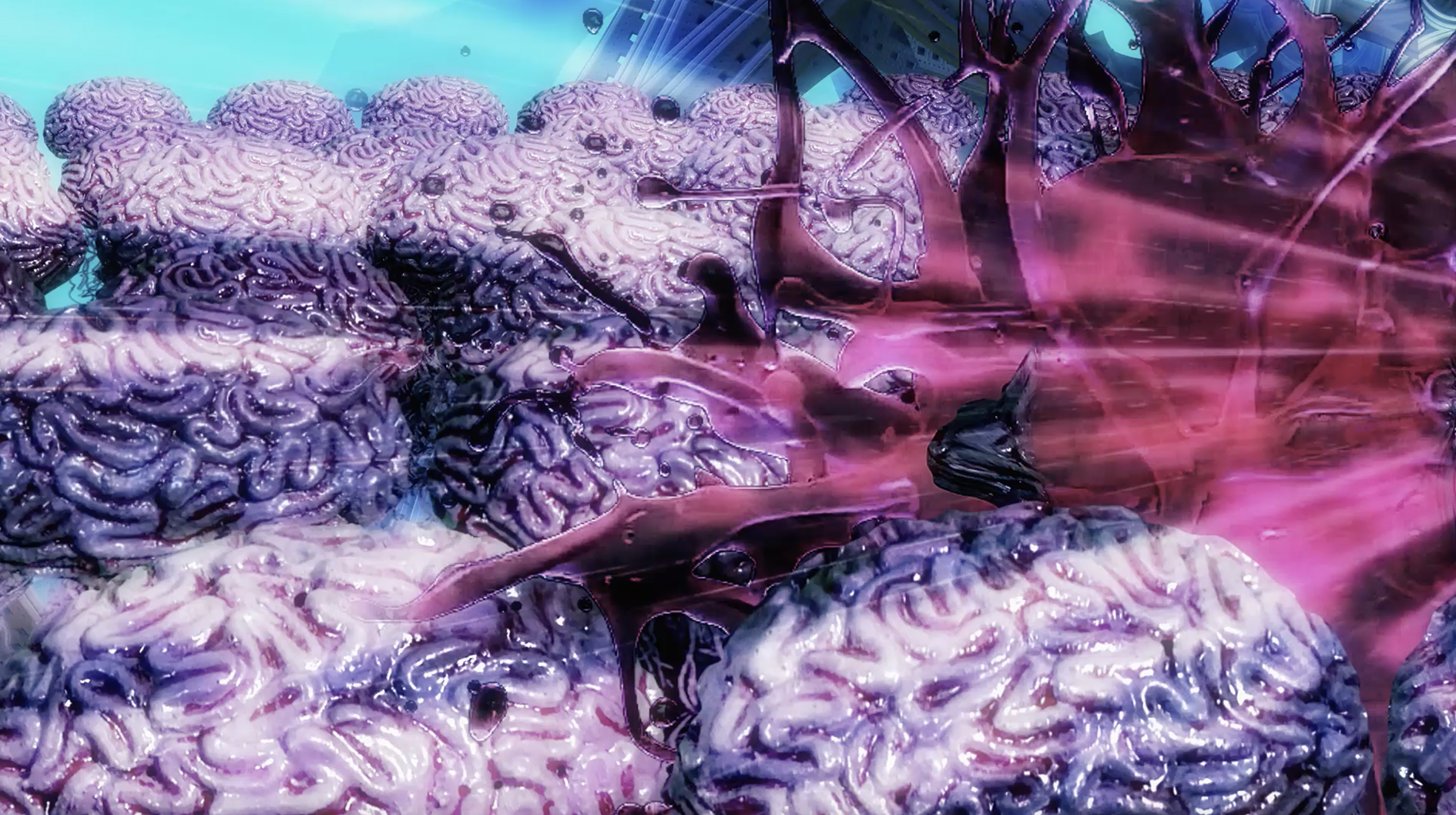
"The Red Brain" seems to have been a favorite among the readers. It was reprinted twice in Weird Tales, and most probably published in one of the sci-fi pulps down the line. I believe the above illustration is from one of these reprints. Looking at it, you can see that the alien brains of the story are portrayed with big bulging eyes. They look kind of funny, to be honest. In the actual text, they're only described as giant brains supplied with a kind of snail's foot underneath, a versatile appendix that can transform into anything they need; a hand, a foot, or a tentacle. I went with a cluster of tentacles in constant flux (a digital stock animation), a writhing mass of biological matter, ready to spring into action.
It has been pointed out to me that the story is basically a pastiche of Edgar Allan Poe's tale "The Masque of the Red Death"; a group of individuals takes refuge in a sanctuary to escape a horrible doom, only to find out that they have actually locked themselves in with their doom. I've never read any analysis of "The Red Brain", but I guess that Lovecraft, being a Poe devotee, had a nice chuckle when he read Wandrei's story.
So, let's start with talking about the making of the brains. My aim was always that I'd have a bunch of brains that each had different swirly patterns, so the viewers could all see that I hadn't just used one brain model, duplicated many times in editing. I started with sculpting a brain in medium-grade Monster Clay.
Over the sculpture, I built up a silicone mold using DragonSkin FX silicone. My idea was to cast the brains in plastic.
I cast one brain in tinted Rhino plastic, and it turned out very well. BUT I realized that making at least three brains this way would cost a bit more, involving expensive materials, than I wanted to spend. When you come to such a point in your creative work, it's time to explore your cleverness and come up with a cheaper solution, because there is always one.
So I began anew by making a basic brain-like clay shape and covered it with cotton dipped in latex.
When the latex / cotton skin had dried I cut it open along the bottom. The process was then repeated a couple of times more.
The wrinkles on the brain surface were made with slim foam rubber shapes. I used very thin sheets of polyurethane foam soaked in latex and allowed to dry. I buy these sheets in packages of many hundred from a medical goods supplier. When the latex had dried I rolled up each sheet into thin sausage shapes.
As you can see, they're extremely flexible and very easy to bend into any shape.
Each foam sausage was twisted into the swirling patterns of the wrinkled brain surface. Liquid latex was used as an adhesive.
This will become the actual Red Brain, and if you look at it you can hopefully see that the brain pattern is smaller than on the brain in the previous photo. I made the Red Brain bigger to differentiate it from the regular brains.
I made three regular brains. I used hot glue to coat the inside of each brain through the slit in the underside to make them sturdier. Tinted latex was sponged onto each brain in two layers, first a dark purple, and then a lighter flesh tone.
All brains were supplied with a rod wrapped in yarn and painted with green screen paint. The Red Brain also had a few inflexible tentacles made from cotton dipped in latex. I used both photos of the brains as well as a few video shots, where they turn or move about slightly.
The writhing mass under each brain was, as I've mentioned, a CGI animation downloaded from Videoblocks.com. With a bit of tweaking in AE it became a very weird-looking organic texture. I placed it in a layer behind each brain.
We briefly follow the evolution of life on the brain planet and start with a very primitive creature, a worm of some kind. I built this puppet using latex cast from older plaster molds draped over a bit of aluminum wire wrapped in soft yarn and provided with t-nuts as tie-down points at each end. It was built in an afternoon.
The rest of the planet's primitive life was summed up with an alien sort of dinosaur, a reptilian behemoth.
Most of this puppet was covered by latex skins cast in older plaster molds, but I did make an original sculpt of the head and the jaw in Monster Clay.
I built this puppet pretty big, probably bigger than it had to be, but I wanted to include a lot of details in its skin, and a larger size will allow for that, of course. Here's how the armature turned out.
The yellow foam seen here is very soft and allows for easy movement of the joints, despite being laid on pretty thickly.
The plates on its back were made from cotton dipped in latex. Apart from that, as I mentioned earlier, the foam was covered by patches of latex skins cast in older plaster molds. A lot of what I sculpt in that regard can be re-used. A base color was sponged on using tinted latex and thinner layers of various colors were then dry brushed on to give a sense of organic depth to the hue of the skin.
Teeth and claws were tissue paper dipped in latex. The eyes were just painted onto the latex head cast.
Eventually, life on this planet takes on an advanced form, quite human-like, which not surprisingly results in a devastating war.
I actually only made a clay sculpture representing these advanced creatures. I added hair and colors in Photoshop and used the puppet tool to animate the Photoshopped images to raise their heads slightly.
Eventually, and after the war, the inhabitants grew big brains and smaller bodies. I decided to place them in a world with such advanced architecture that up and down is lost as concepts.
I sculpted this bust and cast a latex copy from it from a plaster mold.
The body was a very quick and simple build-up, using a weird skin texture mold to create the black latex skin, representing a one-piece suit. I plucked a metal wire support stand from a broken hot glue gun and used that to create a simple handle for the vessels the inhabitants use to get around their strange cities. The stand was actually stuck to the green screen animation stage, so I could add a digital image under the feet of the puppet. The actual floating platform was cut from a digital stock image of a futuristic city. As I recall it, this thing was originally the top of a tower. I modified it slightly in Photoshop to meet my needs and added it in a layer behind the puppet and the glue gun stand in AE. I animated this puppet twice, so it could represent two citizens passing each other. But when editing it all together I felt that I had made the heads too small. Since the bodiless brains were their next stage of evolution I figured their heads at this point should be a bit bigger, so I made the heads bigger in After Effects.
I actually forgot about another prehistoric creature, what I call the ur-Antarean, a sort of extraterrestrial Neanderthal. I simply re-used an older puppet, a creature from my film "Imps." All I had to do was straighten out the puppet, which was bent around itself, walking in an awkward posture in "Imps", and give it a bit of loincloth and a spear. I also animated it with a small, but bright light close to the puppet to get that campfire effect.
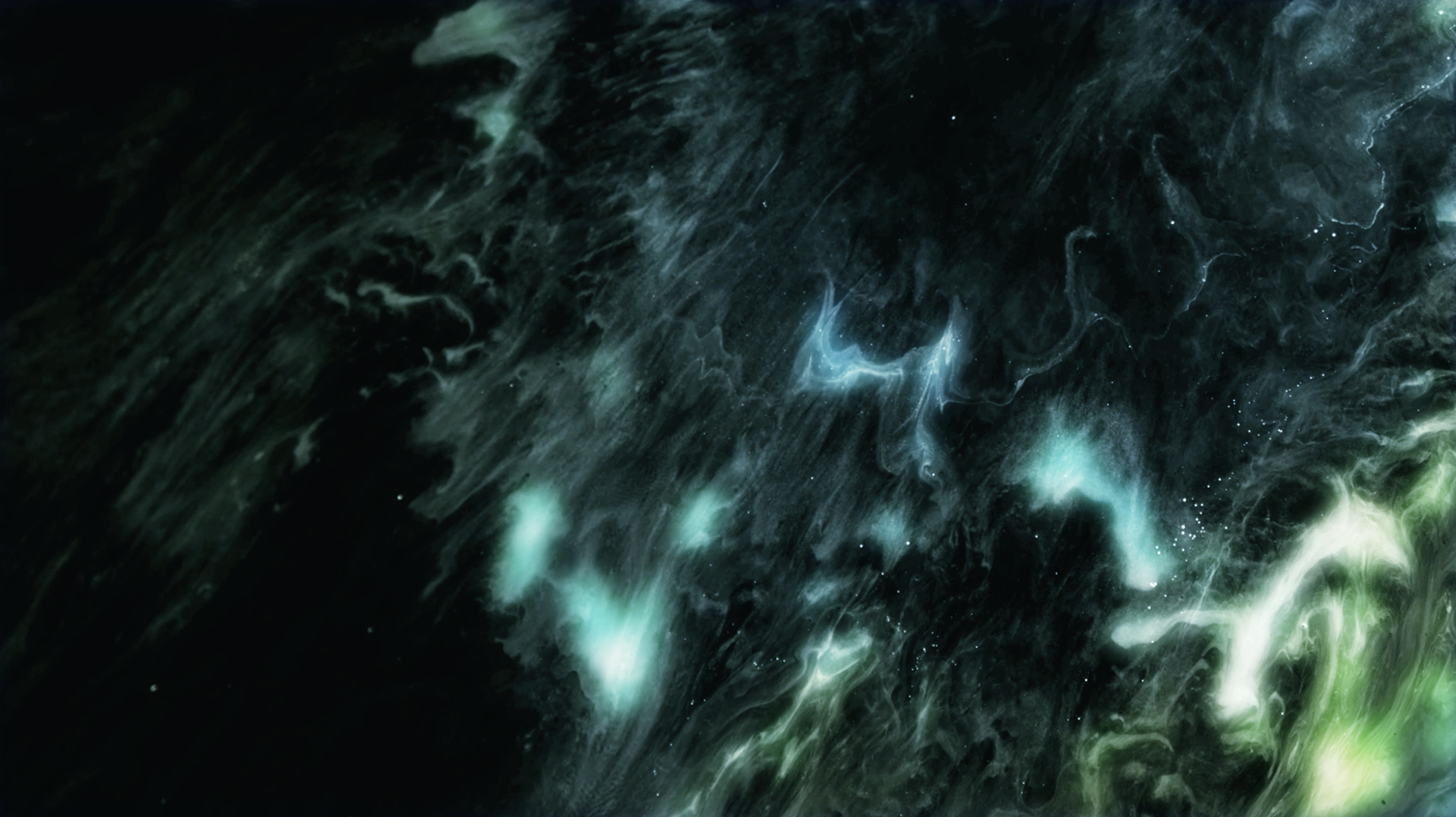
I'd say that half of the film is held together by the visuals, which are all a mix of digital stock footage and stock footage still images. Parts of those are manipulated in Photoshop to meet my needs, and the combining of several layers in After Effects joins everything together. The actual cosmic dust cloud was found on Rocketstock.com. I think it's some kind of paint or chemical blended in some liquid to produce this very dreamlike look.
When the dust swallows various worlds, comets and suns I again combined the dust footage with other bits of mostly CG stock footage. Over everything, I added a filter in an adjustment layer to achieve a special weird look and tone.
You briefly see a planet disintegrate as the dust swallows it. The effect was done with a photo of (I think) Ganymede falling to pieces using various particle effects in AE. It was basically the same trick used in the Marvel movies when people turn to ashes after Thanos snaps his fingers. I couldn't quite get a grip on how to replicate the effect in AE, but it worked out well enough for this brief shot.
All in all, my subscription to Depositphotos.com presented me with a smorgasbord of digital stock images, especially various fractal art, that could be turned into complex and mind-boggling structures for the brain civilization.
We get to see that the brains try to genetically perfect a super brain with which to tackle the threat of the cosmic dust. It doesn't go well to begin with, as the results are monstrous. To create a monster brain mutant, I re-used an animation of the Ubbo-Sathla ooze created for a previous film about Clark Ashton Smith's primeval slime and added a few writhing tentacles; old animations from earlier projects.
The red superbrain they eventually create makes short work of his inferior masters. When the brains explode I only used still images, manipulated with a distortion tool in AE plus the digital effect of an exploding ball of paint added on top. The combination worked well enough to make the intended effect work, I think.
The ever-reliable John Hutch provided the narration. His idea was to make the master brain sound a bit like Churchill and the Red Brain a bit like Hannibal Lecter, which I think were both very effective choices. It took him a while to finish his recording since his neighbors kept having very vocal arguments next door every night. This film marks my first collaboration with Italian paleontologist and musician Marco Zanelli, who provided the evocative electronic score. You'll be hearing more from both him and John in some of my upcoming projects.
"The Red Brain" is yet another example of a pulp-era story that has now slipped into public domain status. I've seen it pop up as an audiobook in a few podcasts and YouTube videos, which is nice since the story is finding a new audience so many years after it was originally published.
One of my all-time favorite authors is Clark Ashton Smith, a buddy and a contemporary of H P Lovecraft. They both contributed to the same magazines and developed the genres we now call sci-fi, fantasy, and horror. In their days it was all more or less simply "weird fiction." Smith invented his own bestiary of strange and terrifying beings, one of them being Ubbo-Sathla, basically a primeval soup of DNA with some kind of sentience. Well, I won't go into too many details. Hopefully, you've by now watched the video clip posted above, and you know everything you need to know on the subject.
I have many CAS (as Smith is often abbreviated) projects in the pipeline. Some of his writings are by now in the public domain, but I took the precaution some years ago to contact his stepson, head of the CAS estate, explaining my intentions and requesting permission to adapt his stepdad's work for my YouTube channel. He didn't have any problems with that, so off I went! "In the Ooze of Ubbo-Sathla" is the first of these projects I've managed to finish.
The main character is the wizard Zon Mezzamalech. For this role, I called upon my old buddy John Hankins who is looking more and more like a wizard for every passing year. You might recognize him as the doomed hero (sans beard) in the film "Feather of Owlbear." John has a green screen and a plethora of home-made fantasy outfits, so he could provide me with footage of Zon staring into the crystal orb of the story. He drew some shapes with blue paint on his face, which allowed me to remove the blue and add a digital effect of swirling lights onto his head, showing the being a wizard and staring into unwholesome objects might change you gradually.
Let's get to the backgrounds right away. They were all made in Photoshop using stock images downloaded from Depositphotos. This shot with John as Zon was made up of 12 elements pieced together in After Effects: The background, real candle flames, John, the flickering lights in his face (a stock CGI animation), the stone table, the orb, and the light shapes in the orb. John is in the USA and I'm in Sweden, but I could mail him instructions and he would mail me the filmed results.
This shot is another bit of trickery; it's a still image of John combined with a stock image och a guy in a wizard's robe. It's so short that using stills worked OK in this case.
The sonorous narration was performed by another American buddy, Fabian Rush. I helped out Fabian with a bit of stop-motion animation for his film "Forsaken: Rock Opera of Chaos", and he happily contributed his voice talents to my project. Fabian is in his own right a very interesting creator, a hard-rockin' musician and filmmaker, and, like me, a big fan of the work of H P Lovecraft and Ray Harryhausen. We plan to have more collaborations in the near future.
The city of Mu-Thulan, where Zon Mezzamalech has his tower of sorcery, was also created with layers of stock photos of various buildings. The people moving about in the shot were leftover takes from a production of "Aladdin" that I made with a group of special needs people some years ago. These takes were all shot in front of a green screen. Applying the 3D effect to each layer allowed me to do a fake pan through the city up to the tower.
There are other people in the film, but they're all either stock photos manipulated with the puppet tool in AE, or stock video. I experimented with transitions quite a bit in this project. I wanted to add organic transitions between the shots and achieved this look by applying shots of black ink dissolving in water and using the black and white contrast of those shots to create a matte effect in AE. That was a bit of a learning curve, but it garnered a very useful result in the end. I try to do something new with AE in every new project.
Now let's go on to the creatures. The text describes Zon Mezzamalech's descent into primeval brutehood in detail. One of the first stops in this downward spiral is a "man-beast." I wanted to make this puppet as something inspired by the often weird-looking ape suits of studio-era Hollywood. I took specific inspiration from the suits worn by ape performer Ray "Crash" Corrigan, which were bulky, very hairy, and with a peculiar-looking face.
The only part of this puppet I sculpted was the face, using medium-grade Monster Clay. Two metallic red pearls served as eyes.
The armature was simplicity itself. I didn't add any articulation to the face except for the jaw, which was in keeping with the rather unexpressive 1940's ape suits. The red pearls are stuck to the backside of the latex face using latex eye sockets. They can be animated by inserting a pin into the hole in each pearl and swiveling the eyeball around. As usual, I'm using aluminum wires and thermoplastic for my armatures.
The padding was also very simple, just a few layers of thin and soft polyurethane foam wrapped around the armature.
Real bulk was achieved with fluffy fake fur, a nightmare for any animator by the way, as you keep moving it around every time you touch the puppet. The teeth were made from toilet paper and latex and the exposed parts of the skin were dry brushed with tinted latex. I also did two hardly noticeable breasts with cotton and latex peering out from the fur, again in imitation of the Corrigan suits.
This puppet is quite big, around 16 inches tall. I placed the puppet for scale next to my main coon cat Ludwig, who's huge. Ludwig, by the way, had a fling with the cat variant of the Coronavirus in November. He's just recovered from his ordeal and his usually bright yellow eyes are still stained a bloodshot red in this photo.
The pterodactyl, a Pteranodon to be specific, was built for an as-of-yet unrealized project, a King Kong fan film that I helped out with during the planning stage. You can read all about the making of this puppet HERE.
The Ichthyosaurus was simply a 2D animated stock illustration. The animation was achieved by splitting up parts of the image in separate image files -the beak and the fins- so they could be animated separately and integrated with the body. The fleeing squid was a stock CGI animation.
Eventually, Zon Mezzamalech devolves into a "forgotten behemoth". I based this puppet on the Permian reptile Ophiacodon. Like with our man-beast, only the head was sculpted in clay. The upper part and the jaw were cast separately for easy mold-making.
Again, a very simple armature. The puppet wasn't required to do much more than walk around and bellow at the moon.
I did spend a bit of time doing a decent muscle build-up in foam. The sinewy parts on the legs were achieved using very thin foam soaked in latex and rolled into the desired shapes.
I used a subtle but bumpy skin texture for this creature. All the textures were pulled from the same texture mold. Additional bumps and warts were drops of latex applied with a pointy tool. The crest on the back was made from tissue paper dabbed with latex.
Teeth and claws were tissue paper and latex. The eyes were painted on and covered with Glossy Accents scrapbooking plastic.
On to the serpent people, which turned out t be the most popular part of my film. In fact, quite a few people have suggested I should make a film just about them. I split up the head pieces in two parts again, which always makes the mold-making bit much easier.
Again another simple armature. The jaw is provided with a single aluminum wire. I debated wether or not I should give the puppet a tail, but adding one made it much more snake-like, of course. I wrapped the neck and tail in thick, soft yarn soaked in latex instead of padding these parts with foam. This makes these parts wrinkle less like a rubber toy and more like the bodies of real snakes.
The job of the padding in this case was to make the body very sleek. I only added some muscle details on the arms and legs.
For the latex skin I used a texture mold I made years ago for some kind of dinosaur or dragon. It's a basic scaly pattern, which doesn't exactly imitate the overlapping scale pattern on snakes. I think it gets the look right when you look at the puppet from a distance. The belly was covered with a texture that was actually sculpted a while back to look like the belly skin of a snake.
The serpent man was painted with PAX paint (Prosaide glue and acrylic colors) using a sponge, with airbrushed details. To create the very small teeth I just added tiny drops of tinted latex onto the jaw with a pointy tool. The eyes were painted onto the latex with Warhammer model paints. The forked spear the puppet is holding here was made for one of my older films, "The King Who Sought Immortality."
For the serpent war shot I dressed up the puppet in leathery armor created from latex castings in molds made for various puppets. Since I only made one puppet (lazy!) I had to animate this single puppet a few times to portray a number of characters. The most complex animation had two serpent men sword fighting. I first dressed up the puppet in one type of armor and had it perform the choreographed movements with his sword. I then re-dressed the puppet in the other armor and animated the corresponding choreography. The timing of the puppets was achieved thanks to a function in the animation software Dragoframe, which allows the animator to upload a videofile that can be played one frame at a time as a transparent guide to the motion animated by the filmmaker and his puppet. Thus I could upload the previous bit of animation and time the impact of the swords striking together without any problems. These sword also came from "The King Who Sought Immortality" and were made from wooden spatulas ground down with a Dremel tool and decorated with Milliput epoxy.
The short serpent war shot was another rather complex composition in AE, with 20-ish layers stacked on top of each other.
Ubbo-Sathla itself was a digital animation created in AE, as was actually most of the environment around it.
I first made a textured layer using the displacement map tool in AE with other effects such as "Glass" and "Tint" added on top of that. What I got was a nasty-looking bubbling, fleshy stew. I rendered out 15 seconds of this.
That shot was then transformed by cutting out a mass of the texture with the rotoscope tool and then using the distortion grid tool to create an undulating animation. I rendered out a bunch of various animations against a transparent background, which allowed me to drop Ubbo-Sathla into any scene I wanted.
The spawn of Ubbo-Sathla were created pretty much the same way, except that I used still images of human veins added on top of a organic texture I made in Photoshop. The spawn shapes were again animated with the distortion grid tool.
And an even simpler version of this technique was used to create the sea of slime in which Ubbo-Sathla reposes. He's joined in the muck by the tablets of star-quarried stone carrying the forgotten wisdom Zon Mezzamalech covets.
These tablets were another simple Photoshop creation, using a font simulating a made-up alphabet to create the writing. I made this writing transparent and placed a digital animation of shiny shapes behind each tablet to make the writing seem truly alien.
CAS´ strange epic "Ubbo-Sathla" is an example of another concept I keep getting back to, the notion of "deep time" -that awe can be supplied by contemplating the sheer vastness of the number of years our planet has existed, how pathetic we and our civilization can appear in comparison to the life cycle of our world. Lovecraft was a master at this type of fiction, but another famous example is Olaf Stapledon's "The Last and the First Men."
I'll certainly return to the mid-boggling fantasy worlds of CAS -I already have a couple of new projects in the works- but I'll also tackle other authors of the so-called Lovecraft group. There's a lot of wonderful weirdness to be mined there, and much of it is in the public domain.