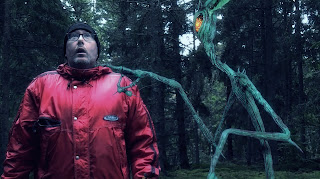
For quite some time I've been thinking about doing stop-motion recreations -of sorts- of weird creatures people claim to have met; cryptids, aliens, etc. I finally got around to it sometime around last September, when I decided to take on one of the very strangest encounters.
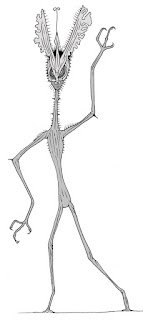
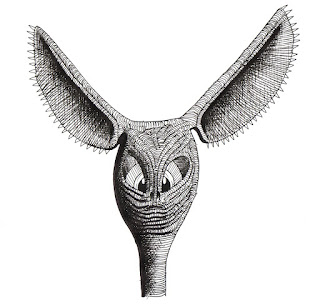
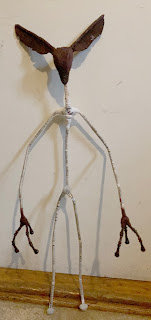
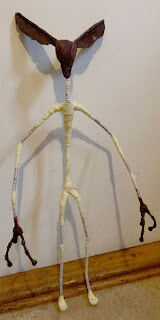
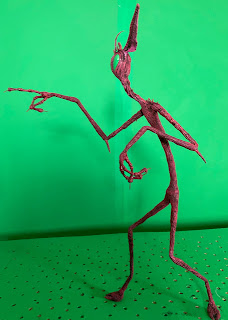
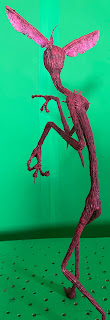
The above two sketches are reconstructions of what bow hunter Jennings Frederick says he encountered in 1968 during a stroll in the woods of Fairmont, West Virginia. According to Frederick he suddenly heard a strange grating sound and felt a painful sting in his neck. A strange, green spindly entity was standing next to him, poking him in the neck with its finger. A voice (maybe in Frederick's head) told him: "YOU NEED NOT FEAR ME. I WISH TO COMMUNICATE. I COME AS A FRIEND. WE KNOW OF YOU ALL. I COME IN PEACE. I WISH MEDICAL ASSISTANCE. I NEED YOUR HELP."
Afterthis short ordeal Frederick's was apparently let go and the creature disappeared into the woods. The flabbergasted hunter noticed that a line of blood trickled down his neck and he concluded that was what the alien stranger accosted him for. He then heard a strange sound which he surmised was coming from the creature's craft, whatever that may be. This very strange story has become something of an odd favorite among people interested inthe unexplained.
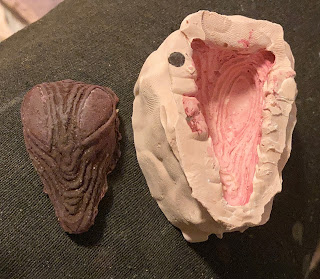
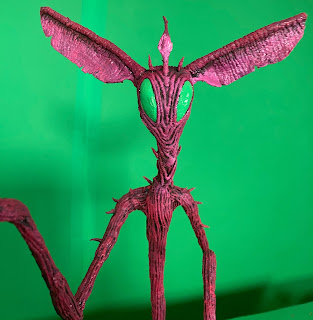
To make my vegetable man puppet I sculpted two pieces in clay and cast them in latex from dental plaster molds. The first was the head, or, more precisely, the face.
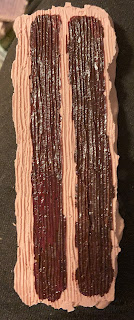
The second piece was a bit of bark-like skin texture, from which I could cast the bits of skin that would cover the puppet.
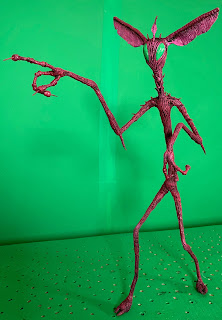
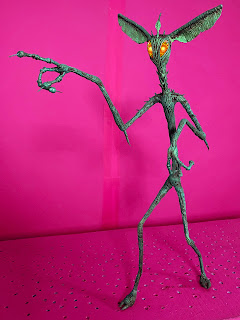
I made this pupper large, almost 40 cm tall, so I could make the limbs really thin. I used 1,5 mm aluminum wires reinforced with thin, but rigid, metal rods for the hard skeletal parts between each joint. A tight wrapping of crochet yarn soaked with latex held everything in place with the help of some Polymorph thermoplastic.
Though the creature was supposed to be very stick-like I still added a few spots of muscular detailing by soaking thin bits of polyurethane foam in latex and pressing those onto the body.
In the report, the creature is a dull green, but since I'm shooting against a green screen I painted the finished puppet red. The eyes were kept a chroma key green, so I could key those out and add animated eyes instead.
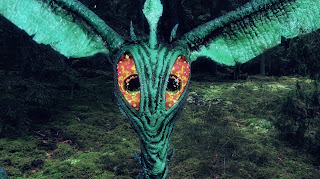
In After Effects I could then change the color of the puppet into green and also remove the eyes.
I used a caleidoscopic CG animation stock footage clip for each eye, which I think created a nice hypnotic effect.
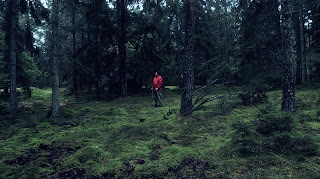
The film was shot at a forest about 20 minutes walk from where I live. It was absolutely pouring down this day and both I and my single actor were soaked through after a while.
This actor, by the way, is Leif Hult, who is also quite an accomplished singer. He suffered through the gloomy afternoon and even dropped to the ground in the wet moss in one scene. The puppet was animated to interact with his movements.
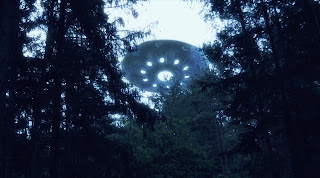
At the end of the film it's revealed that the creature is actually an alien, and Leif watches it take off in a flying saucer above the trees. I tried to film the tree tops without having the rain completely soak my camera. The UFO is another CG animation downloaded from Storyblocks.com as a green screen shot. I composited it into the sky above the forest by creating a matte from the trees. I used a contrast tool to make the trees completely black and the sky completely white. After Effects then allows you to place your original footage in a layer above the contrasted footage and using it as a matte, which makes the trees a layer without the sky. A third layer with the sky is then dropped under both these layers. It sounds a bit complicated, but it really isn't. It's actually a very old effect that's been used since the silent movie era. Back in the day it was a chemical process created with an optical printer, or by reversing the shot in camera and running the footage twice through the camera gate. Doing it digitally is, of course, much, much easier.
As you saw in my version of the story, Leif isn't a bow hunter. He's just a guy out for a stroll in the woods and happens to encounter this creature. I did, however, use what the creature said verbatim. It seems this film was quite appreciated by my YouTube audience, and I was encouraged to do more projects of this kind. Since there are almost countless similar weird encounter stories from all over the world to pick from I will get back to the subject eventually.
I never did a behind-the-scenes video for "The Other Gods", but since people keep asking me questions (mainly about the puppets) on YouTube, I decided to make one.
As I've mentioned before in my posts, right now I'm working half-time at a project called "Media Power", where special needs people of all ages learn how to blog, make interviews, do pod casts, make videos, and generally find out how to use the free social medias to promote themselves and their various interests. I'm the technical go-to guy, and I also try to think up fun stuff for the crowd to do. Last year we made three short films; among these "Beans vs Aliens", which I covered in a couple of posts here.
Now I'm feverishly editing our next project" Aladdin and The Magic Lamp", which was all shot in front of a green screen. This means I'm now spending my days (and sometimes nights) compositing every single scene for this 20-minute film. It's a huge experiment, and an incredible amount of work. However, I felt this was the only way to make a visually exciting representation of this evergreen fairy tale.
My two co-workers on the project, Jenny and Mia, have worked very hard on it too, but the brunt of the work has fallen on my shoulders. I feel that my colleagues don't feel it's necessary to put in as much effort into the production as I do. But I want people to be surprised at what we have accomplished, using fairly primitive equipment. As for our actors, they're certainly a motley crew both in talent and commitment. Emil, who plays Aladdin, is doubtlessly the big star, carrying the narrative of the fantastic story with great panache.
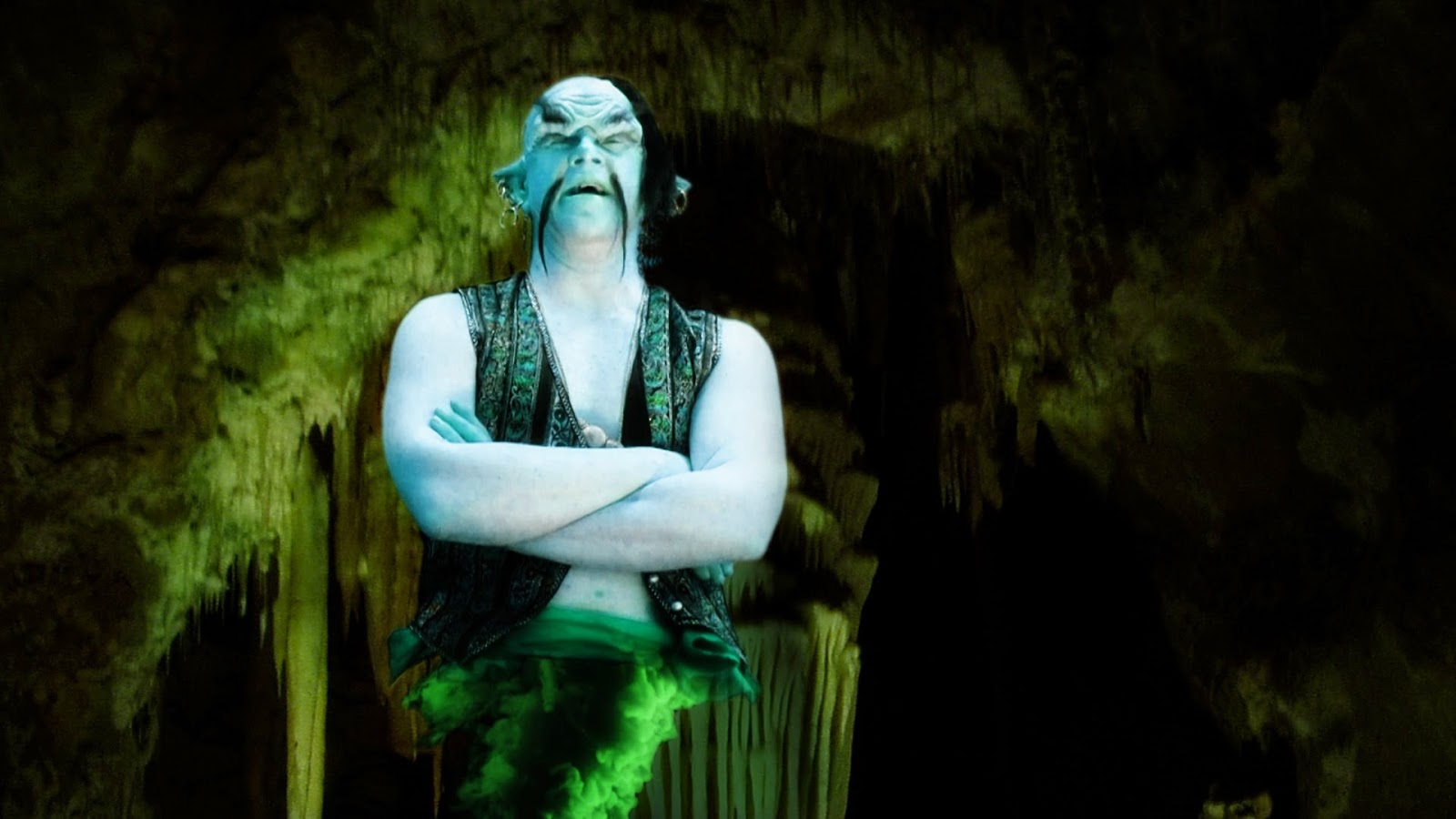
I thought it might be interesting to show some of my work on this project, so lets start off with the genie of the lamp. Not having a properly impressive genie would make for a poor Aladdin story, so I decided to apply some rubber to the face of our genie actor Henrik to make him less meek in his appearance. I slush cast a bald cap, a forehead and two pointy ears in latex, using old plaster moulds made for orc and dark elf mask pieces. The appliances were stuck on with ProsAide glue, and the edges covered up with a ProsAide/microballoon paste.
Crepe wool hair was used for the eyebrows and mustasches, and also for a ponytail eventually added to the top of Henrik's head.
Rubber mask greasepaint covered with a sealer was used to blend skin and latex to a uniform look.
I can't say that Henrik particularly enjoyed the process of being made up into the genie, but once the makeup was complete and he went in front of the camera he forgot about the uncomfortable mask, and acted out his domineering genie part to the hilt!
When filmed Henrik sat on a stool with a piece of the greenscreen tucked into his pants. A red sash provided a barrier between his body and what would in After Effects editing become a traditional legless smoke-pillar lower body. His skin tone was also changed in AE to a properly alien-looking hue.
I wanted to create the look of old Hollywood Arabian Nights epics, where lush costumes make up a big part of the overall enjoyment. For example, we were going to have a couple of palace guards pop up here and there, and I wanted them to have a special look as part of my big scheme. I decided to build a golden shield to be carried by the guards, and used an old plastic snow saucer I bought years ago. My plan had always been to make a shield out of it, but I never got around to it until now.
First, the two handles had to come off, and I used a Dremel drill tool to cut the thick plastic.
I saved one of the handles to create a simple grip on the back side of the shield. Some soft yarn made the handle more comfortable to hold.
The handle was stuck to the shield using hot glue and screws. Bits of wooden dowel placed in the handle ends created durable points of attachment.
Before painting the shield I'm adding some detail. During the summer I haunt the local flea markets and garage sales in search of various interior design brick-a-brack. This piece here is apparently the decorative end bit of a curtain rod. It looks exactly like those brass studs and plates stuck to leather armour in Roman Empire epics, making them look functional as well as attractive. In fact, pieces like this will add some glamour to mostly anything, as you'll soon see.
I'm making a silicone mould from this piece, so I can cast any number of copies in plastic.
A simple containment wall was created using thick paper sealed up with hot glue.
DragonSkin FX was poured over the metal plate to create the mould.
When the silicone had set, SmoothCast 325 dyed black was used for the casting process.
Here's the first one out of the batch..
..And here's a bunch of them, all produced in an afternoon.
The "Roman studs" were stuck on with hot glue, along with some other decorative cast pieces, including a lion's head moulded from a toy shield.
A coat of black base paint was first sprayed on..
..Then followed by durable gold spray paint. I found a metallic paint that stinks to high heaven when you use it (preferably outdoors) but won't chip off as far as I can detect. Subconsciously I seem to have been slightly influenced by the snazzy shield carried by Harry Hamlin's Perseus in Ray Harryhausen's original "Clash of the Titans".
To show just how fast and easy you can piece stuff together, here's a "steel" chest plate made from an ordinary paper plate, another plastic lion head cast, and studs made out of hot glue squeezed into a silicone mould.
Joakim, playing one of the palace guards, is here see sporting the full ensemble. The sword is plastic and aluminum, created for another film project years ago, and the helmet is real steel, and built by my blacksmith buddy Martin Merkel. The armour is real leather, but all the decorations are plastic castings.
I couldn't find a real old oil lamp, and the only ready-made fake option was the Disney version. I opted to make my own instead using a cheap sauce boat with some Monster Clay added.
Hot glue and thick paper was used to create a containment area for the silicone.
Skipping the silicone-pouring part, here's the plastic cast right out of the mould.
Some epoxy paste and a plastic bead creates a small lid on top, and a copper spray paint guilds the lily.
Making chroma key effects with consumer film recording equipment is asking for trouble. The results vary from really good-looking to merely passable. The nay-sayers (and there are plenty of those in my native Sweden) ask what the point is then, if I can't make it look professional all the way through.
But I can't be bothered with those who ask "why", just the ones who ask "why not?" There are many levels of creativity, and if you're not making your art for the sake of commerce, then it's your damn duty to make it for the fun of it. Lastly, and perhaps not surprisingly, I've managed to infuse this version of Aladdin with some stop-motion monsters. More about those in an upcoming post.