Thursday, July 25, 2013

My Lovecraftian Alphabet part 1

Last time I blogged about my attempt to build a Cthulhu stop-motion puppet. This is the project I built it for.
 A while ago I bought a couple of fun-looking little books from eBay. They were the Lovecraftian poetry parody books (there's a high concept for you) “The Young Guy From Fuggoth” by M. M. Moamrath, and “The Arkham Alphabet Book For Children” by Darrell Schweitzer. Both of them were great fun, and I thought of adapting one or two of the texts as YouTube videos. Both books contained parodies of children's alphabets; here, of course, focusing on Lovecraftian horrors.
I bought the books directly from Darrell and asked for his permission to use the texts. He gave me the go-ahead for his book, but the other one was a different matter. Two authors had joined forces as the pseudonym M. M. Moamrath, and neither of them could be reached. In fact, they seemed to have vanished from the face of the Earth (the work of eldritch powers??)

After having spent a few days trying to get hold of said parties I finally though, what the hell -Can't I write my own humorous Lovecraftian alphabet? It turned out I actually could. I spent an afternoon composing the verses, and then sent them off to my regular Lovecraftian video narrator, Mr John Hutch of London. He sent a jolly good MP3 back to me the following day, and I started on creating the scenes illustrating the alphabet, beginning with “A is for Azatoth, that amorphous blight; B is for Byakhee, which flies in the night.”

Now, what is really the point of this exercise in monstrous Lovecraftian indulgence? Well, that is actually the point: To have fun with the monsters and texts of old Lovecraft, but also to give myself a challenge -how can I produce visuals of a huge number of monsters and places without spending forever doing it, and all of my money? This is why this project might be of interest to other creative minds. I hope to show you in this part and the next that it's possible through lots and lots and LOTS of cheating.

 I knew that I had to approach each of Lovecraft's often indescribable creatures as simplified concepts; the bare bones, tentacles and slime of them, so to speak. Azatoth, “the mad Daemon Sultan”, is as ambiguous as they get. I decided to show him as a rotating lump of mouths, eyes and tentacles suspended in space. I started sculpting a flat circle of nasty details in Chavant clay, but immediately noticed how time consuming this was. When I started out in the early 1990's I knew nothing of clay sculpting techniques or mould-making and casting. I simply built everything up, from puppets to masks, using liquid latex and lumps of cotton. This was the proper way of making this monster, and I did the whole thing in just an hour or so.

 The finished latex/cotton “sculpture” was airbrushed and had red scrapbooking beads added here and there as eyes. I also did a cloth/latex hand puppet, basically a sock puppet with latex teeth added. This contraption was pushed through a green piece of cardboard and filmed live, while operated by me.
 
 Multiple shots of the toothy sock puppet together with some animated tentacles were added over a photo of the Azatoth body sculpture, with all of it animated to rotate in After Effects. Presto: A space-bound Daemon Sultan.
 The Byakhee was done in a very similar manner. A Byakhee is a sort of flying beast, used as a riding animal by several fractions in the Cthulhu “mythos”. Lovecraft describes them as having features of ants, moles, bats, birds, decomposing humans, and other unlikely elements. Again, overthinking this creature would simply keep me from ever getting it finished, so I tried to simplify things as best I could. I started off with a jointed head and neck stuck to a piece of wood painted greenscreen green. This allowed me to animate this part of the monster's body as an isolated element.

 The rest of the body consisted of Googled still images of various insects and crustaceans hobbled together in Photoshop, with the arms and animated wings of a previously built puppet, the Nightgaunt, added in After Effects. A stock footage night shot was added behind the creature.
Of course, this sort of trick film cheating won't hold up for portraying a monstrous character throughout an entire film. But for the odd quick shot, building an entirely new puppet may not be the best option, especially not if it's a very complicated character.

 And you can certainly do the same thing with humans and surroundings. Here's my friend Håkan reading the blasphemous book the Necronomicon, and blowing his mind in the process. The library is a Photoshopped photo collage, the book is another manipulated photo saved with a transparent background, and Håkan, filmed against a greenscreen, is spliced in between these two elements. A stock footage steam effect is protruding from his ears.

 This shot illustrating the story “The Colour Out of Space” is one piece Photoshopped photo collage, and one piece stock footage CGI effect added. Even simpler, in other words.

 Another example: Here we're approaching the fabled city of Kadath in the Dreamlands. It's yet another Photoshop mash-up, with added stock footage sky and smoke.


 I've done so many Lovecraftian projects by now that I'm able to recycle my puppets. Here I've pressed both my flying polyp puppets from “The Shadow Out of Time”, and my claymation shoggoth from my buddy Daniel Lenneer's “The Terror From the Abyss” back into service again.

 In my alphabet V is for “victims of re-animation”, in other words the zombie creatures created by mad doctor Herbert West. I helped a bunch of high school kids make a zombie film, and between takes of their movie, they shambled past my camera for this scene in my project.

 My contribution to their film was the actual zombie make-ups. I spent four hours making up about 10-12 people as the living dead. Prior to that I held a full day rubber guts-making course, which was much appreciated.
Next time I'll delve into the more complicated scenes, where puppets, people, and various Photoshop and digital image files are combined. Stay tuned!

Tuesday, June 25, 2013

Re-creating Cthulhu

Horror and fantasy author H P Lovecraft would probably be quite astounded today if he could see what a pop culture phenomenon his monstrous creation Cthulhu has become. And then he'd marvel over how few people have actually read the story "Call of Cthulhu". Cthulhu has become regarded as a maskot or symbol of unstoppable cosmic evil, and is (like his creator) the brunt of many an internet parody or satire. "Cthulhu for president -Why vote for a lesser evil", and so on.

But what, in short, is really this green, octopus-headed, many-loved horror? It's mentioned in a number of Lovecraft's tales, and tales by others trying to emulate his style, but is the focus of the short story "The Call of Cthulhu" (1928). A carved idol representing the monster is described thusly: "A monster of vaguely anthropoid outline, but with an octopus-like head whose face was a mass of feelers, a scaly, rubbery-looking body, prodigious claws on hind and fore feet, and long, narrow wings behind." He came from the stars to the primitive earth with a horde of his "star spawn", and fought other alien races, before retreating into his tomb/sleeping chamber on the island of R'lyeh, which sank into the ocean. Bad omens and hinted at portents reveal that he will eventually wake up, and bring doom to our civilization.

 Cthulhu is generally portrayed in a myriad of very similar interpretations, and the web is teeming with them. Mostly, Cthulhu looks like he's been working out quite a bit in his crypt over the millennia, and can't wait to flex his muscles before the horrified gaze of mankind.
 Lovecraft did at least a couple of sketches in letters, revealing how he saw his creation himself. This version is a rubbery, bulbous, seemingly six-eyed abomination, that has actually been realized as a cast resin sculpture, available for sale on some websites.
So, why haven't I made my own, stop-mo version of the great Cthulhu yet? Well, I haven't had a project for him. But now I have. I won't be doing "The Call of Cthulhu" as that one has already been lovingly recreated on film by the Lovecraft Historical Society. Instead I have a few other ideas, which I will talk about in detail in a while.
 Lovecraft fans are quite vocal about their dislike for half-baked or totally erroneous interpretations of Lovecraft's visions. Hollywood has rightly taken the brunt of this critique. Amateur filmmakers usually avoid taking on stories that demand the recreations of Lovecraft's more elaborate creatures, instead focusing on tales that are driven by suggestions and atmosphere. I enjoy taking the other route. However, instead of burying myself in pictorial research on Cthulhu I just jumped into the creation of my puppet, opting to work as fast as I could, simply driven by my impressions of the character. The head sculpture in Chavant clay was not overworked. I added three eyes on either side, and stopped as soon as I thought I had captured the essence of the monster. 

 For practical reasons I decided to give this Cthulhu only seven tentacles on his octopoid head. They're aluminum wires covered with soft, thick string, made fleshy by covering them with latex casts of wrinkly skin textures. The latex head skin cast was supported by a “skull” made with Friendly Plastic thermoplastic, and the tentacly beard was stuck to this structure using more plastic.

 The body armature was made, as I always do, out of thick aluminum wires acting as joints, with Friendly Plastic bony parts.

 I've written before about my home-made technique for making bat/pterodactyl/dragon wings, but here's a recap: An aluminum wire bone structure is covered with sewing string, and latex. This whole thing is lowered into thick plaster of Paris, the cheaper hobby store kind, and half submerged.

 When the plaster is dry I etch veins and other details into the plaster, and the areas between the “Fingers” are covered with latex simulating wing membranes.

When the latex has dried, the wing is removed from the plaster. I either add more wing details to the smooth backside of each wing using a needle dipped in latex, or simply cast thin latex pieces from the plaster moulds, and attach them to the wings using liquid latex.

 The wings are attached to the body armature with more thermoplastic. I can now begin to bulk up the body with padding.

 I did the padding work very quickly and without dwelling too much on details. I kept a vague body outline in mind, and tried to stick with that. Some structures and muscle build-up were achieved using rolled up cotton pieces covered with a thin layer of latex.

 The skin was cast from a variety of old skin moulds, originally produced for monsters in other films I've made. I keep re-using those moulds over and over. As you can see I've added a dark green tint to the latex during the casting process.

 Here's the puppet with a light coating of PAX paint (Pros-Aide glue plus acrylic paint)..

..And here it is with acrylic airbrush shading and detailing.
 
 I am a frequent user of pearly plastic scrapbooking beads to simulate glowing eyes. The thing is, these half-beads reflect light shone at them right back into the camera at all angles, so you'll always get a sinisterly glowing red dot (or whatever colour you're using) staring back at you from the centre of the “Eye”, even if your puppet isn't lighted very well. Much simpler and cheaper than using small electric lights.


 As you can see, this puppet isn't very big; just about a foot tall. All in all, this puppet took about four days to build from start to finish. As I said, I didn't want to dwell too much on details, but focus on the essence of this very famous character. Hopefully I managed to do him justice.

 This puppet will be used in a project just nearing completion now, where he'll be seen in a short four second clip. But so far the reaction to this puppet in various social media has been so good that I'm already thinking of using it a bit more elaborately. One day I'll probably make another version, which is done with more consideration. For now, this fellow will do, I'm sure... A great wailing shall be heard, and the cities of man shall fall before his might!!

By the way, my favourite all-time version of Cthulhu is this knitted one, made for me a few years back by German knitting artist Hecateslight Muse on Elfwood and Deviantart.

Saturday, June 22, 2013

To Green Screen, Or Not To Green Screen


 Whether 'tis nobler in filmmaking to suffer
the slings and arrows of location shooting,
or to take arms against a sea of troubles,
by simply cooping up in a small room clad with green cloth, and shoot your entire film there.

I call upon your forgiveness, good Sirs and Ladies, but having the choice I now more often go for the green screen option, no matter what story I'm telling. There is a bit of critisism flying about the internet pertaining to the fact that many amateur fillmakers are now using chroma key, or green screen effects, with a fervour that would impress George Lucas himself. I am, I confess, one of them. The complaint is that the filmmakers are lazy when they coose to chroma key a scene which could be shot on a real location, especially if they can't get the effect perfected. 

 I have up til this week been using a 4m X 4m room for my green screen shoots. The main problem has not been its size, but the fact that the door into the room is slightly off set from the center, thus forcing me to always film at an angle, and thus never being able to use the full area of the screen. But now I've moved to a room almost twice this size, and the difference is remarkable. Now I can shoot more complicated stories, giving the actors more freedom of movement.

But why is everyone using green screen so much? Let's take a few examples.

 Here's my British buddy Bernie, better known as mujawooja on YouTube. He does a fair share of location shot old-style slapstick comedy with his friend Jim, but he also tells stories taking place in all sorts of exotic locations. How to get there? Get in front of the old green screen. Bernie's a green screen wizard, and when he's doing a video project all by himself he acts out all the parts on his own, sometimes taking this to extremes. The still you see here is from his film "Atomic Monster B Movie", where giant bugs threaten to destroy the world, and a super attack squad is called out to deal with them. Bernie plays all the members of the squad, and lets his imagination run riot.

 Another example: My teenage friend Anthony, more known as "kkmoviechannel" on YouTube, is obsessed with old stop-mo monster movies, especially the dinosaur-filled epics of Ray Harryhausen and Willis O'brien. Since he has no money at all to spend on his projects, and even has difficulty finding actors, he gets around his problems by using green screen effects. Instead of NOT doing the sort of stories he loves to tell, he does the best he can with what he's got, and gets on with it. I applaude him for that.

 But why am I using green screen so much? When I started out way back in 1986 all I had was real locations, and so, filming fantastic stories in exotic locations always proved disappointing. Sand pits stood in for deserts and alien planets, and Swedish woodland rich with big ferns had to symbolically double for jungles. When I finally got into chroma key effects I realized that only my imagination was the limit. I could plonk people down in any location I chose. More than that; I didn't have to care about the weather or the time of day or night.
An example from my own repartoire: My Gandalf film shows the wizard walking in a variety of surroundings, both small, intimate and familiar  forests (shot on location), and grand fantasy landscapes (shot in my green screen studio). I quickly found that the chroma key shots better conveyed what my imagination wanted to show the audience.
 Of course, having Gandalf appear on the bridge of Khazad-Dûm necessitated the use of green screen. The fact is, the more I've been using chroma key, the more my imagination wanders and invites ideas of grander stories to tell. Though the effect is far from perfect, I feel that it's effecient enough to suspend audience disbelief into accepting what they see as a particular fantasy world, not only in the story, but also in the visual style. I'll go so far as to say that this is the same supension of disbelief that allow us to enjoy a silent film, despite it being in black and white, and without sound.

 A particular example of this is my film "Save Prince Plutonium" which is completely contained in a chroma key world of photoshopped surroundings. This is a highly artificial reality, but it's consistent, and therefore (I hope) convincing in the same way a surrealist film, or an expressionist film can convince despite it's bizarre visuals. Here's the thing; The ever more available chroma key software options allow more and more amateur (or "independent") filmmakers to dream bigger and dare more. That is a good, even great, thing I think.

Tuesday, May 7, 2013

Ray and Me

 Yesterday I was heartbroken to learn that Ray Harryhausen, the great wizard of stop-motion effects, had passed away at 92. Although it is inevitable in the end, we don't want our heroes to die. It seems impossible, since they've achieved feats that seem far beyond the means of mere mortals. I spent my evening reminiscing with people at Facebook, making new friends, and enjoying the flood of love pouring over the memory of this man. It was a celebration of a life well lived, not a funeral wake.

The signed photo above hangs on the wall by my animation stage. Next to it is a photo of a scantly clad Fay Wray, and also a clipping from Cinefex magazine; a last tribute by his colleagues to David Allen after his passing. Fitting images of Pete Peterson and Jim Danforth will doubtlessly find their way there too. I keep that photo in the corner of my eye to remind me of what can be achieved, and what I should strive to live up to. A presumptious ambition to be sure, but I'd like to think it's a noble one.
 
 Growing up in Sweden in the 1970's and 80's meant that fantasy films weren't shown very often on TV. Thank goodness the classic "King Kong" was an exception. I had the fortune to see it on TV at age five, and it changed my life forever. With the advent of home video things changed a bit. I and my mom found that a nearby laundrymat had started renting out VHS video tapes, so we went there, and I picked out something called "Clash of the Titans". Again I was blown away by what I saw on the screen. This time the epic effects were in colour, and the interaction between monsters and actors flawless and far more intricate than in "Kong". The fact that the subject matter was Greek mythology, which I was slightly obsessed with at the time, only added to the incredible wonder.
Eventually I found a magazine called "Starlog" at a local magazine vendor, and faithfully bought a new issue every month. Starlog's celebratory 100th issue featured an interview with the enigmatic "Ray Harryhausen", and for the first time I got a proper look into this man's career.

 
 Some slightly blurry, but no less exciting photos aluded to a Sinbad film, as well as other movies. I set out to hunt them all down and somehow get them in my possession; something that wasn't an easy feat in the days of rental-only-video. Some time later Swedish TV screened "Jason and the Argonauts", and, finally, while visiting my dad who had just moved to the US, I raided Blockbuster Video for every Harryhausen tape they had. To say that those films influenced my life would be saying that a glass of water after walking through the desert was "refreshing"! They possessed my mind with a burning ambition to make films just like them, in any way and form I could.

 
 More Starlog articles followed, as well as research into the puppet-making and stop-motion animation crafts, usually via the now Starlog Group-published CineMagic. My dad also got me the first edition of Ray's "Film Fantasy Scrapbook" to include "Clash of the Titans". During this new millennia, Ray has treated us to a bunch of luxurious books dealing with every aspect of his life and career, as well as the legacy of many other stop-motion artists. My edition of "Ray Harryhausen an Animated Life" is, by the way, signed by the master.

 
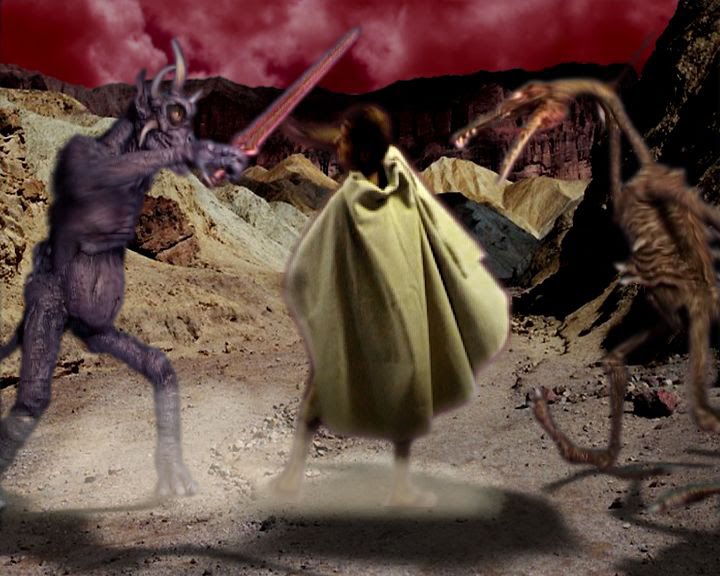
Although I am only an amateur filmmaker posting my videos on YouTube, I like to imagine that I walk in "uncle" Ray's footsteps. I've come to realize that there are quite a few of us doing that, so I'm in good company. My own purest Harryhausen tribute is probably "The King Who Sought Immortality", which features a questing hero walking into set-pieces with monster encounters. However, only one of these scenes is a traditional Harryhausen-style battle, but done with all the zest that I and my main actor Dag could muster. The scene has a more than a slight nod to the multi-opponent skeleton fight of "Jason".
Ray's passing has made me more than determined to continue my "hobby", as others like to call it, my passion, as I like to call it. It has also made me realize I have to pick up my slack if I wish to be a prolific filmmaker, even if it as as an unpaid, YouTube backyard-epic mogul. It made me realize that I haven't done my own Greek mythology epic -gotta fix that. I haven't made my own Arabian Nights epic -I actually have a script for that. I haven't made my own dinosaurs vs cavemen film -let's get to work!
Let us not dwell on the "remakes" of Ray's "Clash of the Titans", as these films are insults in every way to both Ray and the moviegoing audience. Let's instead consider the many "children" of Ray, and celebrate the incredible influence he's had on popular culture. Both George Lucas and Peter Jackson has admitted that no Harryhausen, no "Star Wars" or "Lord of the Rings" movies. The same goes for his influence on James Cameron, and the whole slew of amazing British animations, spearheaded by Aardman. The examples of master movie craftsmen and women are too many to list. In short, Harryhausen is one of the most important figures in the history of entertainment. So many have been led by his example of excellence, and new aspiring fimmakers continue to discover him.
Anyway, this has been my little tribute and walk down memory lane.
Thanks Ray; my life would be so much poorer without you.

Thursday, January 24, 2013

Stop-Motion Devil Puppet

Swedish film editor and CG FX creator Christoffer Åström contacted me about building and animating a cartoony devil for a music video featuring US band "Angry Johnny and the Killbillys". It's supposed to be a tiny imp, haunting the video's protagonist, and hounding him into doing dastardly deeds. Is the devil real, or is it just in his head; who knows! 
 
 
I started off with sculpting the head to get an interesting expression, defining the character. This puppet was going to be about the scale of the “real” devil, and slightly bigger than my usual puppets. Plastic balls stood in for the eventual finished eyes.

 
As I usually do I sculpted the front half of the puppet's torso, allowing me to have control over the most visible part of the puppet. This whole piece is cast as a loose latex skin, into which I can add padding, eyes, and the head armature.

 
The horns were actually the first thing I did, as you might've figured out from that first image. I did one horn sculpture in Chavant clay, based on the wild mountain Ibex goat. The sculpture was encased in soft silicone (DragonSkin FX), and removed, pretty intact, actually, after the silicon mould had set.

 
Two horns were cast in black-tinted SmoothCast 325. No news here for those of you who usually frequent my blog; I've been using the same materials for years, and as long as they work for me I see no reason to change to something else.

 
The hooves and the teeth and gums of the devil were also sculpted in clay and cast in plastic. For the teeth I used a different plastic; the slightly more flexible, and therefore more durable, SmoothCast 65D.


SmoothCast 325 can be a bit brittle when casting minute detail, like miniature teeth, for example, and the 65 D variant doesn't have that problem. It also cures solid white, which of course is the perfect base colour for teeth.


I did a slightly different armature this time around. Instead of using two or more tightly braided medium-thick aluminum wires I used very thick aluminum wire as it was. The “bone” sections of the armature were, per my usual method, covered with Friendly Plastic thermoplastic, but I also added long nails with the heads cut off. This meant the wire had to go exactly where I forced it. It bent, and it stopped with virtually no jiggle at all. You want as little jiggle as possible when you animate. This is the way I'll be building all my armatures from now on, even smaller ones.

The protruding rods on the back are screws embedded in Friendly Plastic. They're there simply to act as a sturdy piece I can grab hold of when animating. The cast cloven hooves were added to the armature, with wingnut tie-downs in the bottom.


The padding of the body was constructed out of variously soft and denser pieces of polyurethane foam, following a human muscle diagram. Here and there latex-soaked cotton was added to accent bonier parts, such as the hand and the legs.


Here's the cast torso latex skin, with Friendly plastic holding together different parts on the inside, such as the horns, the teeth and the aluminum jaw wires. There are also wires for the upper lip and the eyebrows. I've glued pieces of foam to certain areas to help fill out the skin in the best possible way.

 
The eyes were simply made from white plastic balls painted with hobby paints and glued into the eye sockets. The inspiration for these orbs were the eyes of Paul Blaisdell's low-budget monsters from various 1950's and 60's films. Blaisdell's monsters were always a tad crude, but his designs really grab you. His monster eyes were bloodshot and bulging. My original intention was to have moveable eyes, but the slit pupil design proved to be tough to keep in proper alignment. These static eyes will do the trick.

 
The padded body was covered with patches of cast latex skin, taken from flat plaster moulds. Liquid latex was used as a bonding agent.

 
I decided to put a fish-fin-like fringe along the puppet's arms. This detail was inspired by medieval art, showing devils with such protrutions here and there on their bodies. The bony outgrowths were simply made by dipping cotton in latex and rolling it between my fingers into a pointy shape. After all these pieces were stuck to the arms, I pressed very soft modelling clay against the arm, embedding the cotton “needles” about halfway, and then painting tinted latex over it.

 
The finished patched skin on the puppet was given a dry rub of tinted latex, and then subtle detailing with acrylic airbrush paints.

 
And here's the finished bad boy, with some fake fur added to his feet and private parts, and a slight paintjob on his horns and hooves. Well, not quite finished, as he'll be wielding a trident pitchfork too (of course). When that's made I'm probably off animating. I shall report on the progress when the project is up and running.