Saturday, January 13, 2024

In the Age of the Piltdown Man


Paleontology has a long and checkered history, with lots of mistakes and false assumptions littering its legacy. Among the more amusing ones is the story of the Piltdown Man. 


The above image shows the so-called Piltdown Gang, the academics and enthusiasts who launched the Piltdown Man into public awareness and created a sensation. The man standing directly to the left of the lab-coated sitting fellow is Charles Dawson, an amateur archeologist who claimed to have found the fossil remains of the "first Englishman" in an East Sussex Piltdown gravel pit in 1912. It took many researchers 41 years to figure out that the bits of a skull and jaw that were found were nothing more than a hoax, and a fairly obvious one at that. The skull was apparently human, while the jaw came from an Ourangutan. It seemed that Dawson created the hoax to fool and ridicule the academics who had dismissed him and his various amateur theories.


41 years is a long time and a lot happened concerning the Piltdown Man skull during those years. Among other things, the "first Englishman" was given a proper scientific name, "Eoanthropus dawsoni" (Dawson's dawn-age man), and several engaging illustrations were produced, showing him stalking through prehistoric Britain. Dawson was not idle during the years following his great "discovery." Perhaps he got cold feet, for as interest in his find grew and more people flocked to the Sussex gravel pit to hunt for more fossils, Dawson started to put things into the pit which would eventually convince the academics that they were dealing with a big prank. He even put a bit of wood into the excavation site, suspiciously similar to a Cricket bat, to illuminate the true nature of the Piltdown Man joke, but to no avail.


I always thought it would be fun to make a story about the Piltdown Man and what a fictional version of prehistoric England might look like. I sculpted four Piltdown Men since my initial idea was to have two Cricket teams with two on each. In the end, I just used two of these characters.
 

The eyes were simple plastic pearls, with painted irises covered with a clear coat of gloss lacquer.


I did cast four latex skins from a single plaster mold covering all four sculptures. I may use the two discarded skins for other characters eventually.


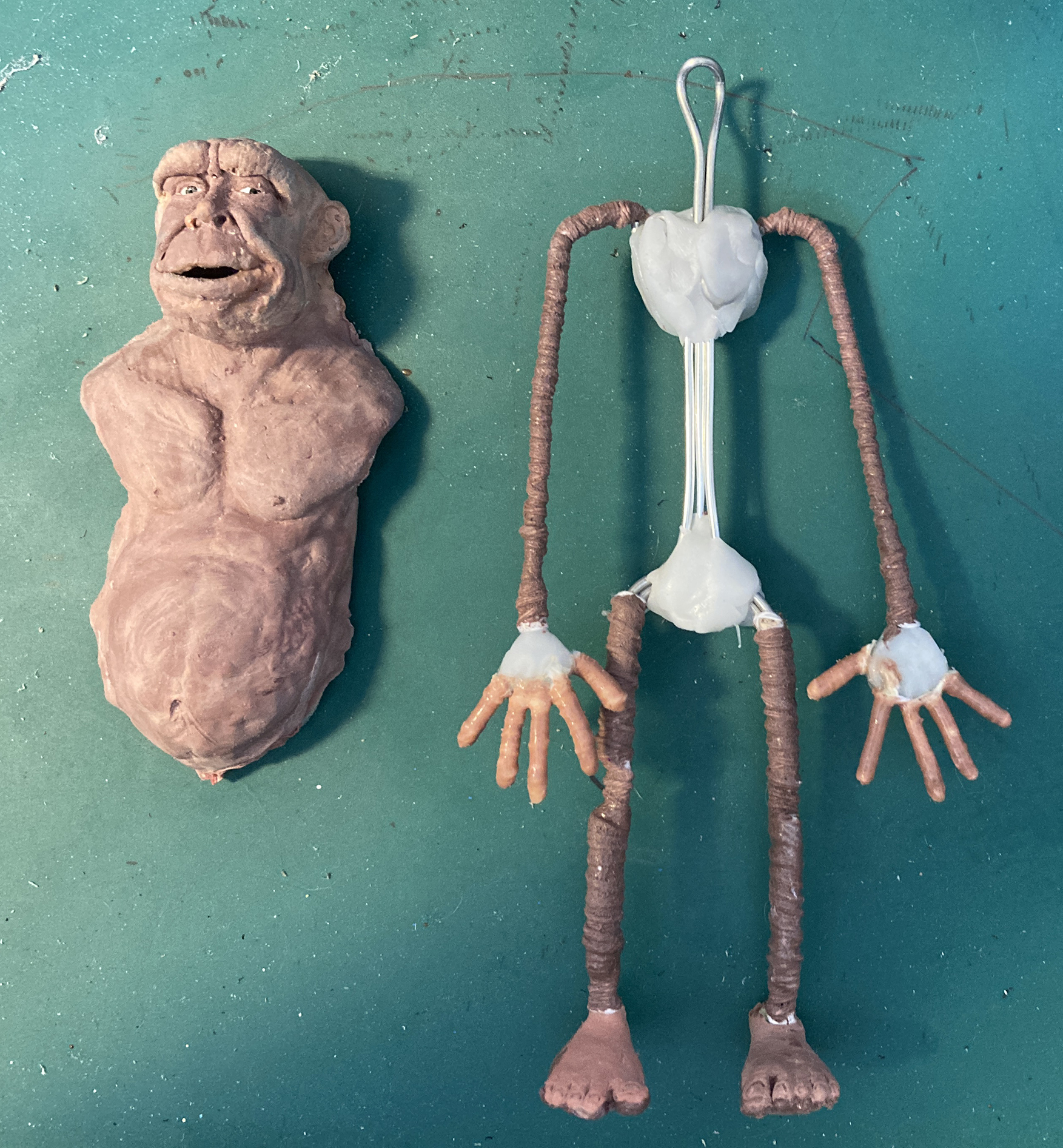
The inside of the head part was lined with a mix of latex and cotton to create a sturdy, leathery quality. After the latex/cotton mix had dried, it was covered with thermoplastic to create a skull of sorts. The eyes were embedded in silicone clay sockets held in place with the thermoplastic. A single 2 mm aluminum wire animates the jaw. Bits of polyurethane foam soaked in latex were stuffed into the chest area to help maintain its shape.


The armatures for my two Piltdown Men were very simple. The feet have threaded bolts for tie-down, and the rump has another threaded bolt for attaching my flying rig for certain scenes. The feet were also sculpted and cast in latex, but they were, in fact, made years ago for another puppet project


I spent quite a bit of time building up foam bits over the armatures to create subtle shapes of fat and muscles.

When the foam build-up was finished I attached the latex chest- and head piece to the armature, and added small patches of tinted latex skin to cover the foam. I have a rubber texture stamp with a very subtle texture imitating pores into which I added thin layers of latex.


The puppet was then given a unifying coat of tinted latex, which was sponged on in thin layers.


The finished Piltdown Men (just one shown here) were augmented with dashes of acrylic paint, and of course, a handsome coat of bodily hair. The hair used was crepé hair (sheep's wool) glued on using liquid latex. Teeth were made from tissue paper and latex. The Cricket bat was cut from a strip of wood painted with watercolors.


I thought it'd be fun to have my very own Piltdown Man skull, so I made one from a discarded human skull I cast years ago (I never throw away anything). To change it into the established reconstruction of the Sussex fossils, I added new parts made from epoxy putty. I used a dark grey variety, which I think was called chemical metal, or something similar, and when I ran out of that I turned to a yellow putty used by model makers.


The skull was then spray-painted with two layers of car paint and touched up with acrylic airbrush paints. The brown parts are a water-based hobby paint applied with a brush. They signify the actual fossil parts found.
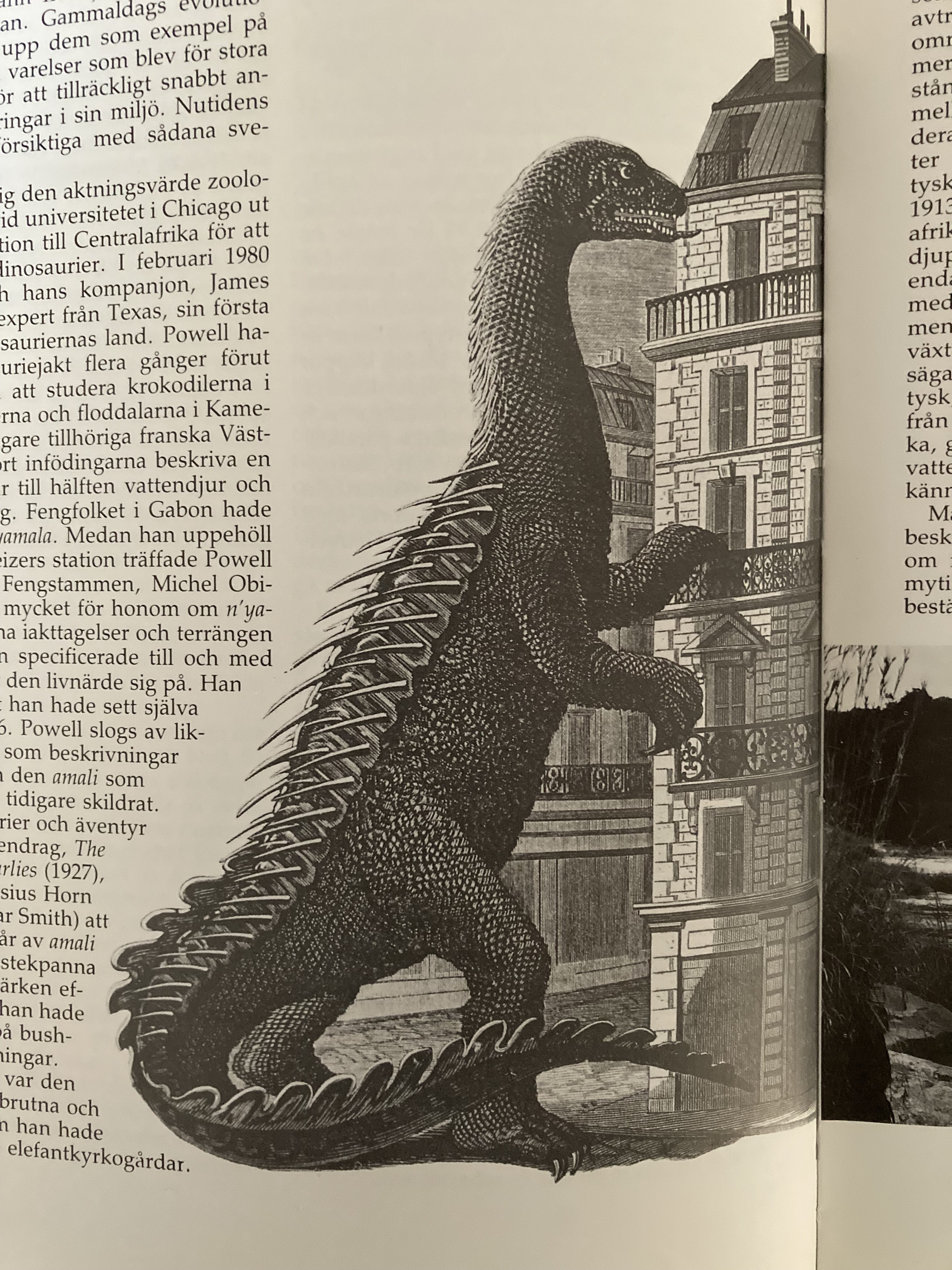
I wanted to add a few examples of prehistoric fauna to my caveman epic and felt that these animals ought to be on par with the Piltdown Man. Today we all know what a Stegosaurus looks like, but back when the original fossils were found several ideas were floating around. The above illustration is the creation of French artist Auguste-Michel Jobin and dates to 1884. Not only have the spikes and plates switched places, but the animal is now a biped. Eventually, American paleontologist Charles Othniel Marsh would figure out what the animal looked like, and with slight corrections, his version is what we still go with today.


Isn't this a cool picture? Jobin's Stegosaurus is taking in the sights in a (then) modern city to show the scale of the animal. All it reminds me of is, of course, modern Kaiju movies. This critter would certainly make a very nice stop-motion puppet.


My favorite movie dinosaur of all time is the 1933 "King Kong" Stegosaurus, built by Marcel Delgado and based on paintings of the animal made by Charles Knight. However you look at it I stole his designs or was inspired by them when sculpting my Victorian Stegosaur head. I also created a sculpture of knobbly, scaly skin similar to the hide on Delgado's monster. My head sculpture was quite small, just a bit over an inch and a half long, but I still managed to pack quite a bit of detail in there. The eyes are tiny doll's eyes and made by a seller on eBay, where I bought them years ago. 


Another one of my usual aluminum wire armatures, here with the head cast in latex attached.


Lots of soft polyurethane foam muscles were glued over the armature using flexible contact cement. I used a speculative reconstruction of dinosaur muscles as a guide.


That knobbly skin is being applied, using liquid latex as a glue. I really like a good texture on a puppet. It monumentally adds to the character.


Here's the whole puppet covered with skin, cast with tinted latex in a texture mold from my skin sculpture.


The finished puppet is dry-brushed with tinted latex, with various subtle colors in layer over layer. The plates are bits of EVA foam covered with cotton and latex. The spikes are tissue paper and latex. The tiny teeth are just drops of latex tinted white. Small bits of latex skin were also attached to the edges of the mouth. I don't know if dinosaurs had that, but I've seen it in alligators and various lizards. The puppet is about 17 inches from the tip of the snout to the tip of the tail.


The second animal I chose to inhabit this undefined era-Britain was an incorrectly reconstructed Uintatherium; a herbivore described by American paleontologist Edward Drinker Cope (bitter enemy of Charles Othniel Marsh, by the way.) Cope called his animal Loxolophodon, and figured it was something like a small elephant or tapir with antlers, for some reason. The correct version of this animal (as far as we know) was provided by Marsh, and the genus Uintatherium was coined by Marsh's colleague Joseph Leidy. Anyway, Cope's reconstruction cried out to be animated, and so it was.
 

I sculpted most of the head for this puppet, not including the antlers and the trunk.


I forgot to snap any photos of the armature, but it's as basic as can be. Again, I used a muscle diagram to place the foam muscles in a believable way. I used a drawing of rhino muscles for this one.


The wrinkly elephantine skin came from a couple of well-used texture molds I made years ago. Lots of my puppets have been draped in these skin textures. The antlers are made from stiff metal wires covered with tissue paper dipped in latex.


The finished Uintatherium was dry-brushed with tinted latex using a sponge. The tusks were made from thermoplastic, and the bristles on the neck and the end of the tail were created with crepé hair.


Of course, this film was the perfect opportunity to finally do a Ray Harryhausen-inspired battle between two prehistoric beasties. Harryhausen's monster fights are quite similar, with certain tropes lovingly repeated, like an actor knowing what his audience wants and giving it to them: The circling combatants before the fight, the biting of horns, the foot on the fallen opponent -I included all of it in my animation. The only difference is that this fight is a draw. The monsters back off and live to fight another day.


A word about the backgrounds. I picked up a bunch of photos of the Hoh rainforest in Washington state, found on the Depositphotos collection, to which I subscribe. I felt that the drooping mosses and the glowing greens could represent a lush prehistoric England. The various marked-out walkways were removed in Photoshop.

The exploding volcano is a bit of stock CGI animation found on Videohive.com.

To research the animation for the Cricket play I actually watched actor Peter Davison perform a perfect bowl in the Doctor Who episode "Black Orchid."

The end credits are adorned by a rendition of Gilbert and Sullivan's "He Is An Englishman", sung by Harry Dearth in a 1907 recording. It's the only public domain recording I could find, but the crackling, ancient sound sort of fits in with the rest of the film.


Saturday, December 23, 2023

Heffalump!


In 2021, the copyright Disney had usurped for the Winnie-the-Pooh property since 1961 expired. I was among the people who had hopes for other creators coming in and adapting the stories in their own way.


Alas,  what we did get was the "satirical" horror movie "Winnie-the-Pooh: Blood and Honey." This disappointment got me thinking about what I could bring to the table, and I thought of an episode in the tales where Piglet dreams of Heffalumps.


Nobody really knows what a Heffalump is, except for it being huge and scary. Pooh illustrator E. H. Shepard portrays the Heffalump as a big, angry elephant, and Disney interpretations have gone that route too, in a way.


So, for my project, I needed a version of Piglet and a version of the Heffalump. Starting with Piglet, I went back to Shepard's original illustrations. Color versions show Piglet's vest (or whatever the garment is supposed to be) being green, so that's what I stuck with too.


I sculpted a piglet head in Monster Clay, having the notion to reproduce the sculpture as a latex skin, as I usually do. In the end, I only used a portion of it.


This simple armature made the basis for the puppet. Not seen in this photo, there is an attachment point on the armature's bum for a flying rig.


The arms and legs were wrapped with soft yarn, and the rest of the puppet was padded with soft foam.


Here's the finished Piglet puppet covered with latex skin. I did consider making Piglet a felt puppet, which would've looked better. But since I was more familiar with latex and foam padding I went that route. The eyes and buttons are scrapbooking half-pearls glued on.


My idea for a Heffalump was realized a bit earlier than my planning for this film. I made this drawing just for fun and posted it on DeviantArt. I thought it'd make a good animation puppet.


I started with making the face in medium-grade Monster Clay. I simply made the face a bit too big, which meant that the rest of the puppet would have to be bigger than I usually make my puppets.


The face was cast in tinted latex from a dental plaster mold created over the sculpture. I made two eyes from a couple of very colorful plastic pearls and drilled a concave surface into them to create irisis. Each iris was painted and filled in with UV resin. The eyes are placed in silicone clay sockets held in place with thermoplastic. Three and four millimeter aluminum wires were added for the ears, the eyebrows, and the jaw. As you can see I removed the latex eyebrows. I sometimes do that to improve on the flexibility of that part of the face. The white stuff you can see on the inside of the latex skin is Polymorph thermoplastic, adding support for the head. I also added a rigid plastic tube as extra support for the mid-section of the face.


New eyebrows were built up with soft foam.


I decided to make a trunk with a grasping hand at the end. Fingers were built up by wrapping soft yarn around aluminum wires, while the trunk had a base of yarn, with foam on top of it. The yarn wrapping at the base makes the trunk less wobbly and more organic-feeling.


I also sculpted a foot and cast four hollow latex versions of it, using a blend of latex and cotton lining the inside of each cast to make it extra sturdy.


This turned out to be a huge puppet, the biggest I've ever built, standing a little over 16 inches tall. Each leg had a bundle of 4 mm aluminum wires for its joints. The body piece is a bit of plywood. 


Lots of padding for this puppet. It really wouldn't flex its midriff, so I just built up a big blob of foam, making it both bulky and slightly gangly-looking with its long legs.

Lots of latex patches cast in skin texture molds were draped over the foam. All the patches were tinted when cast, which gives a very fleshy look.


The base color was applied using a sponge and tinted latex. Over this, I worked up hues of purple and blue, with red shadows in creases and folds.


Here's the finished Heffalump. The hair is dark grey fake fur dabbed with tinted latex. This made the hair stiff and easy to control. The nails and teeth were made from tissue paper and latex. Even the tusks were made this way. I rolled long strips of tissue paper soaked in latex and pressed them together until I had a tusk-like shape.


The backgrounds were all digital 2D images. Piglet's bedroom was cobbled together in Photoshop using various stock image elements. I found an old photo of a teddy bear and placed it in a frame, making a portrait of Winnie-the-Pooh.  Piglets pillows and bedclothes were bits of felt and cloth I had lying about. I animated Piglet saying "Bother!" when he woke up, but then remembered that it's Winne-the-Pooh who says that -Piglet says "Oh dear!" But when I dubbed in my Piglet voice (which I did myself) "Oh dear!" fitted anyway.


Piglet's nightmare forest was downloaded from depositphotos.com, where I have a subscription, and I'm assuming it's AI art.


So, that's my contribution to the pop culture universe of Winnie-the-Pooh and friends. Some kind people have suggested I should do more of this, but at the moment I'm happy with this short excursion. I love the Winnie-the-Pooh stories, and though it would be fun and a privilege to adapt them, I also feel I want to leave them alone and not add on my interpretations.