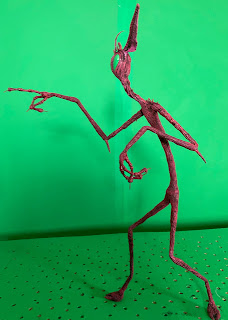
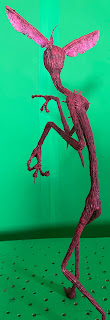
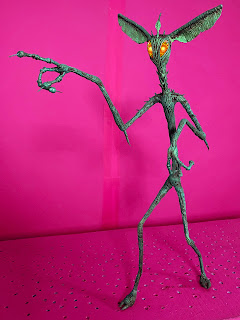
For quite some time I've been thinking about doing stop-motion recreations -of sorts- of weird creatures people claim to have met; cryptids, aliens, etc. I finally got around to it sometime around last September, when I decided to take on one of the very strangest encounters.
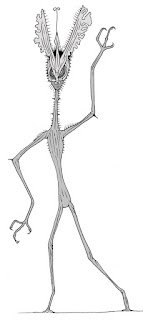
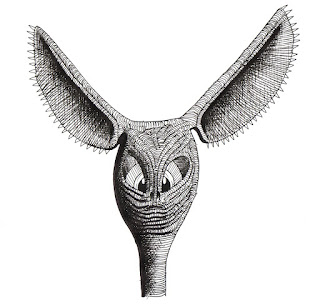
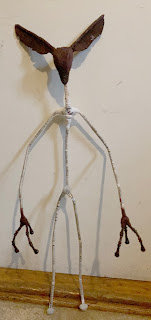
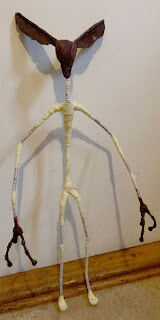
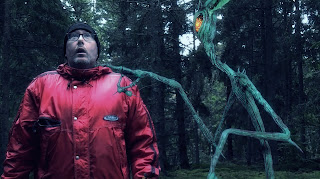
The above two sketches are reconstructions of what bow hunter Jennings Frederick says he encountered in 1968 during a stroll in the woods of Fairmont, West Virginia. According to Frederick he suddenly heard a strange grating sound and felt a painful sting in his neck. A strange, green spindly entity was standing next to him, poking him in the neck with its finger. A voice (maybe in Frederick's head) told him: "YOU NEED NOT FEAR ME. I WISH TO COMMUNICATE. I COME AS A FRIEND. WE KNOW OF YOU ALL. I COME IN PEACE. I WISH MEDICAL ASSISTANCE. I NEED YOUR HELP."
Afterthis short ordeal Frederick's was apparently let go and the creature disappeared into the woods. The flabbergasted hunter noticed that a line of blood trickled down his neck and he concluded that was what the alien stranger accosted him for. He then heard a strange sound which he surmised was coming from the creature's craft, whatever that may be. This very strange story has become something of an odd favorite among people interested inthe unexplained.
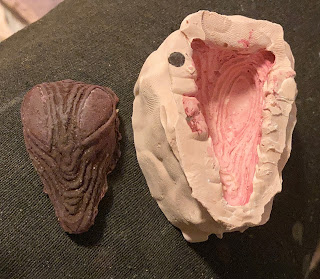
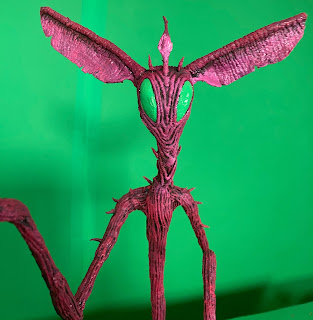
To make my vegetable man puppet I sculpted two pieces in clay and cast them in latex from dental plaster molds. The first was the head, or, more precisely, the face.
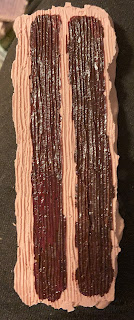
The second piece was a bit of bark-like skin texture, from which I could cast the bits of skin that would cover the puppet.
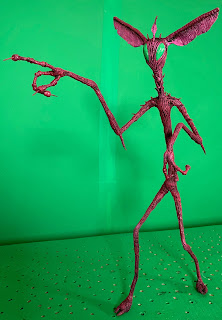
I made this pupper large, almost 40 cm tall, so I could make the limbs really thin. I used 1,5 mm aluminum wires reinforced with thin, but rigid, metal rods for the hard skeletal parts between each joint. A tight wrapping of crochet yarn soaked with latex held everything in place with the help of some Polymorph thermoplastic.
Though the creature was supposed to be very stick-like I still added a few spots of muscular detailing by soaking thin bits of polyurethane foam in latex and pressing those onto the body.
In the report, the creature is a dull green, but since I'm shooting against a green screen I painted the finished puppet red. The eyes were kept a chroma key green, so I could key those out and add animated eyes instead.
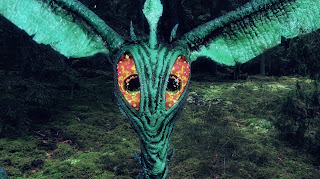
In After Effects I could then change the color of the puppet into green and also remove the eyes.
I used a caleidoscopic CG animation stock footage clip for each eye, which I think created a nice hypnotic effect.
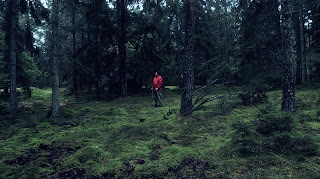
The film was shot at a forest about 20 minutes walk from where I live. It was absolutely pouring down this day and both I and my single actor were soaked through after a while.
This actor, by the way, is Leif Hult, who is also quite an accomplished singer. He suffered through the gloomy afternoon and even dropped to the ground in the wet moss in one scene. The puppet was animated to interact with his movements.
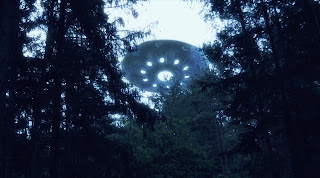
At the end of the film it's revealed that the creature is actually an alien, and Leif watches it take off in a flying saucer above the trees. I tried to film the tree tops without having the rain completely soak my camera. The UFO is another CG animation downloaded from Storyblocks.com as a green screen shot. I composited it into the sky above the forest by creating a matte from the trees. I used a contrast tool to make the trees completely black and the sky completely white. After Effects then allows you to place your original footage in a layer above the contrasted footage and using it as a matte, which makes the trees a layer without the sky. A third layer with the sky is then dropped under both these layers. It sounds a bit complicated, but it really isn't. It's actually a very old effect that's been used since the silent movie era. Back in the day it was a chemical process created with an optical printer, or by reversing the shot in camera and running the footage twice through the camera gate. Doing it digitally is, of course, much, much easier.
As you saw in my version of the story, Leif isn't a bow hunter. He's just a guy out for a stroll in the woods and happens to encounter this creature. I did, however, use what the creature said verbatim. It seems this film was quite appreciated by my YouTube audience, and I was encouraged to do more projects of this kind. Since there are almost countless similar weird encounter stories from all over the world to pick from I will get back to the subject eventually.
So, here's the story behind "Swamp Feeder." For years and years, I had been peering at the tiny blurry photos of Clark Ashton Smith's various sculptures, that could be found on the internet. As far as I know, they were all scanned from a single book, "The Fantastic Art of Clark Ashton Smith" (1973) which now fetches prices around $200 or so. A more recent book featuring his sculptures, carvings, drawings, and paintings; "In the Realms of Mystery and Wonder" (2017), is already incredibly expensive. Hence what I knew of his figurative carvings had to be gleaned from those small, blurry images.
Most of his sculptures were carved out of soapstone, and other soft minerals found in the Californian hills where Smith lived. All his work has the look and atmosphere of ancient artifacts. There was especially one piece that tickled my imagination, an elephantine monster named "swamp feeder." I always thought that the little creature could translate into a very effective stop-motion beastie, and the name would make a great title for a film. This idea was the simple foundation for the whole project.
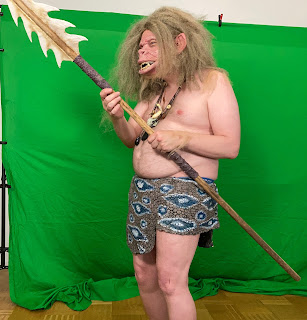
My first idea was to use a main character who was also a stop-motion puppet, but I changed my mind when I thought about my quirky pal Andreas Pettersson. If you've been following my YouTube videos the latest four years or so you'll recognize him. Andreas has a number of physical and mental afflictions, among them an almost blind eye, epilepsy, ADHD, and cerebral paresis. Still, he blasts through life with greater gusto than most perfectly healthy people I know. He's also not averse to heavy make-up jobs, so he agreed to play the apeman hero of the film.
I made a clay sculpture for the face, and also a jaw (not pictured) that was slightly comical, with an upturned nose. Over this, I made a dental plaster mold and in it, I cast the latex mask used in the film.
I filmed all of Andreas' scenes in his apartment, using a green screen. I made him up in his kitchen, where he stripped down to his underwear.
I had a pair of old latex Orc ears I made years ago for a friend into live-action fantasy role-playing. Over those, I built a pair of big chimpanzee ears using tinted latex and cotton. Not my best work, but I think it did the trick. They were glued on over Andreas' own ears using Telesis 6, a very powerful but also very expensive adhesive. I think it's the preferred adhesive of most make-up people working in film and TV today, as it's specifically formulated to work with silicone prosthetics. The white stuff you can see on the ears is Prosaide adhesive mixed with Cabosil to produce a paste that is applied over the edges of the latex ears. This helps cover the rather obvious break between latex and skin.
The same paste was also used over the edges of the face mask. The mask is painted a dark fleshy red using tinted latex to create a base color, and the teeth are made from tissue paper and latex.
I use rubber mask grease paints applied with a sponge and transparent fixing powder to color the mask. The mix between the grease paint and the red base color blended in a rather nice mottled look.
Crepé hair was applied along the cheeks, again using Telesis 6. I also added some on his shoulders and arms, though Andreas is already quite furry.
A Janis Joplin-like wig gilds the lily along with a cluster of stone-age jewelry.
The shaft of the spear was made from the remnants of a cut down brush in my garden. The harpoon-like spiky bits were cardboard covered with latex and cotton. Strips of scaly latex skin were cast in old plaster skin texture molds. The same goes for his loincloth, which was simply tucked into Andreas' underwear, and miraculously stayed in place for the whole shooting. When we filmed this in Juli it was blazing hot, and the jaw appliance kept coming loose. Apart from that, the whole ensemble held up very well.
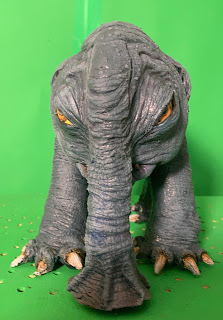
As for the puppets populating the world of the hunter, let's start with the actual swamp feeder itself. The only new sculpture I made for this puppet was the head, which I made in medium-grade Monster Clay. As you can see, I only did the base of the trunk.
I wanted really big and expressive eyes for the puppet, and made them out of two wooden balls, adding photoshopped irises, paint, and UV resin over them. The eyes were then placed in silicone sockets.
The body is padded with thin strips of polyurethane foam, wrapped around the aluminum wire armature, and used as rudimentary muscles. The trunk is also padded aluminum wires, then covered with patches of latex skin.
This very blurry photo still, hopefully, conveys the look of the puppet covered with textured latex skin right before it's painted.
The final puppet was painted with tinted latex. The teeth are tissue paper and latex. The feet are cast in latex from an old mold made for an older puppet project.
However, the first creature the hunter encounters in the film is the "prickleback", as I named it. It's a huge, slow dinosaur-like creature with a spiky backplate. I sculpted the head and a bit of the neck being inspired by the look of soft-shelled tortoises. Some of them have an elongated snout, which they use as a snorkel. I also added a crest which in the final puppet would extend into long, thin shafts, similar to the lures seen on deep-sea fish.
The armature was very plain, with a center section held together by wood tongue depressors and thermoplastic.
Here's another blurry photo, but I hope you'll get an idea about how the foam padding was structured over the armature. The white foam making out the back is denser than the rest.
I used latex skin patches cast in old texture molds, but to give the skin a more prominent look I added drops of latex to the skin to create an alligator-like appearence. Almost all of the puppet was given this treatment, so it took a while to get it all done. The shell on the back is a latex cast, backed with latex-soaked cotton, which came out of a plaster mold I made in the early 2000s. It was originally a coral used in a film that a friend made.
All the spikes as well as the toes, the teeth, and the hook claw hands were made from tissue paper and latex. The crest on the head was made from aluminum wires covered with sewing thread and latex. The whole thing was painted with a sponge and tinted latex. The eyes were a couple of shiny fake pearls.
Our intrepid hero also encounters a bird of sorts. It's very brief, but I had fun making the eccentric puppet. This one was also based on a work by Clark Ashton Smith, a sketch made with graphite pen.
I didn't take a photo of the bird's armature, so you'll have to take my word for it being brilliantly simplistic. I also didn't take any photos of the one new sculpture I made for the puppet, which is the head. This piece was sculpted in two separate parts; upper and lower. The pointy ears were cast in an older puppet mold. I padded the body with a blend of thin polyurethane foam (the green parts) and foam soaked in latex (the yellow bits.) The wings were actually lying around from some discarded project I can't remember anymore. They're thin latex skins draped between aluminum wires wrapped in soft yarn.
As usual, I grabbed a couple of old plaster skin texture molds and cast the bits of skin I needed to cover up the padding.
The finished puppet was drybrushed with tinted latex. I used a couple of glass bird's eyes from a taxidermy shop.
I found another CAS sketch that was inspiring. I decided to make a slug-like creature and thought this weirdo with its tendrils would fit the bill.
I made a pretty detailed Monster Clay sculpture for the better part of the head. I used two big plastic toy jewelry beads for the eyes.
The head was cast in tinted latex, with the tendrils being single aluminum wires covered with soft crochet yarn and latex. The eyes were painted with bright hobby paints, and covered with UV resin to create a basic lens effect over the eyes. I also added a thicker single aluminum wire around the inside edges of the slit-like mouth.
Here's the very simple armature. I included 4 mm threaded nuts in the two feet. These were the only tie-down points on the puppet.
The back of the head was built up with dense foam covered with latex and cotton. The body had a very simple padding, using foam with various densities.
An old often used skin texture mold provided the latex skin for the puppet. The big claws are also latex, cast in plaster molds going all the way back to the early 2000s.
Also this puppet was drybrushed with tinted latex. I added some Glossy Accents scrapbooking plastic around the mouth to make it look moist.
Briefly, a flying creature goes past the "camera". Ever since the Dagobah scenes in "The Empire Strikes Back" it's kind of obligatory to have a strange winged, squawking critter flying past the camera in an alien swamp setting, so I had to have one too. However, I cheated with this one. I didn't build a new puppet for this single shot. Instead, I used a still image of a puppet I built for my US filmmaking buddy James Balsamo earlier this year.
These long-legged fish-like critters are called "seatars" in Balsamo's movie "Raven Slender: Alien Danger", where they're a background feature, again, like in the original Star Wars movies. I'll do a post specifically about my work on that project. I simply removed the legs in Photoshop and added a couple of stock footage CG wings in After Effects.
So, what about the actual swamp of the Swamp Dweller? It looks nice and dense but is actually made up of only three models, plus a few close-up photos of lichen and mosses.
I wanted a forest of huge strange-looking plants dominating the environment. So I built a single model which was very detailed and allowed for close-quarter shots. This model had a simple armature made from thick aluminum wires and steel wires attached to an empty paint jar, using thermoplastic to fix everything in place. I also made a bunch of tentacles -steel wires wrapped in thick yarn- and stuck them to the paint jar base.
The huge roots were padded just like I pad my puppets, with strips of polyurethane foam wrapped around the metal wires.
The finished model has a covering of very detailed latex skins, again pulled from older skin texture molds. Tinted latex was sponged on and then I applied dots of glitter glue here and there to add shiny spots of beauty to the otherwise grotesque model. Hanging from the underside of the trunk are "air roots" made from "chunks o flesh", basically a thin surface of tinted latex scrunged up. This technique produces lovely organic-looking shapes, and I've used it many times on my puppets.
Both the roots and the branches can be positioned in endless ways, so that's exactly what I did -I bent the various parts, took a photo, re-positioned the parts, turned the model a bit, and took another photo. Eventually, I had a bunch of photos of these alien trees that I could layer in After Effects to make a dense forest.
I also made this fungus for the swamp. The stem is a plastic tube, actually a effervescent vitamin tablet dispenser, covered with a thick latex cast from another texture mold. The top is another prop made for the same project from which I took the back shell for the prickleback. I had it lying around my workshop for many years, and eventually it ended up here.
This strange plant was built in a similar very quick way. The trunk is another empty paint jar covered with "chunck o flesh" and spike outgrowths made from cotton soaked in tinted latex. Both this prop and the fungus were photographed multipal times from various angles and cut out in Photoshop to be added to layers in After Effects.
"Swamp Feeder" was entirely inspired by the image art of Clark Ashton Smith, and it was a fun project to do. Andreas who played the hunter also had fun, though he went through a very demanding make-up process. I'll most likely do similar projects, where I'm more inspired by imagery rather than a story that's already written by someone else.
The music was especially composed by my italian friend Marco Zanelli, who produced it in record-breaking time. I'm glad I have so many talented collaborators!