Saturday, February 28, 2015
"The Other Gods": The Finished Film
And here it is, ladies and gentlemen. I hope you'll enjoy it. It took two years to finish the darn thing, but the main reason for that is that I've been crazy busy with other things since the fall 2013. Hopefully, I won't take that long to finish the next one.

Saturday, February 14, 2015
The Story of Odin
Taking a short break from "The Other Gods" I thought another project might be of interest to you. Besides working on my own personal stuff I make films with the handicapped people at my day job, teaching them how to use the film equipment, how to blog, and generally how to take advantage of the various social media to market yourself and your creativity. You may remember a film from last year, "Aladdin", made with this group.

Last fall I shot this film, "The Story of Odin", conceived by Joakim Strömgren, who has a light psychological disability. He wanted to make a film based on Norse mythology, with himself in the lead. We settled on the tale of how Odin lost his eye, became a mighty magician, and eventually the chieftain of the gods. Joakim presented me with an outline of what he wanted to include, and we cobbled together the manuscript.

Here's how the film was shot; in a hopelessly crammed space, with bad lighting and a very simple consumer market camera, not at all suited for chroma key work. The resulting footage needed a lot of processing and tweaking in After Effects to work. The actual effects of the film also required tons of tweaking. I didn't have the time to make all the puppets needed to portray frost giants, trolls etc, so I had to compromise and use 2D animation far more than I'd ever done before. It was not something I preferred to do, but I got the basic job done.

Here's an example. These two frost giants inhabiting the desolate world before the real world is created was made up using photos of several puppets. The cyclops to the right is actually a fully constructed puppet that I haven't used yet for any project. Since I didn't have time to properly animate him, I simply took a snapshot of the puppet and animated it in After Effects using the puppet tool. This tool allows you to add key points on a still image (or a moving one) and pulling at those points between key frames in the timeline allows you to simulate very smooth motion. It's a popular way of creating fake extreme slow motion.

The two-headed giant to the left is pieced together using photos of an elephantine demon puppet from "The King Who Sought Immortality", and the heads of the scorpion men from that same film. I coloured all parts in the same flesh tone in Photoshop, and animated the 2D creature using the puppet tool.

Many scenes were created this way. Here's another example; the giant Ymir eating one of the smaller human-like Aesir(Norse race of gods). This puppet is also finished and was built for a project that is still waiting to be pieced together. Lack of time forced me to use the puppet tool on photos of this guy too.


Then there were shots that, in my humble opinion, couldn't have been created any other way than using 2D images and the puppet tool. A depiction of the fall of the gods at the battle of Ragnarok was created with numerous layers of images, including one of Joakim as Odin straddling his eight-footed steed Sleipner, and another where Odin is swallowed by his arch-enemy the Fenris wolf. I used stock photos of animals and lots of photos from various LARP and reenactment societies, including a local one.


When telling a story taking place in the world of Norse mythology you can't be stuffy about it -you have to at least attempt to show the grandeur of that world. So filming against a green screen was a no-brainer. It turned out quite well, but a better camera would've made the film better-looking. The backgrounds are a mix of Photoshopped still images and stock footage, mainly from Videoblocks. In the end I managed to achieve the look and atmosphere both I and Joakim were hoping for.

In the original script Odin passes through Jotunheim, home of those giants and trolls that didn't perish in the great flood that created the new world. He was supposed to meet and fight three trolls, and I started on the puppets with clay sculptures and plaster moulds. Unfortunately time constraints forced me to abandon the troll encounter, so these puppets will have to wait for another film project.

I did however include an encounter with Nidhögg, a serpentine dragon who gnaws on one of the roots of the cosmic world-tree Yggdrasil. This monster was realized as a finished and stop-motion animated puppet.

I decided that I wouldn't build the whole of the monster, just the head and neck, and concentrated my efforts on making a gnarled and unpleasant-looking, but regal head for Nidhögg. The head sculpture was split in half and cast in dental plaster moulds.

Cast in latex lined with a leathery latex/cotton mix, the head and jaw were joined with thick aluminum wires. Another thick aluminum wire was attached to a piece of board and joined to the head with Friendly Plastic thermoplastic. Soft polyurethane foam padded the body, which was then covered with cast latex skins pulled from older dinosaur and monster skin moulds.

Nidhögg has a crest along his back similar to the fins of deep sea fish, or, if you will, the crests and wings of devils of medieval church interior art. The spikes were pieces of cotton dipped in latex and rolled between my thumb and index finger. The skin between them were latex applied to soft clay stuck to one side of the spikes. After two layers of latex the clay could be removed. The latex was dusted down with talcum powder first.
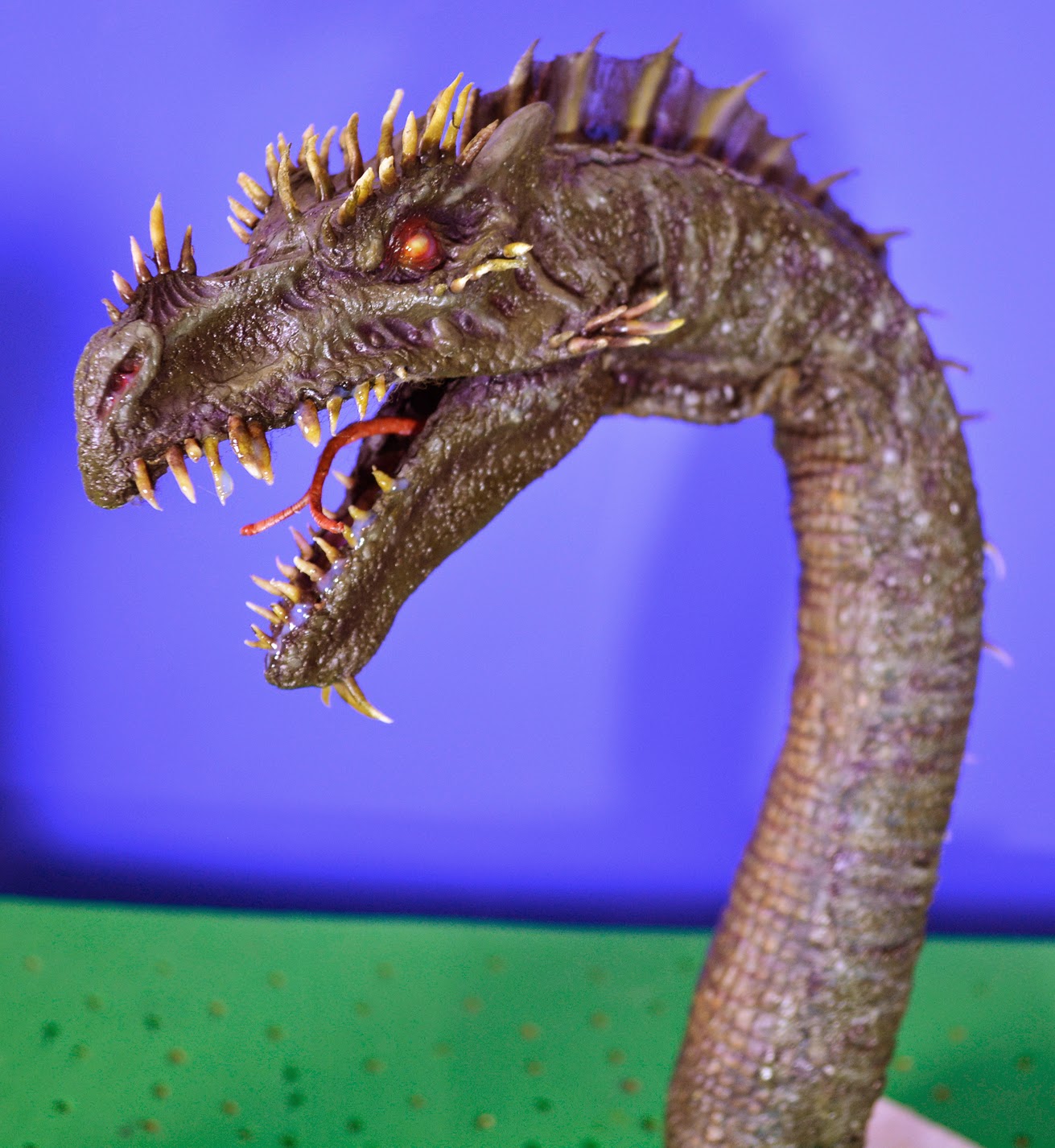
The teeth and horns were also cotton and latex. A mix of acrylic paint and Prosaide glue covered the puppet as a base paint. Acrylic airbrush colours were used for the finishing touches. As you can see a tongue was also added by wrapping sewing string around very thin steel wires and then applying tinted latex.


Joakim was a delight to work with, and I hope to do it again, this time with better equipment and a longer production period. And finally, here's the finished film. It's all in Swedish, though.
Last fall I shot this film, "The Story of Odin", conceived by Joakim Strömgren, who has a light psychological disability. He wanted to make a film based on Norse mythology, with himself in the lead. We settled on the tale of how Odin lost his eye, became a mighty magician, and eventually the chieftain of the gods. Joakim presented me with an outline of what he wanted to include, and we cobbled together the manuscript.
Here's how the film was shot; in a hopelessly crammed space, with bad lighting and a very simple consumer market camera, not at all suited for chroma key work. The resulting footage needed a lot of processing and tweaking in After Effects to work. The actual effects of the film also required tons of tweaking. I didn't have the time to make all the puppets needed to portray frost giants, trolls etc, so I had to compromise and use 2D animation far more than I'd ever done before. It was not something I preferred to do, but I got the basic job done.
Here's an example. These two frost giants inhabiting the desolate world before the real world is created was made up using photos of several puppets. The cyclops to the right is actually a fully constructed puppet that I haven't used yet for any project. Since I didn't have time to properly animate him, I simply took a snapshot of the puppet and animated it in After Effects using the puppet tool. This tool allows you to add key points on a still image (or a moving one) and pulling at those points between key frames in the timeline allows you to simulate very smooth motion. It's a popular way of creating fake extreme slow motion.
The two-headed giant to the left is pieced together using photos of an elephantine demon puppet from "The King Who Sought Immortality", and the heads of the scorpion men from that same film. I coloured all parts in the same flesh tone in Photoshop, and animated the 2D creature using the puppet tool.
Then there were shots that, in my humble opinion, couldn't have been created any other way than using 2D images and the puppet tool. A depiction of the fall of the gods at the battle of Ragnarok was created with numerous layers of images, including one of Joakim as Odin straddling his eight-footed steed Sleipner, and another where Odin is swallowed by his arch-enemy the Fenris wolf. I used stock photos of animals and lots of photos from various LARP and reenactment societies, including a local one.
When telling a story taking place in the world of Norse mythology you can't be stuffy about it -you have to at least attempt to show the grandeur of that world. So filming against a green screen was a no-brainer. It turned out quite well, but a better camera would've made the film better-looking. The backgrounds are a mix of Photoshopped still images and stock footage, mainly from Videoblocks. In the end I managed to achieve the look and atmosphere both I and Joakim were hoping for.
In the original script Odin passes through Jotunheim, home of those giants and trolls that didn't perish in the great flood that created the new world. He was supposed to meet and fight three trolls, and I started on the puppets with clay sculptures and plaster moulds. Unfortunately time constraints forced me to abandon the troll encounter, so these puppets will have to wait for another film project.
I did however include an encounter with Nidhögg, a serpentine dragon who gnaws on one of the roots of the cosmic world-tree Yggdrasil. This monster was realized as a finished and stop-motion animated puppet.
I decided that I wouldn't build the whole of the monster, just the head and neck, and concentrated my efforts on making a gnarled and unpleasant-looking, but regal head for Nidhögg. The head sculpture was split in half and cast in dental plaster moulds.
Cast in latex lined with a leathery latex/cotton mix, the head and jaw were joined with thick aluminum wires. Another thick aluminum wire was attached to a piece of board and joined to the head with Friendly Plastic thermoplastic. Soft polyurethane foam padded the body, which was then covered with cast latex skins pulled from older dinosaur and monster skin moulds.
Nidhögg has a crest along his back similar to the fins of deep sea fish, or, if you will, the crests and wings of devils of medieval church interior art. The spikes were pieces of cotton dipped in latex and rolled between my thumb and index finger. The skin between them were latex applied to soft clay stuck to one side of the spikes. After two layers of latex the clay could be removed. The latex was dusted down with talcum powder first.
The teeth and horns were also cotton and latex. A mix of acrylic paint and Prosaide glue covered the puppet as a base paint. Acrylic airbrush colours were used for the finishing touches. As you can see a tongue was also added by wrapping sewing string around very thin steel wires and then applying tinted latex.
Joakim was a delight to work with, and I hope to do it again, this time with better equipment and a longer production period. And finally, here's the finished film. It's all in Swedish, though.
Sunday, February 8, 2015
"The Other Gods": The Gods Themselves Part 2
I addition to building and animating puppets I've used other techniques to depict the more abstract Lovecraftian horrors. There's only so much you can do with a practical puppet when it comes to creating truly mind-boggling creatures; then you'll have to use other tricks. "Digital 3D animations" you may think. Nay, my friend - a lot can be achieved with old-school 2D animations using Photoshopped images and simpler puppet animations.

Let's start with this "god". The background is a time lapse stock film clip downloaded from Videoblocks, as is the organic-looking rotating ball in the center. The other parts are bits of illustrations made by Ernst Haeckel depicting corals and oceanic micro life.
 Haeckel's beautiful and sometimes curiously disturbing art was collected as "Art Forms in Nature" in 1904. I use this book frequently as inspiration when sculpting Lovecraftian monsters. The clean crisp details are both inspiring and informing.

Ten bits of Haeckel illustrations make up the various parts of the abstract "god". They were imported in a number of layers in After Effects and made to rotate in various directions by key framing their movements in the timeline. If this all sounds like Greek to you, then do what all civilised people do; look up "key framing in AE" on YouTube. When this animation was rendered out it was imported again and a softening filter from Rampant Color FX was added over the clip.
This creature was created by using Photoshopped 2D images and a little piece of stock CGI animation, but I find that the best composite monsters are made up with moving sculpted parts, in other words puppet animated bits. So let's take another example.

This critter slowly spins around in the air and opens a mouth in its flower-like head to attack one of the protagonists. If this monster seems familiar it's because I re-used a mould of a sculpture for a worm monster created a few years back for a Lovecraftian game created by Rolando Guiterrez. I'm using that monster's head here with his permission.

This time the head was mounted on a wooden support painted in the chroma key green I use for most of my backgrounds nowadays. The latex head has aluminum wires in the four flaps that open up into a mouth when pulled back, and each "petal" along the fringe also has a bit of wire in it. This allowed me to animate an undulating motion in the fringe.

New for this project was this larger fairly detailed tentacle. I animated it moving as slowly as I could.

Also added were three layers of this collection of smaller tentacles animated for my previous "Lovecraft Alphabet". When put together in After Effects, the finished composite created a quite lively squirming monstrosity, looking something like this:

I might've been able to build and animate a whole puppet like this, but the resulting headache was something I didn't want to take on. Doing it this way, with composite elements is a better solution, and it allows me to keep check of each part of the monster, making adjustments as work progresses.
I have been busy for most of 2014 with my day job activities, which mostly include making films with people having various handicaps. Very little free time has been made available to me, but I'm changing that. I can't let me own projects linger for months on end, so I've changed my duties at work, and I hope that 2015 will turn out to be one of my most productive years yet.
Let's start with this "god". The background is a time lapse stock film clip downloaded from Videoblocks, as is the organic-looking rotating ball in the center. The other parts are bits of illustrations made by Ernst Haeckel depicting corals and oceanic micro life.
Ten bits of Haeckel illustrations make up the various parts of the abstract "god". They were imported in a number of layers in After Effects and made to rotate in various directions by key framing their movements in the timeline. If this all sounds like Greek to you, then do what all civilised people do; look up "key framing in AE" on YouTube. When this animation was rendered out it was imported again and a softening filter from Rampant Color FX was added over the clip.
This creature was created by using Photoshopped 2D images and a little piece of stock CGI animation, but I find that the best composite monsters are made up with moving sculpted parts, in other words puppet animated bits. So let's take another example.
This critter slowly spins around in the air and opens a mouth in its flower-like head to attack one of the protagonists. If this monster seems familiar it's because I re-used a mould of a sculpture for a worm monster created a few years back for a Lovecraftian game created by Rolando Guiterrez. I'm using that monster's head here with his permission.
This time the head was mounted on a wooden support painted in the chroma key green I use for most of my backgrounds nowadays. The latex head has aluminum wires in the four flaps that open up into a mouth when pulled back, and each "petal" along the fringe also has a bit of wire in it. This allowed me to animate an undulating motion in the fringe.
New for this project was this larger fairly detailed tentacle. I animated it moving as slowly as I could.
Also added were three layers of this collection of smaller tentacles animated for my previous "Lovecraft Alphabet". When put together in After Effects, the finished composite created a quite lively squirming monstrosity, looking something like this:
I might've been able to build and animate a whole puppet like this, but the resulting headache was something I didn't want to take on. Doing it this way, with composite elements is a better solution, and it allows me to keep check of each part of the monster, making adjustments as work progresses.
I have been busy for most of 2014 with my day job activities, which mostly include making films with people having various handicaps. Very little free time has been made available to me, but I'm changing that. I can't let me own projects linger for months on end, so I've changed my duties at work, and I hope that 2015 will turn out to be one of my most productive years yet.
Tuesday, January 6, 2015
"The Other Gods": The Gods Themselves Part 1
SPOILERS: If you don't want to have a peek at the monsters of "The Other Gods" before the film is finished, then go watch some funny cats on YouTube or something else. Or keep reading if you're not hyper sensitive to such things.
Since the "gods" of Lovecraft's short story aren't defined as any of the recognizable critters of the later Cthulhu Mythos, I felt that I didn't have to adhere too strictly to descriptions of any certain creature. I did, however, include the avatar of Nyarlathotep, also known as "The Howler In the Dark", "The God of the Bloody Tongue", etc, since I had already built that puppet. I made it for my Lovecraftian Alphabet film, but didn't include it in the end.

You can find a complete description of how that puppet came to be HERE.
One of the puppets built specifically for "The Other Gods" is my version of Shub-Niggurath, “The Black Goat of the Woods with a Thousand Young”. This cosmic horror is, like most Lovecraftian beings, just too terrible to be described, so the puppet had to be something quite simple. I hope it'll still be spine-tingling enough.

This is a miniature skull I did years ago as a piece of LARP jewelry. I sculpted it in Chavant clay and made a Dragonskin silicone mould for it. I thought it might do as the naked skull of Shub-Niggurath.


And here's the final plastic cast, joined to the skull with two bits of aluminum wire. I chose to tint the plastic a tan colour, since it would make a good base colour for the aged look I wanted for the finished skull.


Since she's supposed to have “a Thousand Young” I thought I'd better equip her properly. This sculpture was made in Chavant clay and will become a latex cast for the front of the puppet.

I decided to give her a "skirt" of tentacles, while her torso had two human-looking arms. These tentacles are aluminum wires wrapped in thick soft string, and then dipped in latex.

The tentacles are stuck to the rest of the wire armature with melted Friendly Plastic, and the middle is covered up with cotton and tinted latex. Before the cotton dries too much you can sculpt wrinkles into it using a thick needle.
The body is padded with bits of old cushion foam, and then covered with the cast latex skin of the chest and belly. In the center of the tentacles is a support rod with a wing nut for attaching the puppet to the animation stage.

More bits of cast textured latex skin cover the rest of the body, including the back. Small tentacles around the waist were created by mixing latex and Cabosil micro balloons into a butter-like paste, which I could roll between my thumb and index finger to make the shapes. The same technique was used for the outgrowths on the back.

Here's the finished puppet, with a base paint of PAX (acrylic paints and Prosaide glue), and then touched up with Liquitex acrylic airbrush paints.


I also gave her a long tongue made the same way as the skirt tentacles, so she can "kiss" the head tentacle of Nyarlathotep by wrapping them together. Isn't love beautiful??
Since the "gods" of Lovecraft's short story aren't defined as any of the recognizable critters of the later Cthulhu Mythos, I felt that I didn't have to adhere too strictly to descriptions of any certain creature. I did, however, include the avatar of Nyarlathotep, also known as "The Howler In the Dark", "The God of the Bloody Tongue", etc, since I had already built that puppet. I made it for my Lovecraftian Alphabet film, but didn't include it in the end.
You can find a complete description of how that puppet came to be HERE.
One of the puppets built specifically for "The Other Gods" is my version of Shub-Niggurath, “The Black Goat of the Woods with a Thousand Young”. This cosmic horror is, like most Lovecraftian beings, just too terrible to be described, so the puppet had to be something quite simple. I hope it'll still be spine-tingling enough.
This is a miniature skull I did years ago as a piece of LARP jewelry. I sculpted it in Chavant clay and made a Dragonskin silicone mould for it. I thought it might do as the naked skull of Shub-Niggurath.
It didn't have a lower jaw, though, so I made one in Monster Clay.
Testing it out against the plastic skull, so the teeth will overlap and interlock properly.
And here's the final plastic cast, joined to the skull with two bits of aluminum wire. I chose to tint the plastic a tan colour, since it would make a good base colour for the aged look I wanted for the finished skull.
I decided to give her a "skirt" of tentacles, while her torso had two human-looking arms. These tentacles are aluminum wires wrapped in thick soft string, and then dipped in latex.
The tentacles are stuck to the rest of the wire armature with melted Friendly Plastic, and the middle is covered up with cotton and tinted latex. Before the cotton dries too much you can sculpt wrinkles into it using a thick needle.
The body is padded with bits of old cushion foam, and then covered with the cast latex skin of the chest and belly. In the center of the tentacles is a support rod with a wing nut for attaching the puppet to the animation stage.
More bits of cast textured latex skin cover the rest of the body, including the back. Small tentacles around the waist were created by mixing latex and Cabosil micro balloons into a butter-like paste, which I could roll between my thumb and index finger to make the shapes. The same technique was used for the outgrowths on the back.
Here's the finished puppet, with a base paint of PAX (acrylic paints and Prosaide glue), and then touched up with Liquitex acrylic airbrush paints.
I also gave her a long tongue made the same way as the skirt tentacles, so she can "kiss" the head tentacle of Nyarlathotep by wrapping them together. Isn't love beautiful??
Thursday, January 1, 2015
"The Other Gods": Filming Cosmic Horrors In a Tiny Green Room
First of all: Happy New Year! Let's help out making 2015 a really swell year. Unfortunately, 2014 was almost only work, work, work for me, and not of the fun kind. But never mind that now; new year, new possibilities.
We're off to Lovecraft Land again with my latest video effort. This is another of my projects that's been lingering on for a couple of years, bit which is finally getting to the finish line with editing and effects work.
First a few words about the actual story. "The Other Gods" is apparently an early effort by weird fiction master H P Lovecraft. Scholars say that it's an example of the influence of Lord Dunsany's lyrical and mystical tales on Lovecraft's imagination. This one is sort of a moral tale, with a couple of characters sticking their noses into business they'd better leave alone. Barzai the Wise and his disciple Atal climb mount Hatheg-Kla to spy on the dancing gods of the Earth, but find out too late that they do not dance alone..

We filmed the whole thing in one 2013 afternoon, in my crammed green screen room.

Håkan looked suitably sage in a fantasy astrologer/astronomer outfit..

...And Björn might actually pass for Sinbad the sailor in his get-up. Something that got me thinking regarding future projects.
All the scenes were pieced together in After Effects. I now subscribe to software in Adobe Cloud, and therefore have access to all the tools I need for my creative digital work. Or almost all tools. The standard AE plugin Keylight is very good, but since I almost never get the ideal quality green screen shots I always think I'll get, I need stronger stuff to pull a good enough key. So I coughed up the $799 Red Giant want for their Keying Suite, which includes Primatte Keyer, Key Correct and Warp. I'm very happy with the results I'm getting, so for me it was certainly worth every penny.

Here's how the opening shot of Barzai in his tower looks when finished. I'm still sticking to a not-quite-real look, which is inspired by both Ray Harryhausen's fantasy films as well as more experimental auteur's like Karel Zeman.

Here's how the full background image looks. It's created in Photoshop and consists of 22 layers. The various bits are photos from Wikimedia, travel photos from friends and other sources. I love creating my "sets" in Photoshop, since the possibilities are endless. There are, in fact, no limits to what you can stitch together for your film.

Since the background image is so big, I could flip it and use bits of it for close-ups of Håkan. The telescope is also just a photo collage.

All in all, there were only three background images created for the tower interior. In some shots we actually used natural sunlight coming in through a window to light the green screen set-up. It worked better than I at first thought it would.

Walking in the desert might seem like a difficult thing to do, when you only have a green screen with a length that will allow for about four steps. The solution is simply to film each actor in two separate shots, and then combine them in AE. And have them walk very slowly.


You can even climb mountains, though your green screen studio feels like a closet. You only need a few seconds here and there to convey each part of the story.

And, of course, you have to prod your poor actors to crawl around in scenes which they have no idea how they'll turn out in the end. This little studio is history now, since the building is being renovated. Now I'm using another space, which I have to pay a small rent for since it's at a school, and I'm not the only one using . Ideally I'd love to have a big room just for myself, but that'll have to be a future project. It's on my dream list.

Without giving too much away (if you haven't read the story) things don't go too well for our heroes. Here's Björn with scratches and sores made up with fake blood and bread crumbs.

Barzai's fate is a grim one indeed, and it's probably correct to say that he's the first in a long line of Lovecraftian protagonists that meet a sticky end. So what is Barzai actually looking at? Well, since the story is called "The Other Gods" it's presumably clear that it's not the beings he climbed the mountain to have a peek at. More about those in a coming blog post, but here are a couple of dancing monstrosities to hopefully tickle your fancy.


Subscribe to:
Comments (Atom)