It's been a while! I haven't posted anything here since November last year, simply because I've been over-busy with all sorts of things, mostly my two day jobs. But stuff is in the pipeline. You can expect more posts the coming weeks. Now over to a film I did last year.
"The Troll Hill" is based on a local folktale which is typical for how trolls behave in Swedish folklore. It was actually made for one of my day jobs, an educational centre where I produce videos on a number of subjects.
I recruited my pal Andreas Nordkvist to lay the hapless farmhand who gets kidnapped by the trolls. We went out into the woods to film on the Eve of Midsummer, no less; the biggest holiday in Sweden bar Christmas. It was the hottest summer in Sweden -ever, so we were absolutely broiled. Luckily for us a cool breeze made the maneuver bearable.
I used a bunch of puppets that are getting on a bit. The fact is some of them are by now 20 years old and quite brittle. Those that didn't stand up for any manual animation were simply manipulated in After effects using the puppet tool. A bit of a cheat, but it allowed me to finally put some of these previously unused puppets in a film.
I'll probably do more folklore-themed films later this year; I hope you'll like `em :)
H P Lovecraft, although not commercially successful during his lifetime, did influence a lot of writers and artists. You may have heard of "The Lovecraft Circle", which was a bunch of writers who befriended him and were inspired in one way or another by his work. One such circle member was Frank Belknap Long, or "Belknapius", as Lovecraft nicknamed him.
Long's most famous story may be "The Hounds of Tindalos", which you can find in numerous anthologies, and which has been included in the so-called Cthulhu Mythos. But he also wrote other types of horror and a fair amount of scifi. It's generally thought that Long was not as accomplished a writer as HPL, but he was more successful in his day, and I think his prose may be more accessible to a modern reader than Lovecraft's. At any rate, I enjoy the works of "Belknapus", and for years I've been thinking about how I could build and animate one of his most famous creations, the cosmic horror Chagnar Faugn. This monstrous being (and others like him) appears as the villain of his novel "The Horror From the Hills", a madcap tale of aliens, horrible transformations, strange archeology and death ray inventions. However, I settled on a poem which Long wrote for Weird Tales, September 1932. It features Chaugnar Faugn before he comes to Earth, apparently, or may simply be a stand-alone piece of literature.
Chaugnar Fagn's appearance is not as abstract as with some of the other Lovecraftian creatures. Basically, he looks like an evil version of the Indian elephant-headed deity Ganesha. He has some kind of wings or fins that can be mistaken for ears. What looks like a trunk is a proboscis with a blood-sucking orifice, and what seems like tusks is a crystalline outgrowth which entwines towards the end of it's length. His body is generally humanoid.
I started with creating these tusks, sculpting them in medium grade monster clay.
A mold container was slapped together using bits of cardboard and hot glue, into which DragonSkin FX silicone was poured.
This is how the actual silicone mold turned out (with the cardboard removed). The clay tusks have been plied out after making a cut down what will be the backside of the mold.
The tusks were cast using Poly-Optic clear casting resin. However, since I didn't have a vacuum chamber to de-gass the material in, all the air bubbles that emerge during the mixing of the stuff was left in. This caused the tusks to become translucent rather than transparent. In my case that was OK, since completely clear tusks would've become invisible as I was animating the puppet against a blue screen for chroma key work. As the silicone mold is pretty thick it snaps tight around the back side cut, and there was hardly any plastic seeping out, creating thin bits of "flashing." In other words, the cleanup of this casting was minimal.
When the tusks were finished I sculpted the head and the front of the torso in medium grade Monster Clay. I used the shiny read half-beads that I often use for glowing monster eyes. I probably should come up with a new trick to create eyes, but what the heck -I like it! This sculpture took about two days to complete, spending a fair amount of time adding textures and details to make it all look strange but organic.
I cast the head and torso with tinted latex from a dental plaster mold created around the sculpture.
The "ears" (or whatever they are) were made to resemble spiky fish fins using copper wire encased in soft plastic, then wrapped in soft string and covered with tinted latex. Polymorph plastic was used to hold them together. This made the spike bits animate-able, so they could squirm and move in creepy and very un-elephant-like ways.
I used my usual trick of adding skin between the moving parts by encasing the whole armature halfway down into an improvised tub of soft hobby plaster, adding more latex between the tentacle bits when the plaster had dried.
The trunk was made , like most of my tentacly bits, by wrapping soft yarn around a piece of aluminum wire. But I also sculpted a clay trunk, or rather the top side, to give it distinct texture and shape. From a plaster mold poured over the sculpture I could then cast a latex skin added over the wrapped aluminum wire.
The sucker-like mouth was made the same way as the ears, except for that I used clay to embed the armature instead of plaster. When the desired shape was achieved I built up a round orifice with latex and cotton, and also added latex teeth.
The armature was my usual aluminum wire and Polymorph construction. The limbs were covered with muscles created by soaking thin polyurethane foam in latex and rolling up bits of it into long sausages. They were all bonded together with liquid latex, and then covered by extra-extra thin foam to smooth out the shapes.
Arms and legs were padded and covered with skin separately and then joined together to form the body. The feet were also cast from clay sculptures.
The torso was completed with a head supported by a skull made from Polymorph and the armatured ears and trunk. The rest of the body was padded with thin polyurethane sheets covering bundles of cotton balls.
The foam bits were covered up with bits of latex skin cast from old plaster molds used for a number of puppets.
The puppet was painted with a unifying layer of tinted latex before getting a dry brushing with greenish grey latex.
The tusks were simply attached using hot melt glue. They stuck very well to the Polymorph skull that way. The finished puppet is pretty large, around a foot tall.
If you started reading this blog post by checking out the video posted at the top you'll know that old Chaugnar isn't the only puppet. He's being monitored by a bunch of aliens with eyes on stalks. These characters were just the one puppet, made in bits and assembled. The head was sculpted in medium grade Monster Clay.
The body, which is a space suit, was also sculpted in clay, here seen upside down.
Originally I had the notion of making three puppets with slight differences, so I cast three heads and three bodies in latex. However, I soon realized that to make them discernible from each other I had to make them more different than I wanted, so in the end I decided to just make the one puppet, representing the whole alien crew.
I also sculpted some other bits of tech that would be cast in latex and attached to the spacesuit.
I wanted the arms and legs to be tentacle-like so I made them very simply by wrapping soft string around aluminum wire to build up a shape, and then covering that shape with sturdy macrame yarn, and lastly with tinted latex.
Here's the spacesuit body assembled.
And here's how the finished alien(s) turned out with head attached and a greyish metal color added. The eyes are tiny Photoshop print-outs covered with drops of Glossy Accents scrapbooking plastic.
The backgrounds are my usual mix of stock footage, mainly from Videoblocks, where I have a yearly subscription. Some backgrounds were made in Photoshop using stock images from DepositPhotos, where I also have a subscription.
Taking a short break from "The Other Gods" I thought another project might be of interest to you. Besides working on my own personal stuff I make films with the handicapped people at my day job, teaching them how to use the film equipment, how to blog, and generally how to take advantage of the various social media to market yourself and your creativity. You may remember a film from last year, "Aladdin", made with this group.
Last fall I shot this film, "The Story of Odin", conceived by Joakim Strömgren, who has a light psychological disability. He wanted to make a film based on Norse mythology, with himself in the lead. We settled on the tale of how Odin lost his eye, became a mighty magician, and eventually the chieftain of the gods. Joakim presented me with an outline of what he wanted to include, and we cobbled together the manuscript.
Here's how the film was shot; in a hopelessly crammed space, with bad lighting and a very simple consumer market camera, not at all suited for chroma key work. The resulting footage needed a lot of processing and tweaking in After Effects to work. The actual effects of the film also required tons of tweaking. I didn't have the time to make all the puppets needed to portray frost giants, trolls etc, so I had to compromise and use 2D animation far more than I'd ever done before. It was not something I preferred to do, but I got the basic job done.
Here's an example. These two frost giants inhabiting the desolate world before the real world is created was made up using photos of several puppets. The cyclops to the right is actually a fully constructed puppet that I haven't used yet for any project. Since I didn't have time to properly animate him, I simply took a snapshot of the puppet and animated it in After Effects using the puppet tool. This tool allows you to add key points on a still image (or a moving one) and pulling at those points between key frames in the timeline allows you to simulate very smooth motion. It's a popular way of creating fake extreme slow motion.
The two-headed giant to the left is pieced together using photos of an elephantine demon puppet from "The King Who Sought Immortality", and the heads of the scorpion men from that same film. I coloured all parts in the same flesh tone in Photoshop, and animated the 2D creature using the puppet tool.
Many scenes were created this way. Here's another example; the giant Ymir eating one of the smaller human-like Aesir(Norse race of gods). This puppet is also finished and was built for a project that is still waiting to be pieced together. Lack of time forced me to use the puppet tool on photos of this guy too.
Then there were shots that, in my humble opinion, couldn't have been created any other way than using 2D images and the puppet tool. A depiction of the fall of the gods at the battle of Ragnarok was created with numerous layers of images, including one of Joakim as Odin straddling his eight-footed steed Sleipner, and another where Odin is swallowed by his arch-enemy the Fenris wolf. I used stock photos of animals and lots of photos from various LARP and reenactment societies, including a local one.
When telling a story taking place in the world of Norse mythology you can't be stuffy about it -you have to at least attempt to show the grandeur of that world. So filming against a green screen was a no-brainer. It turned out quite well, but a better camera would've made the film better-looking. The backgrounds are a mix of Photoshopped still images and stock footage, mainly from Videoblocks. In the end I managed to achieve the look and atmosphere both I and Joakim were hoping for.
In the original script Odin passes through Jotunheim, home of those giants and trolls that didn't perish in the great flood that created the new world. He was supposed to meet and fight three trolls, and I started on the puppets with clay sculptures and plaster moulds. Unfortunately time constraints forced me to abandon the troll encounter, so these puppets will have to wait for another film project.
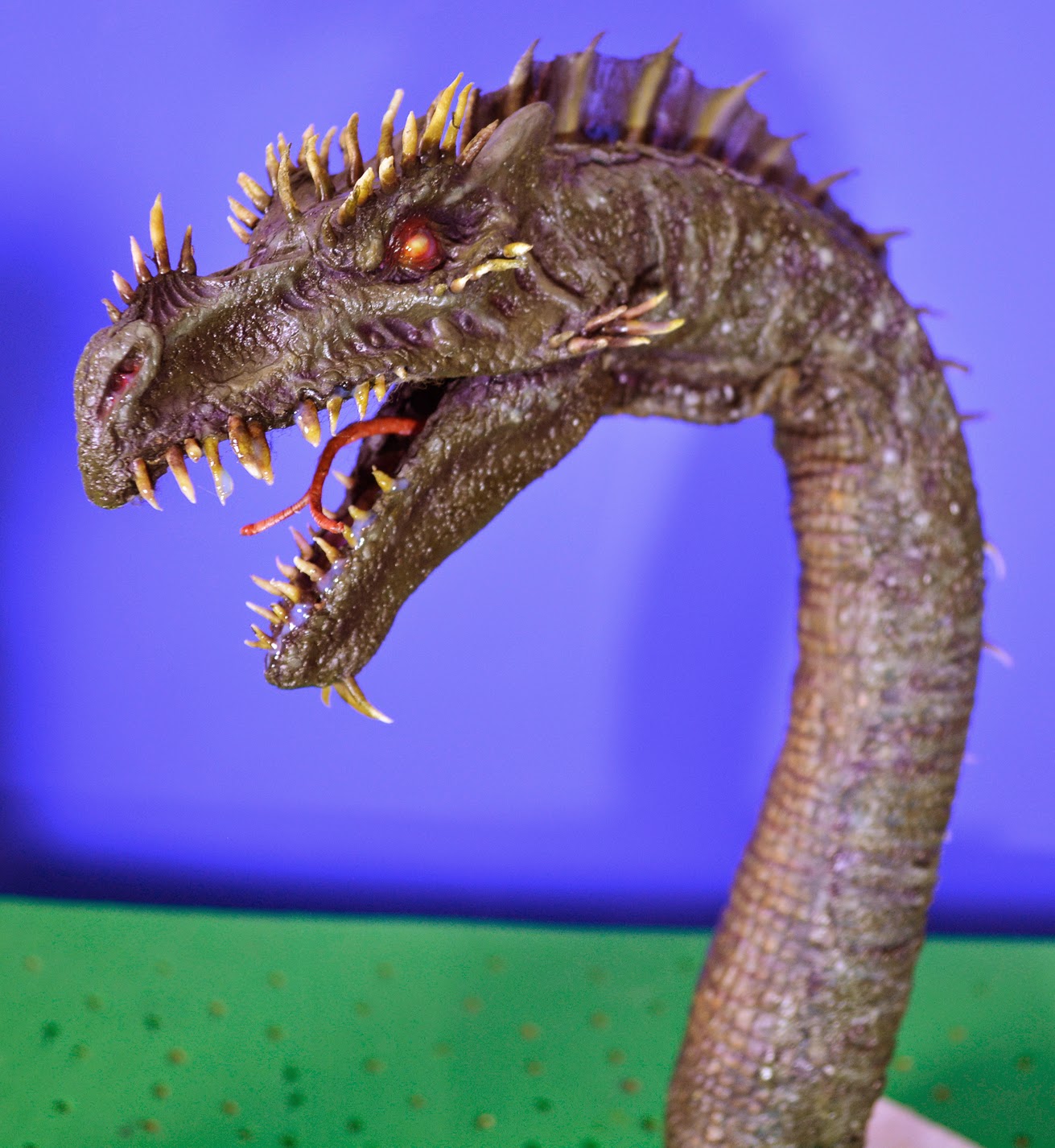
I did however include an encounter with Nidhögg, a serpentine dragon who gnaws on one of the roots of the cosmic world-tree Yggdrasil. This monster was realized as a finished and stop-motion animated puppet.
I decided that I wouldn't build the whole of the monster, just the head and neck, and concentrated my efforts on making a gnarled and unpleasant-looking, but regal head for Nidhögg. The head sculpture was split in half and cast in dental plaster moulds.
Cast in latex lined with a leathery latex/cotton mix, the head and jaw were joined with thick aluminum wires. Another thick aluminum wire was attached to a piece of board and joined to the head with Friendly Plastic thermoplastic. Soft polyurethane foam padded the body, which was then covered with cast latex skins pulled from older dinosaur and monster skin moulds.
Nidhögg has a crest along his back similar to the fins of deep sea fish, or, if you will, the crests and wings of devils of medieval church interior art. The spikes were pieces of cotton dipped in latex and rolled between my thumb and index finger. The skin between them were latex applied to soft clay stuck to one side of the spikes. After two layers of latex the clay could be removed. The latex was dusted down with talcum powder first.
The teeth and horns were also cotton and latex. A mix of acrylic paint and Prosaide glue covered the puppet as a base paint. Acrylic airbrush colours were used for the finishing touches. As you can see a tongue was also added by wrapping sewing string around very thin steel wires and then applying tinted latex.
Joakim was a delight to work with, and I hope to do it again, this time with better equipment and a longer production period. And finally, here's the finished film. It's all in Swedish, though.