If you're a horror fan you're probably acquainted with the monstrous character of Clive Barker's "Rawhead Rex", either from his original Books of Blood story or from the flawed 1986 movie adaptation of that story. Either way, Barker's Rawhead is a primal creature with a penchant for biting some people's heads off and baptizing others by pissing on them. Without a doubt, Barker was inspired by the folkloric character of Rawhead and Bloody Bones, a very nasty boogeyman from Great Britain who appears in a variety of guises, as well as a monster in North American folklore. Generally speaking, Rawhead and Bloody Bones eats kids and has googly eyes, big teeth, and big claws. His origin and physiognomy vary depending on from where a particular story comes. For my adaptation, I chose to use an English nursery rhyme, adding a verse of my own to make it slightly longer for my video.
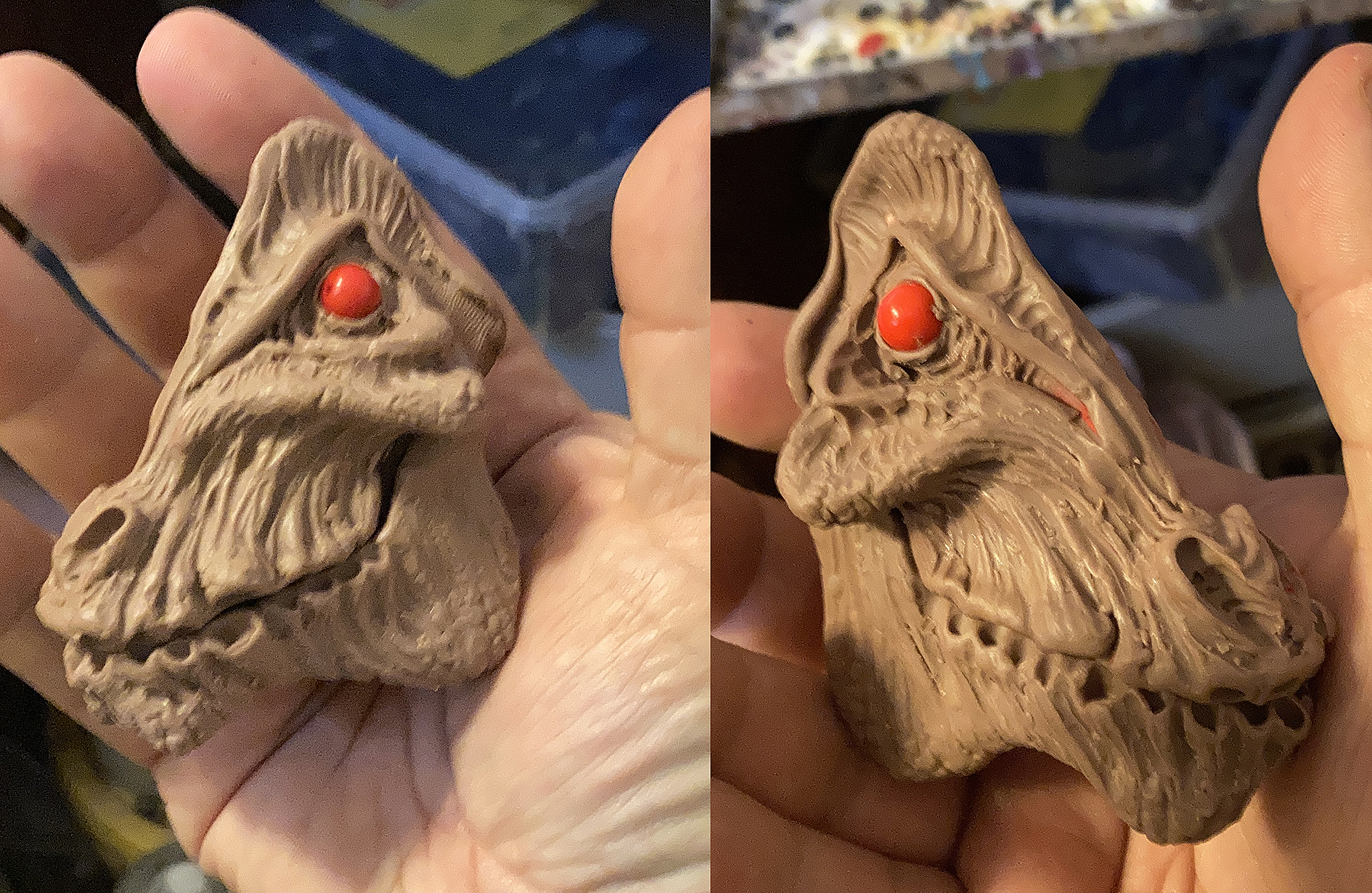
My design of Rawhead's head was a mix of various animalistic features. I looked at skulls from horses, dogs, and apes, and this is what I ended up with. The crest on top of the head comes from the gorilla, an anatomical feature to which the jaw muscles are attached for extra chomping power. Bigfoot, by the way, is also said to have this crest. All sculptures were made in my preferred medium of medium-grade Monster Clay. I used two plastic pearls for the eyes.
I sculpted the torso as looking like it was both powerful but decaying or flayed. I don't really know where I was going with that one, but I like how it turned out.
I cast the head in tinted latex, adding teeth made from cotton dipped in latex. The two red pearls have now been finished as eyes with blue irises, covered by a lens of UV resin. They're placed in sockets made from silicone clay. The armature was very simple. It doesn't really show in this picture, but the forearms are split into two bones, like on a real skeleton. I wanted that feature to be visible in the finished puppet to make the character look a bit zombie-like.
You can see that split forearm better here. The muscles on the arms were a mix of thin polyurethane foam soaked in latex and a cotton-latex mix. The rest of the body was padded with layers of soft foam. I didn't bother with adding detail to the legs as they would be covered with fur.
The finished Rawhead has a latex skin, in parts cast from old skin texture molds. The body was painted with a mix of dry brushing on tinted latex and then adding details using acrylic airbrush colors. The fur on the legs comes from an old winter hat. The straggly bits of skin covering the back and the arms were made with the "chunks ó flesh" method, where tinted latex is stippled with a bit of foam onto a flat surface and then scratched apart with my fingernails and pulled off the surface into chunky organic-looking bits.
I get both praise and critique for my "collage" method of creating shots in my films. Some really like the look of it, others find it fake and distracting. It's the way I make my films and I'll keep making them like that. I used a couple of stock footage shots featuring people in this film. One is a scared man in bed, and the other is this good girl diligently doing her homework. Apparently, and according to the nursery rhyme, Rawhead has no interest in good kids, so she's in no danger. This composition is made up of the following twelve layers in After Effects: A stock photo of a wintry garden outside the window, an animation of Rawhead, the steam on the window, the wallpaper, the bookshelf, the window with curtains, the floor, the cat, the shadow under the cat, the girl at the table, the shadow under the table, and lastly an adjustment layer which adds a unifying color grading.
Hannes Karlsson, who gets eaten by Krampus in my Krampus film, and fights the two-headed monster in that video returns as a nasty kid here. I simply re-used a take from Krampus.
I like doing projects inspired by folklore, but my YouTube audience seems a bit divided in their opinions. I try to diversify as a content creator and, most important of all, follow my own desires, making what interests me personally. And how else can I create good films if I don't do that? So much of folklore borders on horror, if not being straight-up horror, and the subject also offers endless possibilities for creating moody, atmospheric shots showing "real" places like the countryside, with old buildings, bogs, and forests. I say "real", because most of it will still be still images and stock videos composed in Photoshop and After Effects to create my ideal environments.
There's a big chance that old Rawhead will return and star in a feature-length film produced by my maverick movie buddy James Balsamo.
Visitors to my YouTube channel have been bugging me for a while about why I don't do any holiday-related videos. I have done a Halloween-themed film, but that didn't exactly set the internet on fire, so I stopped thinking about doing something similar. However, this past Christmas I decided to do something with the Krampus; the so-called Christmas Devil, the evil counterpart to Santa. I was already working on another project, but I paused that to make room for my Krampus video. In other words, this past December was one of the few months where I managed to produce two films featuring a fair amount of animation, and effects editing.
To give you some context, let's have a quick look at Krampus. Traditionally the Krampus character has flourished best in Eastern Europe, the alps and German-language regions like Bavaria and Austria. When Santa comes with candy and gifts, Krampus comes with coal and bundles of sticks for thrashing the bottoms of naughty children. If the kids are really terrible, Krampus puts them in his sack and carries them away.
There's been an odd resurgence of Krampus-related festivities in the last couple of decades. There are Krampus parades in both Europe and the US, and pop culture has placed the fiend in movies of varying quality and budgets. To sum up all of this info I wrote a poem that served as the basis for my video and read it myself.
I wanted my Krampus to be super traditional. Thus I sculpted a character that sort of summed up all the characteristics of the old devil folklore archetype. Medium grade Monster Clay was used, as usual.
I also sculpted what would become the horns in clay, placing the sculpture on a flat surface to make the casting of it easy.
From a plaster mold made over the sculpture, I cast two latex horn skins which were attached to a pair of metal rods padded with yarn and foam dipped in latex. When the latex had dried I twisted the wires with my fingers, making the horns curve in a way you can see on certain goats and antelopes.
The armature was super simple; my usual mix of thermoplastic and aluminum wires. I decided to give my Krampus one human leg and one goat hind leg. He also has a tail.
The tail was covered with a wrapping of yarn soaked in latex, while the body was padded with soft polyurethane foam. As you can see the head wasn't attached at this point.
That's because the aluminum wires inside the head -for brows, ears, and jaw- were stuck directly into the latex cast of the head and torso. Thermoplastic was used to create the skull and the jaw, and also held the two pearls used for eyes in place. Liquid latex applied to both the inside of the latex skin and the foam padding worked as an adhesive.
Patches of latex skin cast in various older skin texture molds were attached in the same way. The teeth are cotton dipped in latex and rolled into pointy shapes. The human foot shape was built up using tinted latex and cotton.
I wanted the Krampus to have a mix of muted colors, ashen grey to be exact, and a color that would make the puppet "pop" a bit on screen. A dark purple seemed to do the trick.
The finished Krampus puppet was adorned with clumps of crepé hair (sheep's wool used for fake beards) to make him look old and mangy. Thin steel wires were used to make bits of body jewelry, and claws were created in the same way as the teeth. Krampus is often portrayed with a long tongue, so that had to be in there in one scene at least. I couldn't fit it into the puppet's mouth, so I made it from latex and a single aluminum wire as a loose prop that could be inserted into the mouth.
Krampus´ sack was made from real burlap and was lined with aluminum wires, so I could animate it bulging and moving around when Krampus was carrying away the kid.
All of the backgrounds in the scenes featuring the Krampus were Photoshopped images layered in After Effects. One of the busiest shots is the one where Krampus minces up the kid. It contains 12 layers: the log cabin wall, the bundle of chains to the right, the big chain to the left, the Krampus turning a mincer handle made from plastic, the table, the cleaver, the bowl, the meat (footage), the mincer, the leg going into the mincer and some smoke. The mincer handle was actually attached to a model mincer I made, but that model kept moving about when I animated the puppet turning the handle, so I simply covered it with a photo of a real mincer.
All the images I used for backgrounds were downloaded from Depositphotos.com. Most of them needed only minute Photoshop manipulation to work on the film.
Now for the actual antagonist of the film. Remember Hannes Karlsson who was the hero in my film "The Two-Headed Monster?" I recruited him again for this project, and he will pop up again in my films later this year.
My long-suffering buddy Andreas Pettersson also appears in the film as a sleeping relative given a whipped cream mustache by Hannes. Andreas' friend Leif also puts in an appearance where he's hit over the head with a pillow.
The rest of the people you see in this film are all stock footage from Videoblocks.com. They had a bunch of Christmas-themed clips which were all so horribly saccharine that I couldn't possibly produce anything myself to match them.
One of the more complicated shots in the film is when Krampus puts Hannes into his sack, simply because it needed to look totally effortless. Technically it's not very complicated. Hannes is placed over Krampus´ hand via tracking, and a mask over Hannes´ legs allow them to pass behind the sack.
Making the shot work all hinged on Hannes selling the illusion, and luckily, that's just what he did. In a single take, he's sitting on the edge of a greenscreen-clad couch supported by the arm of his mom, also clad in green. Balancing on the edge of the couch seat he looks like he's hanging in free air.
The take then continues with Hannes flipping over to a semi-handstand on the floor, wiggling his legs in the air. I sped up this part in editing, so it looks like he's very quickly stuffed into the sack. The Krampus puppet is animated to match Hannes´ movements in this footage accordingly.
So I finally made my Krampus film! It was fun and relatively quick to put together. Coming up, if I can make it, is a film about Walpurgisnight, and the goings-on of witches and fiends on that spooky evening.
I continue my Lovecraftian adaptations with a prose poem called "Memory". I found this text a long time ago in an anthology, and really liked it. It's very vague on what it's really about, but it has a dreamlike quality, and some underlying themes which will make the reader figure out some things on his/her own.
I just finished editing the film, and will shortly post it on YouTube. Here's some info on one of the puppets featured in the film.
The title "Memory" actually refers to one of the characters in the tale; a demon who apparently goes by that name. There are no descriptions of the creature, so I went with my own ideas, deciding to create something that looked old and withered, but also regal.
I only sculpted the torso of this puppet, using Monster Clay medium grade and my teeny tiny loop tools.
Dental plaster poured over the sculpture created a mold into which I could then add tinted latex. I supported the inside of this latex skin with cotton dipped in latex, creating a sturdy leathery feel.
To create that "regal" look built up a sort of crown between the shoulders using tooth picks.
The toothpicks were then covered with cotton and tinted latex. I decided early on to not have a head or face on this character, mainly because I didn't want to bother with animating a face. But it also meant that I could make a creature that looked a bit more abstract than most other characters.
The puppet has my usual aluminum wire and thermoplastic armature, with threaded bolts in the feet.
Most of the body was padded with bits of thin polyurethane foam soaked in latex, and cotton dipped in latex. The latex-soaked foam created a material that is almost clay-like. When it has dried you can press it together with your fingers and shape it pretty well.
The demon has a pair of very traditional devil wings, almost as if ripped from a church wall painting. I won't go into the making of the wings, as I've talked about this many times. But I'll refer you to my YouTube video, which says everything you need to know on the subject.
I
normally sculpt my skin textures or get them from a surface like old
leather or a fruit. But I sometimes create an texture by first
starting it as a negative sculpture, if you will. This is much faster
than creating a normal sculpture. In other words, I carve or etch a
negative pattern into clay, in this case medium grade Monster Clay.
When
that's done I build up a clay containment wall, just like when
casting an ordinary sculpture. I add plaster, first by brushing it in
to avoid air bubbles, and then pouring in the rest. The plaster has
cured, and here you can see what the actual skin texture will look
like.
But
you can't cast anything into this plaster casting, so I'll have to
make another mold on top of the plaster cast. I choose to do
this by mixing dental silicone and curing agent, and squeezing down
this silicone paste over the plaster cast. But, if you use a sealing
or release agent, you can cast plaster over plaster.
Just
be aware that any slightly unprotected sections might stick, and then
you're goose is cooked, so to speak. You might break off a portion of
your mold, and you'll have to start over again. Which is not a big
deal, really. This dental silicone paste sets up in a few minutes,
and I can peel off the mold pretty easily. So, to cast latex into
this silicone you can wash the mold with some alcohol, if you feel
that silicone oil is making the surface very slippery. Or use a
dulling spray, which is what I do. In this case here I've actually
done neither. I just sponged in tinted latex and it seemed to stick
just fine. After a couple thin layers of latex I'm dabbing the
surface with talcum powder to make the latex skin easier to remove.
Then I can just peel it off. This particular skin was used on the
legs of the demon.
Here's the demon puppet pieced together, skin, wings and all. Now it'll get a light drybrushing of tinted latex, as well as some silvery acrylic paint on the chest area.
And here's the demon as it appears in the film, with a head made up of stock footage fire, fixed up in After Effects to look weird and alien.